

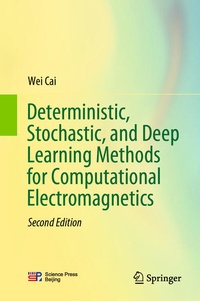
Deterministic, Stochastic, and Deep Learning Methods for Computational Electromagnetics
Description

This book provides a well-balanced and comprehensive picture based on clear physics, solid mathematical formulation, and state-of-the-art useful numerical methods in deterministic, stochastic, deep neural network machine learning approaches for computer simulations of electromagnetic and transport processes in biology, microwave and optical wave devices, and nano-electronics. Computational research has become strongly influenced by interactions from many different areas including biology, physics, chemistry, engineering, etc. A multifaceted approach addressing the interconnection among mathematical algorithms and physical foundation and application is much needed to prepare graduate students and researchers in applied mathematics and sciences and engineering for innovative advanced computational research in many applications areas, such as biomolecular solvation in solvents, radar wave scattering, the interaction of lights with plasmonic materials, plasma physics, quantum dots, electronic structure, current flows in nano-electronics, and microchip designs, etc.
More details
Other editions
Additional editions
Person
Prof. Wei Cai is the Clements chair professor in Applied Mathematics at the Department of Mathematics at Southern Methodist University. He obtained his B.S. and M.S. in Mathematics from the University of Science and Technology of China (USTC) in 1982 and 1985, respectively, and his Ph.D. in Applied Mathematics at Brown University in 1989. Before he joined SMU in the fall of 2017, he was an assistant and then associate professor at the University of California at Santa Barbara during 1995-1996 and a full professor at the University of North Carolina after 1999. He has also conducted collaborative research at Peking University, USTC, Shanghai Jiao Tong University, and Fudan University. He works on fast machine learning, stochastic, and deterministic numerical methods for scientific computing applications, and was awarded the Feng Kang prize in scientific computing in 2005.
Content
Dielectric constant and fluctuation formulae for molecular dynamics.- Poisson-Boltzmann electrostatics and analytical approximations.- Numerical methods for Poisson-Boltzmann equations.- Random walk stochastic methods for boundary value problems.- Deep Neural Network for Solving PDEs.- Fast algorithms for long-range interactions.- Fast multipole methods for long-range interactions in layered media.- Maxwell equations, potentials, and physical/artificial boundary conditions.- Dyadic Green's functions in layered media.- High-order methods for surface electromagnetic integral equations.- High-order hierarchical N´ed´elec edge elements.- Time-domain methods - discontinuous Galerkin method and Yee scheme.- Scattering in periodic structures and surface plasmons.- Schr¨ odinger equations for waveguides and quantum dots.- Quantum electron transport in semiconductors.- Non-equilibrium Green's function (NEGF) methods for transport.- Numerical methods for Wigner quantum transport.- Hydrodynamic electron transport and finite difference methods.- Transport models in plasma media and numerical methods.
