

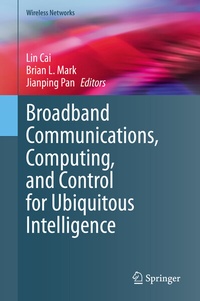
Broadband Communications, Computing, and Control for Ubiquitous Intelligence
1st Edition
Published on 9. August 2022
XIII, 352 pages
978-3-030-98064-1 (ISBN)
Description

This book reports on the latest advances from both industry and academia on ubiquitous intelligence and how it is enabled by 5G/6G communication technologies. The authors cover network protocol and architecture design, machine learning and artificial intelligence, coordinated control and digital twins technologies, and security and privacy enhancement for ubiquitous intelligence. The authors include recent studies of performance analysis and enhancement of the Internet of Things, cyber-physical systems, edge computing, and cyber twins, all of which provide importance guidance and theoretical tools for developing future ubiquitous intelligence. The content of the book will be of interest to students, educators, and researchers in academia, industry, and research laboratories.
- Provides comprehensive coverage of enabling communications, computing, and control technologies for ubiquitous intelligence;
- Presents a novel paradigm of ubiquitous intelligence powered by broadband communications, computing, and control;
- Includes a review of 5G/6G communication technologies, network protocol and architecture design, and ubiquitous computing.
More details
Series
Language
English
Place of publication
Cham
Switzerland
Publishing group
Springer International Publishing
Target group
Professional and scholarly
Product notice
Reflowable
Illustrations
XIII, 352 p. 74 illus., 65 illus. in color.
File size
13,13 MB
ISBN-13
978-3-030-98064-1 (9783030980641)
DOI
10.1007/978-3-030-98064-1
Schweitzer Classification
Other editions
Additional editions
Lin Cai | Brian L. Mark | Jianping Pan
Broadband Communications, Computing, and Control for Ubiquitous Intelligence
Book
08/2022
Springer
€213.99
Shipment within 7-9 days
Persons
Lin Cai
received her M.A.Sc. and Ph.D. degrees (awarded Outstanding Achievement in Graduate Studies) in electrical and computer engineering from the University of Waterloo, Waterloo, Canada, in 2002 and 2005, respectively. Since 2005, she has been with the Department of Electrical & Computer Engineering at the University of Victoria, and she is currently a Professor. She is an NSERC E.W.R. Steacie Memorial Fellow, an Engineering Institute of Canada (EiC) Fellow, and an IEEE Fellow. In 2020, she was elected as a Member of the Royal Society of Canada's College of New Scholars, Artists and Scientists. Her research interests span several areas in communications and networking, with a focus on network protocol and architecture design supporting emerging multimedia traffic and the Internet of Things. She has co-founded and chaired the IEEE Victoria Section Vehicular Technology and Communications Joint Societies Chapter. She has been elected to serve the IEEE Vehicular TechnologySociety Board of Governors, 2019 - 2024. She has served as an Associate Editor-in-Chief for IEEE Transactions on Vehicular Technology, a member of the Steering Committee of the IEEE Transactions on Big Data (TBD) and IEEE Transactions on Cloud Computing (TCC), an Associate Editor of the IEEE Internet of Things Journal, IEEE Transactions on Wireless Communications, IEEE Transactions on Vehicular Technology, IEEE Transactions on Communications, IEEE/ACM Transactions on Networking, EURASIP Journal on Wireless Communications and Networking, International Journal of Sensor Networks, and Journal of Communications and Networks (JCN), and as the Distinguished Lecturer of the IEEE VTS Society and the IEEE Communications Soceity.
Brian L. Mark received the Ph.D. in Electrical Engineering from Princeton University in 1995 and the B.ASc. (Bachelor of Applied Science) in Computer Engineering with an option in Mathematics in 1991 from the University of Waterloo. He was a Research Staff Member at the NEC C&C Research Laboratories (now called NEC Laboratories America) in Princeton, New Jersey from 1995-1999. In 1999 he was on part-time leave from NEC as a visiting researcher at Ecole Nationale Supérieure des Télécommunications (now called Télécom ParisTech) in Paris, France. In 2000 he joined the faculty of George Mason University, where he is currently Professor of Electrical and Computer Engineering. He served as Acting Chair of the Bioengineering Department from 2015-2017. His research interests lie in the design, modeling and performance evaluation of communication networks; wireless communications; network security; stochastic models; statistical signal processing; and machine learning.He is coauthor of the book System Modeling and Analysis: Foundations of System Performance Evaluation (by H. Kobayashi and B. L. Mark, published by Pearson Education, Inc., 2009) and a coauthor of the book Probability, Random Processes, and Statistical Analysis (by H. Kobayashi, B. L. Mark, and W. Turin, published by Cambridge University Press, 2012). He received a National Science Foundation CAREER award in 2002. From 2006-2009, he served as an Associate Editor of IEEE Transactions on Vehicular Technology. In 2011, he received the Outstanding Research Faculty award within the Volgenau School of Engineering. He is a Member of the IFIP 7.3 Working Group on Computer System Modeling and a Senior Member of IEEE.
Jianping Pan is currently a professor of computer science at the University of Victoria, Victoria, British Columbia, Canada. He received his Bachelor's and PhD degrees in computer science from Southeast University, Nanjing, Jiangsu, China, and he did his postdoctoral research at the University of Waterloo, Waterloo, Ontario, Canada. He also worked at Fujitsu Labs and NTT Labs. His area of specialization is computer networks and distributed systems, and his current research interests include protocols for advanced networking, performance analysis of networked systems, and applied network security. He received the IEICE Best Paper Award in 2009, the Telecommunications Advancement Foundation's Telesys Award in 2010, the WCSP 2011 Best Paper Award, the IEEE Globecom 2011 Best Paper Award, the JSPS Invitation Fellowship in 2012, the IEEE ICC 2013 Best Paper Award, and the NSERC DAS Award in 2016, and has been serving on the technical program committees of major computer communications and networking conferences including IEEE INFOCOM, ICC, Globecom, WCNC and CCNC. He was the Ad Hoc and Sensor Networking Symposium Co-Chair of IEEE Globecom 2012 and an Associate Editor of IEEE Transactions on Vehicular Technology. He is a senior member of the ACM and a senior member of the IEEE.
Brian L. Mark received the Ph.D. in Electrical Engineering from Princeton University in 1995 and the B.ASc. (Bachelor of Applied Science) in Computer Engineering with an option in Mathematics in 1991 from the University of Waterloo. He was a Research Staff Member at the NEC C&C Research Laboratories (now called NEC Laboratories America) in Princeton, New Jersey from 1995-1999. In 1999 he was on part-time leave from NEC as a visiting researcher at Ecole Nationale Supérieure des Télécommunications (now called Télécom ParisTech) in Paris, France. In 2000 he joined the faculty of George Mason University, where he is currently Professor of Electrical and Computer Engineering. He served as Acting Chair of the Bioengineering Department from 2015-2017. His research interests lie in the design, modeling and performance evaluation of communication networks; wireless communications; network security; stochastic models; statistical signal processing; and machine learning.He is coauthor of the book System Modeling and Analysis: Foundations of System Performance Evaluation (by H. Kobayashi and B. L. Mark, published by Pearson Education, Inc., 2009) and a coauthor of the book Probability, Random Processes, and Statistical Analysis (by H. Kobayashi, B. L. Mark, and W. Turin, published by Cambridge University Press, 2012). He received a National Science Foundation CAREER award in 2002. From 2006-2009, he served as an Associate Editor of IEEE Transactions on Vehicular Technology. In 2011, he received the Outstanding Research Faculty award within the Volgenau School of Engineering. He is a Member of the IFIP 7.3 Working Group on Computer System Modeling and a Senior Member of IEEE.
Jianping Pan is currently a professor of computer science at the University of Victoria, Victoria, British Columbia, Canada. He received his Bachelor's and PhD degrees in computer science from Southeast University, Nanjing, Jiangsu, China, and he did his postdoctoral research at the University of Waterloo, Waterloo, Ontario, Canada. He also worked at Fujitsu Labs and NTT Labs. His area of specialization is computer networks and distributed systems, and his current research interests include protocols for advanced networking, performance analysis of networked systems, and applied network security. He received the IEICE Best Paper Award in 2009, the Telecommunications Advancement Foundation's Telesys Award in 2010, the WCSP 2011 Best Paper Award, the IEEE Globecom 2011 Best Paper Award, the JSPS Invitation Fellowship in 2012, the IEEE ICC 2013 Best Paper Award, and the NSERC DAS Award in 2016, and has been serving on the technical program committees of major computer communications and networking conferences including IEEE INFOCOM, ICC, Globecom, WCNC and CCNC. He was the Ad Hoc and Sensor Networking Symposium Co-Chair of IEEE Globecom 2012 and an Associate Editor of IEEE Transactions on Vehicular Technology. He is a senior member of the ACM and a senior member of the IEEE.
Content
Introduction.- Advanced communication systems.- Network architecture and protocol design.- Cloud and edge computing.- Machine learning and AI.- Coordinated control and digital twins.- Security and privacy.- Conclusion.
