

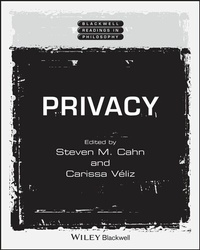
Privacy
Description

An incisive compendium of philosophical literature on privacy, part of the acclaimed Wiley-Blackwell Readings in Philosophy series
Companies collect and share much of your daily life, from your location and search history, to your likes, habits, and relationships. As more and more of our personal data is collected, analyzed, and distributed, we need to think carefully about what we might be losing when we give up our privacy.
Privacy is a thought-provoking collection of philosophical essays on privacy, offering deep insights into the nature of privacy, its value, and the consequences of its loss. Bringing together both classic and contemporary work, this timely volume explores the theories, issues, debates, and applications of the philosophical study of privacy. The essays address concealment and exposure, the liberal value of privacy, privacy in social media, privacy rights and public information, privacy and the limits of law, and more.
- Highlights the work of emerging thinkers and leaders in the subject
- Presents work from philosophers such as Judith Jarvis Thomson, Ruth Gavison, Thomas Scanlon, W. A. Parent, and Thomas Nagel
- Explores privacy in contexts including governance, law, ethics, political philosophy, and public policy
- Discusses data collection, online tracking, digital surveillance, and other contemporary privacy issues
Edited by award-winning privacy specialist Carissa Véliz and renowned philosopher and author Steven Cahn, Privacy is a must-read anthology for philosophers, psychologists, sociologists, and advanced undergraduate and graduate students taking courses on digital and applied ethics, philosophy, media studies, communications, computer science, engineering, and sociology.
More details
Other editions
Additional editions
Persons
STEVEN M. CAHN is Professor Emeritus of Philosophy at the City University of New York Graduate Center, where he taught academic ethics, philosophy of religion, and philosophy of education. He has authored or edited 70 books, including Saints and Scamps: Ethics in Academia, Religion Within Reason, and Inside Academia: Professors, Politics, and Policies. ¿He is the series editor of Wiley-Blackwell Readings in Philosophy.
CARISSA VÉLIZ is an Associate Professor at the Faculty of Philosophy and the Institute for Ethics in AI at the University of Oxford. She is the recipient of the Herbert A. Simon Award for Outstanding Research in Computing and Philosophy, by the International Association of Computing and Philosophy. She is the author of Privacy Is Power and the editor of the Oxford Handbook of Digital Ethics.
Content
Notes on Contributors
Preface
Carissa Véliz
1 The Right to Privacy
Judith Jarvis Thomson
2 Thomson on Privacy
Thomas Scanlon
3 Why Privacy is Important
James Rachels
4 Privacy and the Limits of Law
Ruth Gavison
5 Privacy, Morality, and the Law
W. A. Parent
6 Concealment and Exposure
Thomas Nagel
7 The Liberal Value of Privacy
Boudewign de Bruin
8 What is the Right to Privacy?
Andrei Marmor
9 Privacy Rights and Public Information
Benedict Rumbold and James Wilson
10 Privacy and the Importance of 'Getting Away With it'
Cressida Gaukroger
11 Privacy in Social Media
Andrei Marmor
12 Governing Privacy
Carissa Véliz
Index
