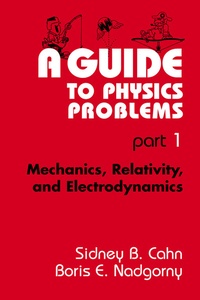
A Guide to Physics Problems
Description

In order to equip hopeful graduate students with the knowledge necessary to pass the qualifying examination, the authors have assembled and solved standard and original problems from major American universities - Boston University, University of Chicago, University of Colorado at Boulder, Columbia, University of Maryland, University of Michigan, Michigan State, Michigan Tech, MIT, Princeton, Rutgers, Stanford, Stony Brook, University of Wisconsin at Madison - and Moscow Institute of Physics and Technology. A wide range of material is covered and comparisons are made between similar problems of different schools to provide the student with enough information to feel comfortable and confident at the exam. Guide to Physics Problems is published in two volumes: this book, Part 1, covers Mechanics, Relativity and Electrodynamics; Part 2 covers Thermodynamics, Statistical Mechanics and Quantum Mechanics.
Praise for A Guide to Physics Problems: Part 1: Mechanics, Relativity, and Electrodynamics:
"Sidney Cahn and Boris Nadgorny have energetically collected and presented solutions to about 140 problems from the exams at many universities in the United States and one university in Russia, the Moscow Institute of Physics and Technology. Some of the problems are quite easy, others are quite tough; some are routine, others ingenious." (From the Foreword by C. N. Yang, Nobelist in Physics, 1957)
"Generations of graduate students will be grateful for its existence as they prepare for this major hurdle in their careers." (R. Shankar, Yale University)
"The publication of the volume should be of great help to future candidates who must pass this type of exam." (J. Robert Schrieffer, Nobelist in Physics, 1972)
"I was positively impressed . The book will be useful to students who are studying for their examinations and to faculty who are searching forappropriate problems." (M. L. Cohen, University of California at Berkeley)
"If a student understands how to solve these problems, they have gone a long way toward mastering the subject matter." (Martin Olsson, University of Wisconsin at Madison)
"This book will become a necessary study guide for graduate students while they prepare for their Ph.D. examination. It will become equally useful for the faculty who write the questions." (G. D. Mahan, University of Tennessee at Knoxville)
More details
Other editions
Additional editions