

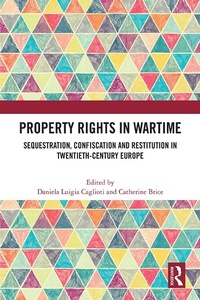
Property Rights in Wartime
Sequestration, Confiscation and Restitution in Twentieth-Century Europe
1st Edition
Published on 31. March 2023
198 pages
978-1-000-85676-7 (ISBN)
Description

This book examines the violation of property rights in the two World Wars and in the interwar period centering on three keywords: sequestration, confiscation and restitution.
Political conflicts, regime change, revolutions and wars make not only people but also their property vulnerable. Plunder and confiscation were common ways of dealing with the enemy - either internal or external - in many conflicts, conquests and occupations during the Old Regime, and resurfaced as crucial political weapons in both the First and the Second World Wars, with disruptive effects. In the two World Wars and the interwar period, sequestration and confiscation grew in scale and scope, reaching an unprecedented magnitude because of three driving forces that were frequently intertwined: nationalism, socialism and antisemitism. Confiscation was a political weapon that furthered different aims. It helped to make the expulsion of enemy subjects irreversible. It was an instrument to exclude from the civic body those who did not belong - the 'internal enemies' - and to prevent undesirable people from acquiring citizenship. It also deprived "enemy aliens" of economic means during the conflict.
Bringing together new historical research on Serbia, Italy, Belgium, Turkey, Holland, Poland, Czechoslovakia, Germany and Austria, the chapters address state violence, law and human rights, as well as the entanglement between citizenship, nationality and property. It will be of great interest to those who study minorities, borders, migration, social and economic history as well as European History. This book was originally published as a special issue of European Review of History.
Political conflicts, regime change, revolutions and wars make not only people but also their property vulnerable. Plunder and confiscation were common ways of dealing with the enemy - either internal or external - in many conflicts, conquests and occupations during the Old Regime, and resurfaced as crucial political weapons in both the First and the Second World Wars, with disruptive effects. In the two World Wars and the interwar period, sequestration and confiscation grew in scale and scope, reaching an unprecedented magnitude because of three driving forces that were frequently intertwined: nationalism, socialism and antisemitism. Confiscation was a political weapon that furthered different aims. It helped to make the expulsion of enemy subjects irreversible. It was an instrument to exclude from the civic body those who did not belong - the 'internal enemies' - and to prevent undesirable people from acquiring citizenship. It also deprived "enemy aliens" of economic means during the conflict.
Bringing together new historical research on Serbia, Italy, Belgium, Turkey, Holland, Poland, Czechoslovakia, Germany and Austria, the chapters address state violence, law and human rights, as well as the entanglement between citizenship, nationality and property. It will be of great interest to those who study minorities, borders, migration, social and economic history as well as European History. This book was originally published as a special issue of European Review of History.
More details
Edition
1. Auflage
Language
English
Place of publication
London
United Kingdom
Publishing group
Taylor & Francis Ltd
Target group
College/higher education
Professional and scholarly
ISBN-13
978-1-000-85676-7 (9781000856767)
Copyright in bibliographic data and cover images is held by Nielsen Book Services Limited or by the publishers or by their respective licensors: all rights reserved.
Schweitzer Classification
Other editions
Additional editions
Daniela Luigia Caglioti | Catherine Brice
Property Rights in Wartime
Sequestration, Confiscation and Restitution in Twentieth-Century Europe
Book
10/2024
1st Edition
Routledge
€63.00
Shipment within 10-20 days
Daniela Luigia Caglioti | Catherine Brice
Property Rights in Wartime
Sequestration, Confiscation and Restitution in Twentieth-Century Europe
Book
03/2023
1st Edition
Routledge
€173.50
Shipment within 10-20 days
Persons
Daniela Luigia Caglioti is Professor of Contemporary History in the Dipartimento di Studi Umanistici at the Universita di Napoli Federico II, Napoli, Italy.
Catherine Brice is Professor of History, Emeritus at the Universite Paris-Est Creteil- CHREC, Creteil, France.
Catherine Brice is Professor of History, Emeritus at the Universite Paris-Est Creteil- CHREC, Creteil, France.
Content
Introduction-Property rights in wartime: sequestration, confiscation and restitution in twentieth-century Europe 1. Between occupation, exile and unification: sequestered and 'abandoned' properties in Serbia and Yugoslavia during and after the First World War 2. From protection to liquidation. The case of the Milanese jurists and enemy alien property (1915-1920) 3. Private property or enemy property: how parliament confiscated the property of the stateless of German origin in Belgium (1918-21) 4. Expropriating the dead in Turkey: how the Armenian quarter of Izmir became Kueltuerpark 5. Categorisation. Classification. Confiscation. Dealing with enemy citizens in the Netherlands in the aftermath of World War II (1944-1967) 6. German property and the reconstruction of East Central Europe after 1945: politics, practices and pitfalls of confiscation 7. Neither citizens nor Jews: Jewish property rights after the Holocaust, a tentative survey 8. The 'Return of Beauty'? The politics of restitution of Nazi-looted art in Italy, the Federal Republic of Germany and Austria, 1945-1998
