

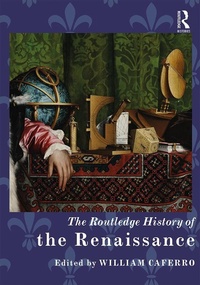
The Routledge History of the Renaissance
Published on 27. March 2017
430 pages
978-1-351-84945-6 (ISBN)
Description

Drawing together the latest research in the field, The Routledge History of the Renaissance treats the Renaissance not as a static concept, but as one of ongoing change within an international framework. It takes as its unifying theme the idea of exchange and interchange through the movement of goods, ideas, disease and people, across social, religious, political and physical boundaries.
Covering a broad range of temporal periods and geographic regions, the chapters discuss topics such as the material cultures of Renaissance societies; the increased popularity of shopping as a pastime in fourteenth-century Italy; military entrepreneurs and their networks across Europe; the emergence and development of the Ottoman empire from the early fourteenth to the late sixteenth century; and women and humanism in Renaissance Europe. The volume is interdisciplinary in nature, combining historical methodology with techniques from the fields of anthropology, sociology, psychology and literary criticism. It allows for juxtapositions of approaches that are usually segregated into traditional subfields, such as intellectual, political, gender, military and economic history.
Capturing dynamic new approaches to the study of this fascinating period and illustrated throughout with images, figures and tables, this comprehensive volume is a valuable resource for all students and scholars of the Renaissance.
Covering a broad range of temporal periods and geographic regions, the chapters discuss topics such as the material cultures of Renaissance societies; the increased popularity of shopping as a pastime in fourteenth-century Italy; military entrepreneurs and their networks across Europe; the emergence and development of the Ottoman empire from the early fourteenth to the late sixteenth century; and women and humanism in Renaissance Europe. The volume is interdisciplinary in nature, combining historical methodology with techniques from the fields of anthropology, sociology, psychology and literary criticism. It allows for juxtapositions of approaches that are usually segregated into traditional subfields, such as intellectual, political, gender, military and economic history.
Capturing dynamic new approaches to the study of this fascinating period and illustrated throughout with images, figures and tables, this comprehensive volume is a valuable resource for all students and scholars of the Renaissance.
Reviews / Votes
"William Caferro has assembled an excellent field of scholars representing a wide variety of disciplines and perspectives in the The Routledge History of the Renaissance. Focusing on the disciplinary origins of Renaissance practices, encounters and transformations, social histories of various stripes, and the articulation of power, the volume is at once a summing up of some of the best recent work in the field and a stimulus to further thinking and scholarship. It should be an essential tool for anyone working or teaching in the field of Renaissance and early modern culture broadly conceived."Christopher S. Celenza, Johns Hopkins University, USA
"This imaginatively structured book is a work of outstanding originality. Scholars of all generations have contributed to a compendium which ranges across disciplines and approaches - an exemplary kaleidoscope of current scholarship. From novices to veterans, all students of the Renaissance who read this marvellous work will emerge with their horizons broadened and their understanding deepened."
Peter Denley, Queen Mary, University of London, UK
"This mosaic of essays uncovers the diversity of issues, cultures, polities, and economies that continue to make the study of the Renaissance a fascinating and contentious category in early modern studies. Scholars and newcomers to the field will discover excursions that guide them to new vantage points on the Renaissance in a global context."
Caroline Castiglione, Brown University, USA
More details
Series
Language
English
Place of publication
London
United Kingdom
Publishing group
Taylor & Francis Ltd
Target group
College/higher education
Product notice
Reflowable
Illustrations
16 s/w Abbildungen, 2 s/w Tabellen, 4 s/w Zeichnungen
2 Tables, black and white; 4 Line drawings, black and white; 16 Illustrations, black and white
File size
5,02 MB
ISBN-13
978-1-351-84945-6 (9781351849456)
Copyright in bibliographic data and cover images is held by Nielsen Book Services Limited or by the publishers or by their respective licensors: all rights reserved.
Schweitzer Classification
Other editions
Additional editions
William Caferro
The Routledge History of the Renaissance
Book
12/2019
1st Edition
Routledge
€58.17
Shipment within 15-20 days
William Caferro
The Routledge History of the Renaissance
Book
03/2017
1st Edition
Routledge
€357.50
Shipment within 10-20 days
Person
William Caferro is Gertrude Conaway Vanderbilt Professor of History at Vanderbilt University. His research has focused primarily on economy and violence in medieval and Renaissance Italy, and most recently on Dante and Empire. His latest book, Contesting The Renaissance (2011), traces the meaning and use of the term "Renaissance" in the major debates of the historiography. He is recipient of a Guggenheim Fellowship (2010) and is foreign fellow of the Deputazione di Storia Patria di Toscana and l'Associazione di Studi Storici Elio Conti.
Content
List of illustrations
List of figures
List of tables
List of contributors
Introduction: The Renaissance Question
William Caferro
Part I: Disciplines and Boundaries
1 - The 'Economic' Thought of the Renaissance
Germano Maifredi
2 - A Makeshift Renaissance: North India in the "Long" Fifteenth Century
Samira Sheikh (Vanderbilt University)
3 - 'By Imitating Our Nurses:' Latin and Vernacular in the Renaissance
Eugenio Refini
4 - Individualism and the Separation of Fields of Study
William Caferro
5 - Riddles of Renaissance Philosophy and Humanism
Timothy Kircher
Part II: Encounters and Transformations
6 - Raw Materials and Object Lessons
Timothy McCall and Sean Roberts
7 - Imagination and the Remains of Roman Antiquity
Will Stenhouse
8 - Sporus in the Renaissance, or The Eunuch as Straight Man
Katherine Crawford
9 - Heritable Identity Markers, Nations and Physiognomy
Carina Johnson
10 - Biondo Flavio on Ethiopia: Processes of Knowledge Production in the Renaissance
Samantha Kelly
11 - Traditions of Byzantine Astrolabes in Renaissance Europe
Darin Hayton
12 - Reading Machiavelli in Sixteenth Century Florence
Ann Moyer
Part III: Society and Environment
13 - Why Visit the Shops: Taking up Shopping as a Pastime
Susan Stuard
14 - Throwing Aristotle from the Train: Women and Humanism
Sarah Ross
15 - Mechanisms for Unity: Plagues and Saints
Samuel K. Cohn
16 - Dead(ly) Uncertainties: Plague and Ottoman Society
Nuekhet Varlik
17 - Mapping Florence and Tuscany
Nicholas Eckstein
18 - Exercise and Leisure: Sport, and Games
Alessandro Arcangeli
19 - War, Entrepreneurship, and Politics
Suzanne Sutherland
Section IV: Power and Representation
20 - From Frontier Principality to Early Modern Empire: Capabilities and Limits of Ottoman Governance
Kaya Sahin
21 - Commerce and Credit in Renaissance Florence
Paul D. McLean and John F. Padgett
22 - Against the Fisc and Justice: State Formation, Market Development and Customs Fraud
Corey Tazzara
23 - Representations of the Florentine Republic at the Royal Court in the Kingdom of Hungary
Katalin Prajda
24 - From the Palazzo to the Streets: Women's Agency and Networks of Exchange
Megan Moran
Further reading
Index
List of figures
List of tables
List of contributors
Introduction: The Renaissance Question
William Caferro
Part I: Disciplines and Boundaries
1 - The 'Economic' Thought of the Renaissance
Germano Maifredi
2 - A Makeshift Renaissance: North India in the "Long" Fifteenth Century
Samira Sheikh (Vanderbilt University)
3 - 'By Imitating Our Nurses:' Latin and Vernacular in the Renaissance
Eugenio Refini
4 - Individualism and the Separation of Fields of Study
William Caferro
5 - Riddles of Renaissance Philosophy and Humanism
Timothy Kircher
Part II: Encounters and Transformations
6 - Raw Materials and Object Lessons
Timothy McCall and Sean Roberts
7 - Imagination and the Remains of Roman Antiquity
Will Stenhouse
8 - Sporus in the Renaissance, or The Eunuch as Straight Man
Katherine Crawford
9 - Heritable Identity Markers, Nations and Physiognomy
Carina Johnson
10 - Biondo Flavio on Ethiopia: Processes of Knowledge Production in the Renaissance
Samantha Kelly
11 - Traditions of Byzantine Astrolabes in Renaissance Europe
Darin Hayton
12 - Reading Machiavelli in Sixteenth Century Florence
Ann Moyer
Part III: Society and Environment
13 - Why Visit the Shops: Taking up Shopping as a Pastime
Susan Stuard
14 - Throwing Aristotle from the Train: Women and Humanism
Sarah Ross
15 - Mechanisms for Unity: Plagues and Saints
Samuel K. Cohn
16 - Dead(ly) Uncertainties: Plague and Ottoman Society
Nuekhet Varlik
17 - Mapping Florence and Tuscany
Nicholas Eckstein
18 - Exercise and Leisure: Sport, and Games
Alessandro Arcangeli
19 - War, Entrepreneurship, and Politics
Suzanne Sutherland
Section IV: Power and Representation
20 - From Frontier Principality to Early Modern Empire: Capabilities and Limits of Ottoman Governance
Kaya Sahin
21 - Commerce and Credit in Renaissance Florence
Paul D. McLean and John F. Padgett
22 - Against the Fisc and Justice: State Formation, Market Development and Customs Fraud
Corey Tazzara
23 - Representations of the Florentine Republic at the Royal Court in the Kingdom of Hungary
Katalin Prajda
24 - From the Palazzo to the Streets: Women's Agency and Networks of Exchange
Megan Moran
Further reading
Index
