

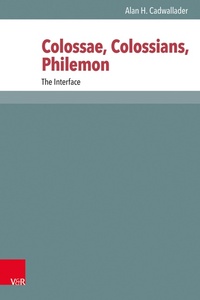
Colossae,Colossians,Philemon
TheInterface
1st Edition
Published on 15. May 2023
814 pages
978-3-647-50002-7 (ISBN)
Description

The material culture of Colossae is here for the first time given as full a collation as possible to the present day. 38 inscriptions, 88 coins and 49 testimonia are brought together in the context of a thorough overview of the site of Colossae. These include evidence that has been thought lost or has been overlooked or misinterpreted or has only recently been discovered. New readings, insights and analyses of the material evidence are brought into a highly creative exchange with the two letters of the Second Testament connected with the site. The texts thereby become additional evidence for an appreciation of the life of a city in the first two centuries of the Common Era. The fullest collation of evidence for the ancient Phrygian city in the Greco-Roman period was the coin catalogue assembled by Hans von Aulock (1987). The most recent catalogue of the inscriptions of Colossae was published by William Calder and William Buckler in 1939. There has never been a full inventory of ancient writings that bear witness to the site. Alan H. Cadwallader in his volume not only updates this material by subjecting it to thorough, critical analysis in the light of comparative evidence from across the Roman province of Asia and the Mediterranean world. New discoveries from the site and from museums and collections in the United Kingdom, Europe, Russia, Australia and the United States are introduced. Into this assemblage and interpretation are brought the letters to the Colossians and Philemon in the Second Testament writings of the Christian Church. For the first time, the letters are released to be players in the highly competitive environment of a city negotiating its way in the new realities of imperial Rome. Here the letters and their recipients become participants in the society of the day, contributing, critiquing and struggling to forge an identity for the Christ followers within that world. Echoes of the gymnasium, gladiatorial spectacles, cosmological speculations, religious devotion and sanction, family structures, commerce and industry, struggles for justice, intercity competition and legal negotiations are found in the letters, echoes that witness to their participation in the life of Colossae. This is a radical new approach, incorporating the turn to material culture as the embedding of literature and its consumers rather than an embellishing backdrop.
Alan H. Cadwallader is a Research Professor at the Australian Centre for Christianity and Culture at Charles Sturt University in Canberra. Recent monographs have been Beyond the Word of a Woman (ATF, 2008), Fragments of Colossae (ATF, 2015), The Politics of the Revised Version (T&T Clark, 2019). He has edited a number of volumes on the interface of early Christianity, ancient culture and contemporary issues: Colossae in Space and Time (V & R, 2011), Pieces of Ease and Grace (ATF, 2013), Where the Wild Ox Roams (Sheffield Phoenix, 2013), and Stones, Bones and the Sacred (SBL, 2016), The Village in Antiquity and the Rise of Early Christianity (T&T Clark, 2023). He holds memberships of the Studiorum Novi Testamenti Societas, Society of Biblical Literature, the Australian Classical Studies Association, the Australian Association for Byzantine Studies, and the Fellowship of Biblical Studies. He is the New Testament Editor for the Australian Biblical Review.
Alan H. Cadwallader is a Research Professor at the Australian Centre for Christianity and Culture at Charles Sturt University in Canberra. Recent monographs have been Beyond the Word of a Woman (ATF, 2008), Fragments of Colossae (ATF, 2015), The Politics of the Revised Version (T&T Clark, 2019). He has edited a number of volumes on the interface of early Christianity, ancient culture and contemporary issues: Colossae in Space and Time (V & R, 2011), Pieces of Ease and Grace (ATF, 2013), Where the Wild Ox Roams (Sheffield Phoenix, 2013), and Stones, Bones and the Sacred (SBL, 2016), The Village in Antiquity and the Rise of Early Christianity (T&T Clark, 2023). He holds memberships of the Studiorum Novi Testamenti Societas, Society of Biblical Literature, the Australian Classical Studies Association, the Australian Association for Byzantine Studies, and the Fellowship of Biblical Studies. He is the New Testament Editor for the Australian Biblical Review.
More details
Other editions
Additional editions
Book
05/2023
1st Edition
Vandenhoeck & Ruprecht
€200.00
Shipment within 5-7 days
Person
Alan H. Cadwallader is a Research Professor at the Australian Centre for Christianity and Culture at Charles Sturt University in Canberra.
Recent monographs have been Beyond the Word of a Woman (ATF, 2008), Fragments of Colossae (ATF, 2015), The Politics of the Revised Version (T&T Clark, 2019). He has edited a number of volumes on the interface of early Christianity, ancient culture and contemporary issues: Colossae in Space and Time (V & R, 2011), Pieces of Ease and Grace (ATF, 2013), Where the Wild Ox Roams (Sheffield Phoenix, 2013), and Stones, Bones and the Sacred (SBL, 2016), The Village in Antiquity and the Rise of Early Christianity (T&T Clark, 2023).
He holds memberships of the Studiorum Novi Testamenti Societas, Society of Biblical Literature, the Australian Classical Studies Association, the Australian Association for Byzantine Studies, and the Fellowship of Biblical Studies. He is the New Testament Editor for the Australian Biblical Review.
Content
- Intro
- Title Page
- Copyright
- Table of Contents
- Acknowledgements
- Abbreviations
- Introduction: Colossae and a material life
- The beginnings of modern material awareness of Colossae
- Colossae in the ancient material world
- The elision of Colossae from materialist investigation.
- Restoring Colossae to material existence.
- Restoring Second Testament letters to a material context
- A skeletal overview
- Chapter One | Colossae, a name in search of a city
- The testimonia
- Toponymy and other confusions
- Topography and other confusions
- Inscriptions and a possible material mooring for Colossae
- The undervalued potential of numismatics
- Destruction as an explanation
- Rethinking Chonai and Colossae
- Confirmation of location and continuing life from material witness
- Chapter Two | Colossae, a city in search of a name
- The punishment of Colossae
- A colossal segue
- Relocating Colossae again
- The name in material culture
- Confronting a toponym with different spellings
- A Phrygian explanation?
- A colossal explanation
- The Hittite/Luwian option
- The appropriation of a colossal etymology
- The opening of the letter to the Colossians and heliotic Colossae
- Chapter Three | Holding together city and country
- Herodotos and the first literary glimpse of Colossae
- An early inscription from Colossae's territory
- The foundation of Laodikeia and the reduction of Colossae's territory
- A dispute over fishing rights
- The twin rivers on the coins of two cities
- Exploring Colossae's territory
- A view from the village
- Foundation myths, festival markets and territory cohesion
- A Colossian foundation narrative
- An alternate foundation story for the Christ-followers at Colossae
- Chapter Four | Rivals and Neighbors: competing Cities in the Lycus Valley
- Bronze coins and the costs of civic life
- Slaves, apprentices and returns
- Monetary exchange in first century Colossae
- Coinage and contest in civic life
- Civic mints and competition in the Lycus Valley
- Comparative insights from Sestos
- A further Colossian example of the Sestos rationale: Artemis
- City pride and prosperity
- The role and returns for benefaction of provincial mints
- Colossae's coins and the city's distinction from Laodikeia
- Multiple homonoia-types from the time of Elagabalus
- Colossae's numismatic territorial claim
- The continuation of antagonism between Colossae and Laodikeia
- Christ-followers within contesting cities
- Chapter Five | The Shadow of a Mountain: cosmic control
- Lost and found: a Colossian intaglio
- The inscription
- The iconography of Tyche
- Tyche and a highly-credentialed leader at Colossae.
- Tyche, cosmic order and the zodiac
- The owl and the kithara
- The elements
- The fickleness of Tyche - earthquakes
- Christos Prototokos
- Chapter Six | Cosmic Visions, Cosmic Learning
- A Colossian student in Smyrna
- Pressing the philologoi
- Theon of Smyrna and the critical components for higher learning
- Cosmic hymn and mundane harmony
- Meter and its absence in ancient hymns
- Hymns and the reinforcement of mundane realities
- The hymn in the letter to the Colossians
- Chapter Seven | Purity, Pollution, Penalties and Power at Colossae: sacred laws and their (monetary) significance for the Colossians
- Illustrative purity concerns in Colossae and the letter to the Colossians
- The application of grasping, tasting, touching
- From purity and pollution to penalties and power
- Bronze coinage, the record of debt and the sacred, and a Christian repudiation
- Competing gospels and the religious consequences
- Debt, religious regulations, and cancellation in a Colossian context
- Religious observance at Colossae
- Distinguishing the Christ-followers from the religious environment of Colossae
- Chapter Eight | Cursing Colossians
- The Kaklık curse diptych
- A village of Colossae near Kaklık
- Daemons, deities and the dead
- Defixiones and the Letter to the Colossians
- Christ the circuit-breaker
- Chapter Nine | Who's Who at Colossae: onomastics, ethnicities and status
- Theaters and spectators
- Small returns of names
- The contribution of onomastics
- Apphia and the Phrygian inheritance
- Phrygian and/to Greek
- The unique "race code" of the letter to the Colossians
- The names in the Letters and one in particular
- Apphia again: the tracking of a Phrygian Lallname.
- Chapter Ten | Christian Identity, the Gymnasium and Gladiatorial Conflict
- Honors for Zenon
- Junior honors for Kastor
- Athletic imagery in the Letter to the Colossians?
- Enter the gladiator .
- Christ-followers and gladiators at Colossae
- Chapter Eleven | Slavery and its Governance at Colossae
- Multiple legal systems at Colossae.
- Memorialization of individuals at Colossae
- Penalties for grave interference
- A bureaucracy for managing pluralities of (commercial and legal) interests
- Drawing implications: slavery and the conflict of laws
- Onesimos and the runaway slave hypothesis
- Manumission of Onesimos?
- Chapter Twelve | Death and Families at Colossae
- The necropolis at Colossae
- The variety of tombs in the Colossian necropolis
- Chamosoria and their bomoi
- The tumuli
- Valuing the dead at Colossae
- Dion the leatherworking specialist
- The anonymous dealer in pigs large and small
- Community and death
- Funerary inscriptions, households and families
- Peter Thonemann and close reading for diversity in families
- Esen Ögüs and the gendered hierarchy of family relationships
- Impressions of Colossian families and households
- The Colossian household code and social realities
- Afterword
- Appendix 1 | Ancient Testimonia for Colossae
- Appendix 2 | A Concordance of the coin types in von Aulock's Catalogue and Roman Provincial Coinage online.
- Appendix 3 | List of Greek names from Colossae
- Appendix 4 | Concordance of Colossian inscriptions
- Map of Asia Minor and the Mediterranean
- Map of the Lycus Valley and environs
- Bibliography
- Index of Ancient, Early Christian and Byzantine Literature
- Index of Inscriptions and Papyri
- Index of Coins
- Index of Modern Authors
- Index of Place Names, Ancient and Modern
- Index of Subjects
- Index of Key Greek and Latin Words
- Greek
- Latin
- Body
