

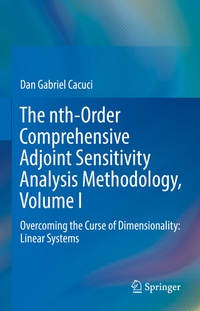
The nth-Order Comprehensive Adjoint Sensitivity Analysis Methodology, Volume I
Description

More details
Other editions
Additional editions
Person
Professor Cacuci's career spans over 40 years in the field of nuclear science and energy, encompassing both academia and large-scale multidisciplinary research centers. His scientific expertise includes predictive best-estimate analysis of large-scale physical and engineering systems, large scale scientific computations and, within nuclear science and engineering, reactor multi-physics, dynamics, and safety. As Scientific Director of The French Alternative Energies and Atomic Energy Commission's Nuclear Energy Pole, Dr. Cacuci oversaw the scientific activities of over 7000 scientists working in nuclear energy. Dr. Cacuci was a member of the Founding Leadership Team of DOE's Consortium for Light Water Reactor Simulations. Since 1984, Prof. Cacuci has been the Editor of "Nuclear Science and Engineering," a research journal of the American Nuclear Society. He has received many prestigious awards, including four titles of Doctor Honoris Causa,the E. O. Lawrence Award and Gold Medal from the US DOE, the Alexander von Humboldt Prize for Senior Scholars and from the American Nuclear Society, the Arthur Holly Compton Award, the Eugene P. Wigner Award, the Glenn Seaborg Medal, Young Members Engineering Achievement Award, and ANS Fellow. He is a member of several international and national academies of arts and sciences, has made over 600 presentations worldwide, has authored 4 books, 7 book chapters, over 200 peer-reviewed articles, and has edited the comprehensive Handbook of Nuclear Engineering. He is the Director of the Center of Economic Excellence in Nuclear Science and Energy and SmartState Endowed Chair Professor of Mechanical Engineering at University of South Carolina.
Content
Chapter 1. Introduction and Motivation: Breaking the Curse of Dimensionality in Sensitivity and Uncertainty Analysis. Part A: Function-Valued Responses.- Chapter 2. Part A: Function-Valued Responses-The First- and Second-Order Comprehensive Adjoint Sensitivity Analysis Methodologies for Linear Systems with Function-Valued Responses.- Chapter 3. The Third-Order Comprehensive Adjoint Sensitivity Analysis Methodology (C-ASAM-3) for Linear Systems with Function-Valued Responses.- Chapter 4. The Fourth-Order Comprehensive Adjoint Sensitivity Analysis Methodology (C-ASAM-4) for Linear Systems with Function-Valued Responses.- Chapter 5. The Nth-Order Adjoint Sensitivity Analysis Methodology (C-ASAM-N) for Linear Systems with Function-Valued Responses.- Chapter 6. Part B: Scalar-Valued Responses-The Fourth-Order Comprehensive Adjoint Sensitivity Analysis Methodology (C-ASAM-4) for Linear Systems with Scalar-Valued Responses.- Chapter 7. The Nth-Order Adjoint Sensitivity Analysis Methodology(C-ASAM-N) for Linear Systems with Scalar-Valued Responses.
