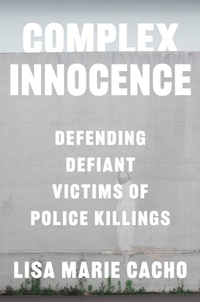
Complex Innocence
Description

Exposes the paradox of self-defense in police violence through five case studies of police killings
Every day in the United States, an average of three people are killed by police officers. Black and Indigenous victims are disproportionately represented, and their stories are too often distorted by courts and media to justify their deaths and exonerate police actions.
In Complex Innocence, Lisa Marie Cacho examines five police killings that occurred between 2012 and 2019 across the continental U.S., Hawai¿i, and the Muckleshoot Nation. Many of the victims were queer people, women of color, and other multiply marginalized individuals who had prior encounters with law enforcement, leading their deaths to be framed as deserved or inevitable. Cacho challenges these narratives by interrogating the legal, cultural, and historical frameworks that determine which acts of self-defense are protected and which are criminalized.
Drawing on self-defense law, Supreme Court cases, anti-resisting arrest statutes, and policing practices, Cacho reveals how "self-defense" as a right has been repeatedly redefined to privilege police officers while denying protection to victims of state violence. Through careful analysis of reports, testimonies, and media portrayals, she demonstrates how people of color's efforts at self-preservation are recast as threats, while officers' violence is framed as justifiable.
By reclaiming the complex innocence of those killed, Complex Innocence exposes the racial, sexual, and colonial foundations of policing. It offers an urgent critique of how U.S. law and culture sustain the cycle of sanctioned state violence.
More details
Other editions
Additional editions