

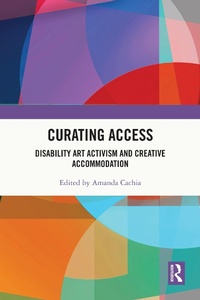
Curating Access
Disability Art Activism and Creative Accommodation
1st Edition
Published on 14. September 2022
332 pages
978-1-000-64817-1 (ISBN)
Description

This book is an interdisciplinary collection of twenty-four essays which critically examine contemporary exhibitions and artistic practices that focus on conceptual and creative aspects of access.
Oftentimes exhibitions tack on access once the artwork has already been executed and ready to be installed in the museum or gallery. But what if the artists were to ponder access as an integral and critical part of their artwork? Can access be creative and experimental? And furthermore, can the curator also fold access into their practice, while working collaboratively with artists, considering it as a theoretical and practical generative force that seeks to make an exhibition more engaging for a wider diversity of audiences? This volume includes essays by a growing number of artists, curators, and scholars who ponder these ideas of ad-hoc, experimental and underground approaches within exhibition-making and artistic practices. It considers how, through these nascent exhibition models and art practices, enhanced experiences of access in the museum can be a shared responsibility amongst museum workers, curators, and artists, in tandem with the public, so that access becomes a zone of intellectual and creative "accommodation," rather than strictly a discourse on policy. The book provides innovative case studies which provide a template for how access might be implemented by individuals, artists, curators, museum administrators and educators given the growing need to offer as many modalities of access as possible within cultural institutions.
This book shows that anyone can be a curator of access and demonstrates how to approach access in a way that goes beyond protocol and policy. It will thus be of interest to students and scholars engaged in the study of museums, art history and visual culture, disability, culture, and communication.
Oftentimes exhibitions tack on access once the artwork has already been executed and ready to be installed in the museum or gallery. But what if the artists were to ponder access as an integral and critical part of their artwork? Can access be creative and experimental? And furthermore, can the curator also fold access into their practice, while working collaboratively with artists, considering it as a theoretical and practical generative force that seeks to make an exhibition more engaging for a wider diversity of audiences? This volume includes essays by a growing number of artists, curators, and scholars who ponder these ideas of ad-hoc, experimental and underground approaches within exhibition-making and artistic practices. It considers how, through these nascent exhibition models and art practices, enhanced experiences of access in the museum can be a shared responsibility amongst museum workers, curators, and artists, in tandem with the public, so that access becomes a zone of intellectual and creative "accommodation," rather than strictly a discourse on policy. The book provides innovative case studies which provide a template for how access might be implemented by individuals, artists, curators, museum administrators and educators given the growing need to offer as many modalities of access as possible within cultural institutions.
This book shows that anyone can be a curator of access and demonstrates how to approach access in a way that goes beyond protocol and policy. It will thus be of interest to students and scholars engaged in the study of museums, art history and visual culture, disability, culture, and communication.
Reviews / Votes
"Curating Access: Disability Art Activism and Creative Accommodation is a must-read for students, museum workers, and scholars alike. Published in 2023, this anthology features 24 essays from 45 artists, scholars, and curators. The collection features reviews of specific disability-centered exhibitions and artistic practices that center accessibility as an integral part of culture creation. Curating Access asks bold questions about the role of the artist, curator, and museum in the promotion, planning, and ensuring of accessibility in contemporary exhibitions. Rather than considering the accessibility of exhibitions and artworks after they have been planned, the authors featured in Curating Access instead ask how radical new modalities of access can be expanded in museums...Curating Access highlights how important it is for museums to evolve beyond outdated policies of minimum compliance with accessibility standards and realize that "access is a topic for creative and intellectual consideration in curatorial and artistic practice, moving well past the checklist for meeting the needs of disabled audiences." By providing readers with exhibition reviews, artists' insights, and ideas for radically inclusive exhibit designs, Curating Access emphasizes the importance of centering the disability community in conversations about inclusivity."Abigail Lowery, 'Accessibility as Praxis', Fwd: Museums Journal (July 2024)
More details
Edition
1. Auflage
Language
English
Place of publication
London
United Kingdom
Publishing group
Taylor & Francis Ltd
Target group
College/higher education
Illustrations
33 Halftones, black and white; 33 Illustrations, black and white
ISBN-13
978-1-000-64817-1 (9781000648171)
Copyright in bibliographic data and cover images is held by Nielsen Book Services Limited or by the publishers or by their respective licensors: all rights reserved.
Schweitzer Classification
Other editions
Additional editions
Book
05/2024
1st Edition
Routledge
€63.90
Shipment within 15-20 days
Book
09/2022
1st Edition
Routledge
€207.00
Shipment within 15-20 days
Person
Amanda Cachia is an independent curator and critic from Sydney, Australia. She received her PhD in Art History, Theory & Criticism from the University of California San Diego in 2017. Cachia has curated approximately 40 exhibitions, many of which contain social justice themes and content. Her research interests include contemporary art and disability, decolonizing the museum, and accessible curatorial practices.
Content
Introduction: Committed to Change-Ten Years of Creative Access; Part I: Curatorial Reflections in the Age of COVID-19: Chapter 1: The "Swell": Disability Arts in the Time of COVID-19; Chapter 2: Becoming Indisposable: Curating Disability in a Time of Pandemic; Chapter 3: Connect2Abilities: Staging Virtual Intercultural Collaboration during COVID-19; Part II: Curatorial Reflections: Chapter 4: Disabled Artists, Audience, and the Museum as the Place of Those Who Have No Part; Chapter 5: Generative Forms of Experiential Access; Chapter 6: From Dust to Dust: Hallucinating the Absent Exhibition; Chapter 7: Perspective: Highlighting Disabled Experience through an Interdisciplinary and Socially Engaged Art Project; Chapter 8: Unseen Journeys Made Visible: Using Socially Engaged Art to Cross Boundaries and Create a Universally Enriching Experience; Chapter 9: Human Threads: Altered States; Chapter 10: Incarnate Experiences: Learning to Curate Exhibitions for Disabled Bodies; Part III: Access Critique: Chapter 11: On Brand: When Design Museums Discover Disability; Chapter 12: Accommodating and Enabling Anxiety Disorders and Agoraphobia in Digital Access Systems for Cultural Heritage; Chapter 13: Do You Hear My Point? Addressing Accessibility Issues within Spatial Audio; Part IV: Collaboration & Conversation: Chapter 14: Codesigning Access: A New Approach to Cultures of Inclusion in Museums and Galleries; Chapter 15: Desiring Disruption: Experimental Approaches to Audio Description; Chapter 16: Curating Together: A Tangled, Intergenerational, Interdependent Community of Practice; Chapter 17: Networks of Care: Collectivity as Dialogic Creative Access; Part V: Artistic Access Praxis: Chapter 18: Troublesome Access in Pope.L's Instigation, Aspiration, Perspiration; Chapter 19: "My Practice is Staying Alive": Critique and Care in the Sculptures of Emily Barker; Chapter 20: Considering Amanda Coogan's Performance Art as an Accessible Practice; Chapter 21: Open Access: Accessibility as a Temporary, Collectively Held Space; Chapter 22: Alt Text as Poetry Project; Chapter 23: Disability Access Rider; Chapter 24: A Primer On Working With Disabled Group Members: For Feminist/Activist Groups and Organizations; Index.
