

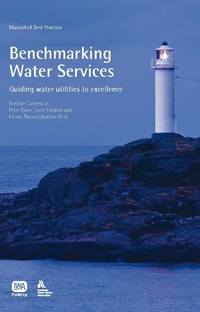
Benchmarking Water Services
Manual of Best Practice
Published on 1. March 2011
186 pages
978-1-78040-087-7 (ISBN)
Description

Benchmarking has become a key tool in the water industry to promote and achieve performance targets for utilities. The use of this tool for performance improvement through systematic search and adaptation of leading practices, has expanded globally during the past decade. Many ongoing projects worldwide aim to address different needs and objectives, in varying contexts, with outstanding results and impact.
Benchmarking Water Services provides valuable information to everyone interested in benchmarking in the water industry. The text is aimed at utilities considering joining a benchmarking project, experienced practitioners in charge of organizing a benchmarking exercise, consultants, regulators and researchers. The document is presented with a clear practice oriented approach and can be used as a how-to-benchmark guide presented from different perspectives (participants, organizers, supervising bodies). Readers will gain practical insight on real life benchmarking practices and will benefit from the experiences gained in some of the leading benchmarking projects of the water industry (including the IWA-WSAA benchmarking efforts, the European Benchmarking Co-operation and the several benchmarking projects carried out in Austria and Central Europe). The manual also presents the new IWA Benchmarking Framework, which aims to harmonize the terms used to describe benchmarking and performance indicators practices in the water industry, guaranteeing a more fluent and efficient communication.
This Manual of Best Practice is edited by the IWA Specialist Group on Benchmarking and Performance Assessment, and co-published by AWWA and IWA Publishing.
Praise for Benchmarking Water Services: "The continual trend of conceptual to specifics throughout the book provides for an educational experience each time the book is either casually perused or carefully studied." "The authors (Cabrera, Haskins and Fritiz) diligently pursue the focus of improvement." "Benchmarking Water Services is an in depth and practical 'must have' guide for any utility currently engaged in or planning to develop a benchmarking process" - Gregory M. Baird (2012) Benchmarking: An International Journal 19:2.
More information about the book can be found on the Water Wiki in an article written by the author: http://www.iwawaterwiki.org/xwiki/bin/view/Articles/TheNewIWABenchmarkingFramework
A Spanish language version of this book is available as a free eBook: http://www.iwawaterwiki.org/xwiki/bin/view/Articles/eBookTitlesfromIWAPublishingFreetoDownload-Volume2#HBenchmarkingParaServiciosdeAgua
Benchmarking Water Services provides valuable information to everyone interested in benchmarking in the water industry. The text is aimed at utilities considering joining a benchmarking project, experienced practitioners in charge of organizing a benchmarking exercise, consultants, regulators and researchers. The document is presented with a clear practice oriented approach and can be used as a how-to-benchmark guide presented from different perspectives (participants, organizers, supervising bodies). Readers will gain practical insight on real life benchmarking practices and will benefit from the experiences gained in some of the leading benchmarking projects of the water industry (including the IWA-WSAA benchmarking efforts, the European Benchmarking Co-operation and the several benchmarking projects carried out in Austria and Central Europe). The manual also presents the new IWA Benchmarking Framework, which aims to harmonize the terms used to describe benchmarking and performance indicators practices in the water industry, guaranteeing a more fluent and efficient communication.
This Manual of Best Practice is edited by the IWA Specialist Group on Benchmarking and Performance Assessment, and co-published by AWWA and IWA Publishing.
Praise for Benchmarking Water Services: "The continual trend of conceptual to specifics throughout the book provides for an educational experience each time the book is either casually perused or carefully studied." "The authors (Cabrera, Haskins and Fritiz) diligently pursue the focus of improvement." "Benchmarking Water Services is an in depth and practical 'must have' guide for any utility currently engaged in or planning to develop a benchmarking process" - Gregory M. Baird (2012) Benchmarking: An International Journal 19:2.
More information about the book can be found on the Water Wiki in an article written by the author: http://www.iwawaterwiki.org/xwiki/bin/view/Articles/TheNewIWABenchmarkingFramework
A Spanish language version of this book is available as a free eBook: http://www.iwawaterwiki.org/xwiki/bin/view/Articles/eBookTitlesfromIWAPublishingFreetoDownload-Volume2#HBenchmarkingParaServiciosdeAgua
More details
Series
Edition
Digital original
Language
English
Place of publication
London
United Kingdom
Target group
College/higher education
Professional and scholarly
File size
15,95 MB
ISBN-13
978-1-78040-087-7 (9781780400877)
Copyright in bibliographic data and cover images is held by Nielsen Book Services Limited or by the publishers or by their respective licensors: all rights reserved.
Schweitzer Classification
Other editions
Additional editions
Enrique Cabrera | Peter Dane | Scott Haskins
Benchmarking Water Services
Book
03/2011
IWA Publishing
€147.07
Shipment within 3-4 weeks
Content
- Cover
- Copyright
- Contents
- Foreword
- Acknowledgments
- About the authors
- Chapter 1: Introduction
- 1.1 What is benchmarking?
- 1.2 Benchmarking: metric, process or none?
- 1.3 A new benchmarking framework
- 1.4 Why should you benchmark?
- 1.4.1 Governments/regulators
- 1.4.2 Customers
- 1.4.3 Owners/shareholders
- Chapter 2: Performance assessment basics
- 2.1 The IWA performance indicator system
- 2.1.1 Data elements
- 2.2 implementation steps
- 2.3 Indicators selection
- Chapter 3: The IWA benchmarking process
- 3.1 The benchmarking process
- 3.1.1 The benchmarking concept
- 3.1.2 The IWA benchmarking process
- 3.1.3 Project milestones
- Chapter 4: Prerequisites to successful benchmarking
- 4.1 How to successfully join a benchmarking program
- 4.1.1 Alignment with strategic objectives
- 4.1.2 Commitment of senior management
- 4.1.3 Willingness to provide good quality data in time
- 4.1.4 Willingness to share knowledge and experience
- 4.1.5 Stable organization
- 4.1.6 Benchmark at the appropriate level
- 4.2 How to succesfully organize a benchmarking program
- 4.2.1 Experience
- 4.2.2 Comparable participants
- 4.2.3 Performance assessment system
- 4.2.4 Continuous process
- 4.2.5 Code of conduct
- 4.2.6 Funding
- Chapter 5: Project planning
- 5.1 Objectives
- 5.1.1 Thematic objectives
- 5.1.2 Methodological objectives. The "triple C"
- 5.1.3 Individual utility objectives
- 5.2 Scope and deliverables
- 5.2.1 Target group of water utilities
- 5.2.2 Scope of performance assessment and improvement
- 5.2.3 Deliverables
- 5.2.4 Scope and deliverables for utilities
- 5.3 Governance - defning roles and responsibilities
- 5.3.1 Who is benchmarking?
- 5.4 Project schedule
- 5.5 Financial planning
- 5.5.1 Costs
- 5.5.2 Covering costs
- 5.6 Terms & conditions: code of conduct and confdentiality requirements
- 5.7 Recruitment of participants
- 5.7.1 Communication channels
- 5.8 Communication plan & public relations
- 5.8.1 Communication strategy and objectives
- 5.8.2 Communication structure
- 5.8.3 Communication actions
- Chapter 6: Orientation, training and project control
- 6.1 Project level objectives
- 6.1.1 Project plan & protocols
- 6.1.2 Data questionnaire
- 6.1.3 Software, tools and web support
- 6.1.4 Project kick-off
- 6.1.5 Other factors to consider
- 6.2 Utility level objectives
- 6.2.1 Roles and responsibilities. Internal coordinator and team
- 6.2.2 Schedule
- 6.2.3 Assignment of resources
- 6.2.4 Internal training on questionnaire and software
- 6.2.5 Helpful hints
- Chapter 7: Data acquisition and validation
- 7.1 Comparable data - the linchpin for successful benchmarking activities
- 7.2 Data acquisition - translating reality into figures and facts
- 7.2.1 The questionnaire
- 7.2.2 The data collection step
- 7.3 Data validation - quality first!
- 7.3.1 Necessity of data validation
- 7.3.2 Back office validation
- 7.3.3 End of validation step
- Chapter 8: Data analysis & assessment reporting
- 8.1 Synthesizing data
- 8.1.1 The need for a database
- 8.1.2 Data analysis software
- 8.2 Pre-analysis
- 8.2.1 Clustering the utilities
- 8.2.2 Sensitivity analysis of clustering criteria
- 8.2.3 Sensitivity analysis of different PI denominators
- 8.2.4 Comparability of single PIs over time
- 8.2.5 Performance indices and multivariate data models for overall performance rankings
- 8.3 Data analysis
- 8.3.1 Tables
- 8.3.2 Bar, grouped bars and stacked-bars charts
- 8.3.3 Scatter plot
- 8.3.4 Box and whisker plots
- 8.3.5 The "reduced boxplot"
- 8.3.6 Box plot chart, clustered in peer groups
- 8.4 Reporting - different reports serving different target groups
- 8.4.1 Utility individual report
- 8.4.2 Consortium report
- 8.4.3 Public report
- 8.5 Assessment and best practice workshop
- 8.6 Final reporting on performance assessment
- 8.6.1 Preparing final reports
- 8.6.2 Disseminating final reports
- Chapter 9: Improvement actions
- 9.1 Identification and prioritization of improvement actions
- 9.1.1 Identification of improvement actions
- 9.1.2 Prioritizing improvement actions
- 9.2 Implementation of improvement initiatives
- 9.2.1 Establishing a plan to implement the improvements
- 9.2.2 Example of best practice implementation
- Chapter 10: Review improvement actions
- 10.1 Review of improvement actions
- 10.1.1 Assessment at the utility level
- 10.1.2 Timelines
- 10.1.3 Continuous improvement
- 10.1.4 Comparing benchmarking results across years
- 10.1.5 Assessment at the project level
- 10.2 Final evaluation and documentation of the project. Lessons learnt
- 10.2.1 Project closure
- Annex A: Benchmarking efforts in the water industry
- A. Office of water services (OFWAT)
- B. The World Bank
- C. Water services association of Australia (WSAA) benchmarking
- D. American water works association (AWWA) and water environment federation (WEF) - QualServe
- E. Austrian benchmakring
- F. German benchmkairng
- G. Dutch benchmarking program
- H. 6-Cities group
- I. Scandinavian program
- J. European benchmarking
- K. SEAWUN
- L. ADERASA
- M. Canadian benchmarking
- N. PAS project (India)
- Annex B: Examples of project documents along the benchmarking process
- A. Project plans
- European benchmarking cooperation - project plan 2009
- B. Project scopes
- ISO 24500 guideline series - defining scope and performance assessment model
- European benchmarking cooperation - modular project scope
- WSAA benchmarking - scope for function, process & tasklevel on asset management
- Austrian OVGW benchmarking - scope for utility level
- Austrian OVGW benchmarking - scope for process level on water loss management (1 page)
- C. Project governance
- European benchmarking cooperation - program governance
- WSAA benchmarking - steering committee function
- Austrian OVGW benchmarking - project structure
- D. Milestones and schedule
- European benchmarking cooperation - time schedule 2009
- WSAA asset management benchmarking - time schedule
- E. Code of conduct and confidentiality agreements
- European benchmarking cooperation - EFQM European code of conduct (6 pages)
- OVGW benchmarking - confidentiality agreement (extract from the OVGW participation contract)
- F. Recruitment of participants
- European benchmarking cooperation - EBC program leaflet
- European benchmarking cooperation - invitation letter
- G. Project communication
- WSAA benchmarking - project news update Dec 2007
- WSAA benchmarking - project news update Jan 2008
- WSAA benchmarking - project article in WSAA bulletin
- H. Orientation and training
- WSAA benchmarking - agenda for orientation workshops
- WSAA benchmarking - agenda for accreditation workshop
- I. Project control?
- WSAA benchmarking - aquamark assessment guide
- WSAA benchmarking - aquamark user manual
- WSAA benchmarking - aquamark audit protocol
- J. Data acquisition and validation
- WSAA benchmarking - agenda for onsite interview
- K. Assessment reporting
- K.1. Utility reports
- OVGW benchmarking - utility report
- WSAA benchmarking - draft utility report (Anchorage)
- WSAA benchmarking - final utility report (Seattle)
- K.2. Public reports
- European benchmarking cooperation - project overview IB08
- VEWIN Dutch benchmarking - public report 2006
- WSAA benchmarking - f nal project summary
- K.3. Best practice workshops
- European benchmarking cooperation - agenda for best practice workshop
- Austrian OVGW benchmarking - agenda for best practice workshop on water loss management
- K.4. Onsite presentations and utility-individual workshops
- WSAA benchmarking - executive briefing and close out briefing for anchorage water and wastewater utility
- WSAA benchmarking - executive briefing for city of Tacoma - water
- L. Improvement actions
- Austrian OVGW benchmarking - utility action planning
- M. Project review
- European benchmarking cooperation - project evaluation form
- Annex C: IWA performance indicators
- A. Performance indicators for water supply services
- B. Performance indicators for waste water services
- References and select bibliography
