

Calibration
Description

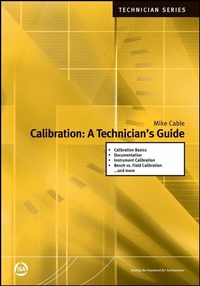
Calibration: A Technician's Guide provides a comprehensive overview of process instrument calibration, laying a foundation for understanding the principles and applications of common tasks performed by technicians. It also serves as an excellent study resource for the calibration section of the ISA Certified Control Systems Technician (CCST) exam.
Topics covered in this book include:
- Terminology
- Bench calibration vs. field calibration
- Loop calibration vs. individual instrument calibration
- Instrument classification systems
- Documentation
- Calibration techniques for temperature, pressure, level, flow, final control and analytical instrumentation
This book serves as a structured learning tool with questions and answers in each chapter. The extensive appendix is an outstanding reference, including sample piping and instrumentation diagrams (P&IDs), loop diagrams, specification sheets, sample calibration procedures and conversion and reference tables. If you calibrate instruments or oversee someone who does, this book is an excellent addition to your library.
More details
Other editions
Additional editions
Person
Michael Cable is a Level 3 Certified Control System Technician. He is currently the Validation Manager at Argos Therapeutics in Durham, NC where his responsibilities include managing the Calibration Program. Michael started his career as an Electronics Technician in the Navy Nuclear Power Program, serving as a Reactor Operator and Engineering Watch Supervisor aboard the USS Los Angeles submarine and then at the AIW prototype in Idaho Falls. After leaving the Navy, he started his civilian career at Performance Solutions performing technical services for the pharmaceutical industry. His 11 years there was highlighted by an assignment to Eli Lilly Corporate Process Automation managing Instrument Qualification projects and then starting up a Calibration Services division within Performance Solutions. His practical expertise in instrumentation and controls led him to his current career path in Validation, which has been his main focus for the last 7 years.
Content
About the Author ix
Acknowledgements xi
Introduction xiii
Chapter 1 Calibration Principles 1
1.1 What Is Calibration? 1
1.2 What Are the Characteristics of a Calibration? 2
1.3 Why Is Calibration Required? 6
1.4 Who Performs Calibrations? - The Control System Technician 8
1.5 Characteristics of a Control System Technician 9
1.6 Loop Calibration vs Individual Instrument Calibration 10
1.7 Bench Calibration vs Field Calibration 11
1.8 Classification of Instruments 12
Chapter Summary 13
Review Questions 14
Chapter 2 Documentation 17
2.1 Calibration Procedure Content 19
2.2 Calibration Data Sheets (See Examples in Appendix A-4) 21
2.3 P&IDs (See Example in Appendix A-1) 23
2.4 Loop Diagrams (See Examples in Appendix A-2) 25
2.5 Instrument Specification Forms (See Examples in Appendix A-3) 26
2.6 Project Specifications 27
2.7 Manufacturer's Specifications 27
2.8 Calibration Intervals 28
2.9 Safety Considerations 29
2.10 Calibration Status Labels 30
Review Questions 31
Chapter 3 Temperature Instrument Calibration 33
3.1 What is Temperature? 33
3.2 Temperature Sensors 34
3.3 Signal Conversion 35
Review Questions 44
Chapter 4 Pressure Instrument Calibration 49
4.1 What is Pressure? 49
4.2 Challenges When Calibrating Pressure 50
4.3 Calibrating Pressure Gauges 52
4.4 Calibrating Pressure Transmitters 55
4.5 Calibrating Pressure Switches 55
Review Questions 56
Chapter 5 Level Instrument Calibration 61
5.1 Types of Level Instruments 61
5.2 Special Considerations with Level Calibration 64
5.3 Calibrating a Differential Pressure Level Transmitter 67
5.4 Calibrating a Capacitance Level Instrument 71
5.5 Calibrating an Ultrasonic Level Instrument 72
Review Questions 74
Chapter 6 Flow Instrument Calibration 77
6.1 Types of Flow Instruments 77
6.2 Calibration of Flowmeters 82
6.3 D/P Transmitter Calibration 83
6.4 Example: Magnetic Flowmeter Calibration 84
6.5 Flowmeter Calibration Using a Master Meter (Prover) 86
6.6 Gravimetric Method for Flowmeter Calibration (Measurement by Weight) 87
Review Questions 88
Chapter 7 Final Control Devices Calibration 89
7.1 Calibration of an I/P Transducer 95
7.2 Calibration of a Valve Positioner 96
7.3 Calibration of a Control Valve 97
Review Questions 97
Chapter 8 Process Analytical Instrument Calibration 101
8.1 pH Calibration Procedure 105
8.2 Diagnostic Test for pH Electrodes 106
8.3 Measuring Conductivity 107
8.4 Calibration Procedure with Explanations 109
Review Questions 111
Bibliography 113
Appendix A-1 Piping & Instrument Diagrams (P&IDs) 117
Appendix A-2 Loop Diagrams 119
Appendix A-3 Instrument Specifications 123
Appendix A-4 Calibration Procedures 145
Appendix A-5 Test Equipment 227
Appendix A-6 RTD and Thermocouple Tables 229
Appendix A-7 Conversion Tables 245
Appendix B Answers to Chapter Review Questions 249
Index 271
2
DOCUMENTATION
After completing this chapter, you should be able to:
List the fundamental elements of a calibration procedure.
List the fundamental elements of a calibration data sheet.
Define the relevant calibration information contained in the following resource documents: P&ID, Loop Diagram, Instrument Specification Sheet, Project Specifications, and Manufacturer's Specifications.
List the resources for determination of initial calibration frequency for an instrument.
Identify safety considerations relating to calibration.
Describe the use of calibration status labels and what information is required on each.
Because of quality system requirements throughout industry, documentation has become as important as the actual performance of a calibration. This chapter will summarize documentation that all calibration technicians should be familiar with. Another ISA text, Instrumentation and Control Systems Documentation, details the documentation mentioned in this chapter, and more.
The accuracy and reliability of instrumentation in a facility is maintained through the development and implementation of a quality calibration program. In addition to inventorying instruments, determining calibration parameters and intervals, and purchasing appropriate test standards, a calibration program includes written procedures for performing calibrations. The level of detail contained in calibration procedures can vary considerably-from a generic procedure used to calibrate an instrument type to a very specific procedure used to calibrate one particular instrument. Different types of calibration procedures are discussed below and examples of each are included in Appendix A-4. Technical Manual procedure: Typically, a manufacturer's technical manual is provided for each similar model of instrument. Calibration instructions for the instrument are usually given in the technical manual. These instructions can be adopted or adapted as the calibration procedure for the applicable instruments. Most often, the manufacturer's calibration procedure is used to develop a company calibration procedure approved by management and the quality department. However, the actual technical manual procedure may be used or referenced as the calibration procedure if this practice is approved.
TABLE 2-1.
Using Calibration Procedures from a Technical Manual
ADVANTAGES
DISADVANTAGES
Very little time/resources required to develop procedures
Does not contain all necessary elements of a calibration procedure
Technically accurate and detailed instructions for the specific instrument
Applies to instrument only, not taking into account application/process
Generic procedure: Generic calibration procedures can be developed for each instrument type. For example, one procedure could be developed for Electronic Pressure/Vacuum Transmitters and another procedure for Pneumatic Temperature Controllers. You could even go more generic and develop a procedure for Pressure Instrument Calibration, which would include gauges, transmitters, etc. for pressure, differential pressure, and vacuum. Generic procedures should recommend using the manufacturer's technical manual to perform any necessary adjustments.
TABLE 2-2.
Generic Calibration Procedures
ADVANTAGES
DISADVANTAGES
Limits number of procedures to a manageable level
Inconsistent methods by different technicians using same procedure
Can be a good first step for new facility start-up until more effort can be devoted to procedure development
Inexperienced technicians need more detail
Specific procedure for an instrument or a manufacturer/model: In most facilities, some calibration procedures will have to be very specific to particular instruments. In some cases, specific detailed procedures are required for each instrument. Analytical instruments for such parameters as conductivity (resistivity), oxygen, and lab instrumentation typically require specific procedures for each type due to the unique differences in the way each is calibrated. Also, if your generic procedure for a particular pressure instrument does not adequately address the proper method, a specific procedure should be developed. Obviously, if safety could be compromised by using an inadequate generic procedure, a new procedure addressing the specific safety issues must be developed.
TABLE 2-3.
Specific Calibration Procedures
ADVANTAGES
DISADVANTAGES
Calibrations are performed the same way by all technicians
Increases resources required to develop, maintain, and track procedures
May take into account the effect on process
Technically accurate and detailed instructions for the specific instrument
Some "old school" technicians initially dislike the use of calibration procedures. They say, "We've always done it this way and never had any problems. Now we've got all this paperwork, it's a wonder we can get any actual work done." Well, in today's regulated environment, you'll be out of business if you don't have a documented calibration program in place. Your customers must be assured of a certain quality product based on parameters you said you could maintain. Most of those assurances are provided from accurate process instrumentation. It has been demonstrated that instrument accuracy deteriorates during use. The only way to keep track of accuracy at any given time is to verify, adjust, and document the calibration data.
2.1CALIBRATION PROCEDURE CONTENT
What information should be included in a calibration procedure? First, the format should follow the format required by your company procedures. Also any governing documents, such as the Calibration Policy, and any applicable procedures subordinate to the Calibration Policy must be followed.
The calibration procedure typically includes most or all of the following sections:
Purpose: Clearly states the reason for the procedure such as: "The purpose of this procedure is to provide standardized instructions for the calibration of temperature instruments."
Scope: Clearly states to what and to whom the procedure applies such as "This procedure applies to the calibration of all analog pressure gauges at the ABC Company calibrated by employee and contract technicians."
Note: The purpose and scope can be combined into one section of the procedure. The information in these sections is typically obvious to those of us who perform calibrations, but the managers need this so they know what they're approving.
Definitions: Contains brief descriptions of key terms, as applicable, for clarity. Acronyms and abbreviations used in the procedure are noted in this section to document their meaning throughout the text.
References/Attachments: Identifies other documents, including attachments, that are required to be used in conjunction with the procedure, or allow the user to gain further information regarding the procedural content.
Test Equipment/Materials Required: Identifies the test equipment and materials required to perform the procedure. Listing specific test equipment in this section helps to ensure uncertainty requirements are met and/or the desired accuracy ratio is achieved, particularly if the minimum tolerance achievable is specified in the Scope or Title of the procedure. Note that if the specified test equipment is not available, the technician must notify the supervisor prior to performing the calibration.
Safety: Provide information on potential human health hazards and potential hazards to the facility, equipment, or process. All Safety Work Permit requirements and Material Safety Data Sheet (MSDS) references are included in this section.
Prerequisites/Initial Conditions (optional): Provides any conditions that should be met prior to performing the calibration, such as tank drained, controller in manual, or system shutdown. Alternatively, these conditions can be included in the test procedure and/or notes printed on the calibration data sheet.
Test Procedure: This is the meat of the procedure which outlines the procedure in a clear, concise, step-by-step manner. If any steps of the calibration procedure cannot be performed as specified, the technician must return the instrument to a safe condition and notify the supervisor.
Acceptance Criteria: The pass/fail criteria may be included in the Test Procedure section or as a separate step at completion, evaluating the results obtained against the tolerances...
