

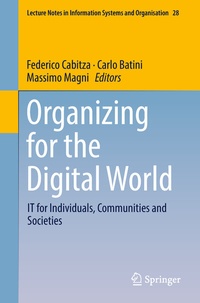
Organizing for the Digital World
Description

The book presents a collection of research papers shedding new light on these phenomena and related practices from both academic and professional perspectives. Given the plurality of views that it offers, the book makes a relevant contribution to the understanding and appreciation of the complexity of the digital world at various levels of granularity. It focuses on how individuals, communities and the coopetitive societies of our new, global and hyperconnected world produce value and pursue their objectives and ideals in mutually dependent ways. The content of the book is based on a selection of the bestpapers - original double-blind peer-reviewed contributions - presented at the annual conference of the Italian chapter of the AIS, which was held in Milan, Italy in October 2017.
More details
Other editions
Additional editions
Persons
Federico Cabitza received his Master in IT Engineering from the Politecnico of Milan in 2001. Since then, he has worked as a Requirement Engineer and Process Analyst in the private sector, specialising in health informatics. In 2007, he received a PhD in Informatics, with a thesis regarding the role of IT in coordination and decision making in the hospital domain. Currently, he is an Assistant Professor at the University of Milano-Bicocca (Milan, Italy) where he teaches Human-Computer Interaction and Data Visualization. His current research interests regard the impact of new technologies in the workplace, and the design of interactive systems supporting knowledge work in cooperative settings, especially in the health care sector. He is author of more than 120 research publications to date, in international conference proceedings, edited books and scientific journals.
Carlo Batini obtained the graduation in Engineering at University of Roma "La Sapienza" in 1972, and the post graduation in Computer Science in 1973. Since 1986 he has been full professor at University of Roma "La Sapienza". From 1993 to 2001 he has been on leave from University, being a member of the executive board, and in the last year President, of the Italian Authority for Information Technology in the Public Administration, where he leaded several innovative eGovernment projects on services to businesses, access to laws, data quality, Enterprise and Informatioin Integration architectures. Since 2001 he is professor at University of Milano Bicocca. From 2008 to 2011 he has been the head of the Department of Computer Science (DISCo) at University of Milano Bicocca. In 2009 he received the IBM Faculty Award. In 2013 he received in Hong Kong the Elsevier Peter P. Chen Award for his research, teaching and publishing activity in conceptual modeling.
Massimo Magni is an associate professor of management at Bocconi University and he has been the director of the Organization and HR Department at SDA Bocconi School of Management. His research interests include technology-enhanced behaviors, information systems development teams in geographically dispersed settings, and adoption and acceptance of new technologies. His current research interests revolve around emergent behaviors under pressure both at the individual and team level of analysis, as well as conducting multilevel research that bridges team context and individual behaviors. His work has been published in information systems and management journals including MIS Quarterly, Journal of Management Information Systems, Research Policy, Journal of Product Innovation Management, International Journal of Human-Computer Studies, Academy of Management Learning & Education, International Journal of Human Resource Management, and Behaviour & Information Technology.
Content
- Intro
- Preface
- Contents
- Organizing for the Digital World: An Overview of Current IT Solutions to Support Individuals, Communities and Societies
- References
- Automation as Management of Paradoxical Tensions: The Role of Industrial Engineering
- 1 Introduction
- 2 Research Methodology: Grounded Theory Data Collection and Analysis
- 3 Emerging Themes: Automation Enhancement Program Ambidexterity
- 3.1 Thematic Coding with the Bottom-up Approach
- 3.2 Interview Guide Definition for Next Steps and First Theoretical Sampling
- 3.3 Insights on Emerging Themes on Data Analysis
- 4 Discussion and Theoretical Integration
- 5 Conclusions
- References
- Visualizing Big Data: The Impact on Sense-Making and Decision-Making
- 1 Introduction
- 2 Background
- 3 Methodology
- 3.1 Data Collection
- 4 Discussion
- 5 Conclusions and Future Works
- References
- XBRL Implementation in the European Union: Exploring Preparers' Points of View
- 1 Introduction
- 2 ESMA's Adoption of XBRL
- 3 Effects of XBRL on Preparers: Literature Review
- 4 Methodology
- 5 Results of the Content Analysis and Discussion
- 5.1 Results of the Content Analysis on Preparers' Responses
- 5.2 Discussions of Results
- 6 Conclusions
- References
- Information Security Policies in Organizations
- 1 Introduction
- 2 Information Security Policies
- 3 Convention Theory-A Pragmatist Approach
- 3.1 Orders of Worth-Defining Qualities of People and Things
- 3.2 Regimes of Engagement
- 3.3 Organizations as Compromising Devices
- 4 Contributions for Research and Practice
- 4.1 Limitations and Future Research Agenda
- References
- E2mC: Improving Rapid Mapping with Social Network Information
- 1 Introduction
- 2 E2mC: Goals and Architecture
- 3 Automated Extraction and Geolocation of Social Media Content
- 4 A Social and Crowd Methodology
- 4.1 Reducing the Amount of Data
- 4.2 Increasing Data Quality by Contributing on the Geolocalization Process
- 4.3 Adding New Data from the Crowd
- 5 Conclusions
- References
- Potential Difficulties During Investigations Due to Solid State Drive (SSD) Technology
- 1 Introduction
- 2 Background
- 3 Analysis of Findings (The Interviews)
- 3.1 The Initial Verdict
- 4 Evaluation
- 4.1 Controllers Making TRIM Obsolete
- 4.2 SSD Interface Incompatibility
- 4.3 User Needs and Write Cycles
- 4.4 SSD Hardware-Based Encryption
- 4.5 Standalone SSD Forensic Tools and Processes
- 5 Conclusion
- References
- AIS and MCS for Port Community Systems: An Empirical Analysis from Italy
- 1 Introduction
- 2 Literature Review
- 3 PCSs in the Seaport Systems
- 4 MCS and AIS for Information Management by PCSs
- 5 Methodology
- 5.1 GAIA Case Study Description
- 6 Concluding Remarks
- References
- Securing National e-ID Infrastructures: Tor Networks as a Source of Threats
- 1 Introduction
- 2 Related Works
- 2.1 Black Markets in the Darknet
- 2.2 The Market of Identities in Cyberinfrastructures
- 3 The Case of Italian Identity Trading in the Tor Network
- 3.1 Data Retrieving Methodology
- 3.2 Data Analysis
- 3.3 Threat Detection via Attack Trees
- 4 Discussion
- 4.1 The Market of Italian Citizens' Identities
- 4.2 Attack Scenarios for e-ID Infrastructures
- 5 Conclusion
- References
- A Giant with Feet of Clay: On the Validity of the Data that Feed Machine Learning in Medicine
- 1 Motivations and Background
- 2 Information Bias, the Open Secret of Medical Records
- 3 Between Gold Standards and Ghost Standards
- 4 Garbage In, Gospel Out
- 5 Embracing Uncertainty, Also in Computation
- 6 Conclusions
- References
- Towards the Development of an Agile Marketing Capability
- 1 Introduction
- 2 Dynamic Marketing Capabilities and IT: A Literature Review
- 2.1 Dynamic Marketing Capabilities
- 2.2 IT Capabilities
- 3 Agile Marketing
- 3.1 Agile Marketing Capability
- 4 Discussions and Conclusions
- References
- Stepping on the Cracks-Transcending the Certainties of Big Data Analytics
- 1 Introduction
- 2 Epistemic Uncertainty
- 3 Difficulties
- 4 Conclusions
- References
- Apulian Mobility Insight: A Data Management Framework for Analyzing QoS in Smart Mobility
- 1 Main Challenges for the Quality of Service in Smart Mobility System
- 2 Regulatory Background in Europe and in Italy
- 3 Service Lifecycle Model
- 4 Taxonomy of Quality, Indicators and Metrics
- 5 Apulia Mobility Insight: A Tool to Validate the Model
- 6 Conclusions
- References
- Ethic Values for Sharing Communities
- 1 Introduction
- 2 Methodology
- 3 Crowdfunding: A Perspective Review
- 3.1 Kickstarter
- 4 B Corp Certification
- 5 Discussion and Implication
- 5.1 Implications
- 6 Conclusion
- References
- Drift of a Corporate Social Media: The Design and Outcomes of a Longitudinal Study
- 1 Motivations and Background
- 2 Framing the Object of Study
- 3 The Research Methodology
- 4 The Local Stage Strategy: A Continuous Care
- 4.1 The Findings from the ``Local'' Questionnaire
- 5 Going Company Wide: A Top-Down Strategy
- 6 Comparing the Two Experiences
- 7 Lessons Learnt
- 8 Conclusions
- References
- Changing Institutionalized Practices When Implementing a Mandated Technology
- 1 Theoretical Background
- 1.1 The Options in Information System Selection
- 1.2 Institutionalization of Information Systems
- 2 Methodology
- 2.1 Research Approach
- 2.2 Data Collection
- 3 Contextual Background-Case Description
- 3.1 Alpha Ltd.
- 3.2 Collaboration Tools at Alpha Ltd.
- 3.3 Data Analysis and Results
- 4 Discussion and Limitations
- References
- Understanding the Contribution and Challenges of Using Soft Systems Methodology to Facilitate Cultural Change: A Case Study in the Public Sector
- 1 Introduction
- 2 Background
- 2.1 Soft Systems Methodology
- 2.2 Partnership in the Public Sector
- 3 Case Study: The Unstructured Problem Situation
- 4 Methodology
- 4.1 Participants' Engagement with SSM
- 4.2 Phase 1: Expressing the Problem Situation
- 4.3 Phase 2: Soft Systems Modelling
- 4.4 Data Collection and Analysis
- 5 Phase 3: Post SSM Application Evaluation (4 Months)
- 5.1 Contributions of SSM Activity to Organizational Change Process
- 5.2 Contextual Factors Inhibiting Organizational Change Process
- 5.3 Factors Influencing the SSM Application
- 6 Phase 4: Post SSM Application Evaluation (12 Months)
- 6.1 Contribution of SSM Activity to Organizational Change Process
- 6.2 Contextual Factors Inhibiting Organizational Change
- 7 Discussion
- 7.1 Stakeholder Selection
- 7.2 Power Structure of the Stakeholder Group
- 7.3 Power Structure of Problem Domain
- 7.4 SSM and Systemic Change
- 8 Conclusion
- References
- The CIO and CDO Socio-technical Roles in the Age of Digital Business Transformation: An Interpretive Study
- 1 Introduction
- 2 Background and Method
- 2.1 Definitions of CIO and CDO
- 2.2 Theoretical Models
- 2.3 A Socio-technical Model
- 2.4 Qualitative Analysis
- 3 Results and Discussion
- 3.1 Digital Business Strategy and Digital Business Transformation
- 3.2 The Tech Trends
- 4 Conclusions
- References
- The Dynamics of Complex Sociomaterial Assemblages
- 1 Introduction
- 2 Assemblage Theory
- 3 Methodology
- 4 Findings
- 4.1 The "Core" TAVI Assemblage
- 4.2 Stabilizing the TAVI Assemblage at the Surgery Theater and Hospital Level
- 4.3 Cycles of De- and Re-stabilization
- 4.4 Interacting Processes and Thresholds
- 4.5 Path-Dependency and Critical Junctures
- 5 Concluding Discussion
- References
- Author Index
