

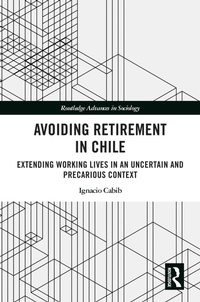
Avoiding Retirement in Chile
Extending Working Lives in an Uncertain and Precarious Context
Published on 29. April 2025
192 pages
978-1-040-35354-7 (ISBN)
Description

Drawing on life-course, gender, and welfare regime theories and relying on primary longitudinal qualitative data (life- story interviews with 90 older workers) and primary longitudinal quantitative data (life-course calendar surveys among 802 older individuals), Avoiding Retirement in Chile critically examines the generalizability of traditional age norms involving the transition to retirement within a persistently uncertain and precarious setting.
Grounded in systematic empirical evidence, this study allows us to reflect on the fact that a definitive and permanent exit from any form of economic activity is increasingly viewed as a fictional scenario by most older individuals. This arises not only from highly precarious social conditions but also from a complex process involving individual agency, wherein the status of being 'retired' is progressively less voluntarily anticipated.
As such, it is of significant interest to a broad spectrum of undergraduate and graduate students, as well as scholars across various disciplines, including social sciences, economics, humanities, gerontology, public health, and social epidemiology. Additionally, the book targets policymakers and decision-makers engaged in topics such as aging, the labor market, pension systems, social and health inequality, and life-course determinants of disparities in old age.
Grounded in systematic empirical evidence, this study allows us to reflect on the fact that a definitive and permanent exit from any form of economic activity is increasingly viewed as a fictional scenario by most older individuals. This arises not only from highly precarious social conditions but also from a complex process involving individual agency, wherein the status of being 'retired' is progressively less voluntarily anticipated.
As such, it is of significant interest to a broad spectrum of undergraduate and graduate students, as well as scholars across various disciplines, including social sciences, economics, humanities, gerontology, public health, and social epidemiology. Additionally, the book targets policymakers and decision-makers engaged in topics such as aging, the labor market, pension systems, social and health inequality, and life-course determinants of disparities in old age.
Reviews / Votes
"As people live longer and populations age around the world, the norms surrounding retirement are shifting dramatically. In this groundbreaking book, Cabib explores the complexities of retirement transitions in Chile, a Latin American country with growing labor force participation in older age and a weak pension system. Drawing on life-course, gender, and welfare regime theories, Avoiding Retirement reveals that permanent and predictable retirement is becoming increasingly unexpected and unaffordable for older men and women. Against the backdrop of rapid population aging and widespread economic insecurity across Latin America, this book offers novel insights into evolving patterns of work in later life and provides timely policy recommendations relevant to Latin America and beyond."Florencia Torche, PhD. Edwards S. Sanford Professor of Sociology and International Affairs, Princeton University, US
"Ignacio Cabib masterfully combines quantitative and qualitative data analysis to bring to life the circumstances, worries and hopes of older adults in Chile as they approach, and increasingly avoid retirement. It is a colorful and vivid portray of Chilean society, one of the most unequal and liberal countries in the world with important insights far beyond the Chilean case as inequality, population aging and labor market de-regulation is rising around the Globe. This book is a must read for anyone interested in public policies, retirement, social inequality and aging societies."
Anette Fasang, PhD. Professor of Sociology and Director of the Department of Social Sciences, Humboldt University of Berlin, Germany.
"Avoiding Retirement in Chile is a significant contribution and a necessary reference, at a pivotal and timely moment for academia, policymakers, and social actors. It offers conjectures, discussion, evidence, and clear and challenging insights based on the experience of a country like Chile, which has progressed to high-income status but lacks the welfare state necessary to address the dilemmas of aging and the policies needed to support transitions throughout the life course."
Fabio Bertranou, PhD. Director of the Decent Work Team and the Country Office for the South Cone of Latin America, International Labour Organization (ILO).
"I am confident that this book will captivate scholars in Sociology, Organizational Psychology, Social Gerontology, and Political Economy. It delves into a dynamic realm of inquiry, rendered particularly salient by the augmented prevalence of older workers within a multitude of nations spanning both the Global North and South. With this work, Ignacio Cabib solidifies his reputation as a leading international scholar and sets the stage for exciting new discoveries in the field."
Mo Wang, PhD. Editor-in-Chief of the journal Work, Aging & Retirement, and University Distinguished Professor and Lanzillotti-McKethan Eminent Scholar Chair, University of Florida, US
"Avoiding Retirement in Chile offers a thoughtful and detailed analysis of the life course factors influencing extended working lives among men and women, in a setting where retirement is increasingly perceived as a non-normative transition in old age. Based on a mix of primary quantitative and qualitative data, this book makes a significant and original contribution to international life course scholarship, particularly in the study of emerging aging dynamics."
Dario Spini, PhD. Professor of Psychology, Universite de Lausanne, Switzerland. Director (2010-2022) of the NCCR LIVES Research Center "Overcoming Vulnerability: A Life-Course Perspective"
More details
Series
Language
English
Place of publication
London
United Kingdom
Publishing group
Taylor & Francis Ltd
Target group
College/higher education
Illustrations
3 Tables, black and white; 26 Line drawings, black and white; 26 Illustrations, black and white
File size
2,14 MB
ISBN-13
978-1-040-35354-7 (9781040353547)
Copyright in bibliographic data and cover images is held by Nielsen Book Services Limited or by the publishers or by their respective licensors: all rights reserved.
Schweitzer Classification
Other editions
Additional editions
Ignacio Cabib
Avoiding Retirement in Chile
Extending Working Lives in an Uncertain and Precarious Context
Book
approx. 07/2026
1st Edition
Routledge
€57.50
Not yet published
Ignacio Cabib
Avoiding Retirement in Chile
Extending Working Lives in an Uncertain and Precarious Context
Book
04/2025
1st Edition
Routledge
€206.00
Shipment within 10-20 days

Ignacio Cabib
Avoiding Retirement in Chile
Extending Working Lives in an Uncertain and Precarious Context
Book
04/2025
Routledge
Unfortunately, price unknown
Available (delivery time upon request)
Person
Ignacio Cabib is Interdisciplinary Associate Professor of Sociology and Public Health at Pontificia Universidad Catolica de Chile, Chile. His main academic interests are the life-course approach, health and social inequalities in old age, cross-national studies, extended working lives, and research methods. Thanks to the support of national and international networks, over the past 15 years he has conducted an agenda that aims to understand how employment, family, and health disadvantages and advantages over the life-course impact multiple later-life inequalities across countries with different welfare regime orientations.
Content
Introduction
1. Extended Working Lives: A Growing Phenomenon in Current Aging Populations
2. Research Objectives, Data and Methods
3. Adulthood Trajectories Across Different Life Domains and Diversity of Labor Force Statuses in Old Age
4. Changing Perceptions on Definitive Labor Market Exit
5. Perceptions of Retirement and Caregiving, Training, and Health Biographies
6. Retirement Perceptions in a Liberal Institutional Regime
7. Extensive Precarity and Uncertainty Tolerance Redefining the Retirement Transition
8. Policy Innovations for Extended Working Lives in Uncertain and Precarious Contexts
1. Extended Working Lives: A Growing Phenomenon in Current Aging Populations
2. Research Objectives, Data and Methods
3. Adulthood Trajectories Across Different Life Domains and Diversity of Labor Force Statuses in Old Age
4. Changing Perceptions on Definitive Labor Market Exit
5. Perceptions of Retirement and Caregiving, Training, and Health Biographies
6. Retirement Perceptions in a Liberal Institutional Regime
7. Extensive Precarity and Uncertainty Tolerance Redefining the Retirement Transition
8. Policy Innovations for Extended Working Lives in Uncertain and Precarious Contexts
