

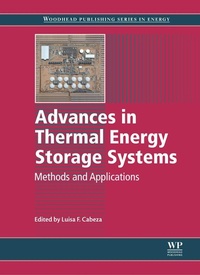
Advances in Thermal Energy Storage Systems
Methods and Applications
Published on 31. October 2014
612 pages
978-1-78242-096-5 (ISBN)
Description

Thermal energy storage (TES) technologies store thermal energy (both heat and cold) for later use as required, rather than at the time of production. They are therefore important counterparts to various intermittent renewable energy generation methods and also provide a way of valorising waste process heat and reducing the energy demand of buildings. This book provides an authoritative overview of this key area. Part one reviews sensible heat storage technologies. Part two covers latent and thermochemical heat storage respectively. The final section addresses applications in heating and energy systems.
- Reviews sensible heat storage technologies, including the use of water, molten salts, concrete and boreholes
- Describes latent heat storage systems and thermochemical heat storage
- Includes information on the monitoring and control of thermal energy storage systems, and considers their applications in residential buildings, power plants and industry
More details
Other editions
Additional editions
Book
10/2014
Woodhead Publishing Ltd
€290.17
Article exhausted; check for reprint
Content
- List of contributors
- Woodhead Publishing Series in Energy
- Preface
- 1: Introduction to thermal energy storage (TES) systems
- Abstract
- 1.1 Introduction
- 1.2 Basic thermodynamics of energy storage
- 1.3 Overview of system types
- 1.4 Environmental impact and energy savings produced
- 1.5 Conclusions
- Acknowledgements
- Part One: Sensible heat storage systems
- 2: Using water for heat storage in thermal energy storage (TES) systems
- Abstract
- 2.1 Introduction
- 2.2 Principles of sensible heat storage systems involving water
- 2.3 Advances in the use of water for heat storage
- 2.4 Future trends
- 3: Using molten salts and other liquid sensible storage media in thermal energy storage (TES) systems
- Abstract
- 3.1 Introduction
- 3.2 Principles of heat storage systems using molten salts and other liquid sensible storage media
- 3.3 Advances in molten salt storage
- 3.4 Advances in other liquid sensible storage media
- 3.5 Future trends
- Acknowledgements
- 4: Using concrete and other solid storage media in thermal energy storage (TES) systems
- Abstract
- 4.1 Introduction
- 4.2 Principles of heat storage in solid media
- 4.3 State-of-the-art regenerator-type storage
- 4.4 Advances in the use of solid storage media for heat storage
- 5: The use of aquifers as thermal energy storage (TES) systems
- Abstract
- 5.1 Introduction
- 5.2 Thermal sources
- 5.3 Aquifier thermal energy storage (ATES)
- 5.4 Thermal and geophysical aspects
- 5.5 ATES design
- 5.6 ATES cooling only case study: Richard Stockton College of New Jersey
- 5.7 ATES district heating and cooling with heat pumps case study: Eindhoven University of Technology
- 5.8 ATES heating and cooling with de-icing case study: ATES plant at Stockholm Arlanda Airport
- 5.9 Conclusion
- Acknowledgements
- 6: The use of borehole thermal energy storage (BTES) systems
- Abstract
- 6.1 Introduction
- 6.2 System integration of borehole thermal energy storage (BTES)
- 6.3 Investigation and design of BTES construction sites
- 6.4 Construction of borehole heat exchangers (BHEs) and BTES
- 6.5 Examples of BTES
- 6.6 Conclusion and future trends
- 7: Analysis, modeling and simulation of underground thermal energy storage (UTES) systems
- Abstract
- 7.1 Introduction
- 7.2 Aquifer thermal energy storage (ATES) system
- 7.3 Borehole thermal energy storage (BTES) system
- 7.4 FEFLOW as a tool for simulating underground thermal energy storage (UTES)
- 7.5 Applications
- Appendix: Nomenclature
- Part Two: Latent heat storage systems
- 8: Using ice and snow in thermal energy storage systems
- Abstract
- 8.1 Introduction
- 8.2 Principles of thermal energy storage systems using snow and ice
- 8.3 Design and implementation of thermal energy storage using snow
- 8.4 Full-scale applications
- 8.5 Future trends
- 9: Using solid-liquid phase change materials (PCMs) in thermal energy storage systems
- Abstract
- 9.1 Introduction
- 9.2 Principles of solid-liquid phase change materials (PCMs)
- 9.3 Shortcomings of PCMs in thermal energy storage systems
- 9.4 Methods to determine the latent heat capacity of PCMs
- 9.5 Methods to determine other physical and technical properties of PCMs
- 9.6 Comparison of physical and technical properties of key PCMs
- 9.7 Future trends
- 10: Microencapsulation of phase change materials (PCMs) for thermal energy storage systems
- Abstract
- 10.1 Introduction
- 10.2 Microencapsulation of phase change materials (PCMs)
- 10.3 Shape-stabilized PCMs
- 11: Design of latent heat storage systems using phase change materials (PCMs)
- Abstract
- 11.1 Introduction
- 11.2 Requirements and considerations for the design
- 11.3 Design methodologies
- 11.4 Applications of latent heat storage systems incorporating PCMs
- 11.5 Future trends
- 12: Modelling of heat transfer in phase change materials (PCMs) for thermal energy storage systems
- Abstract
- 12.1 Introduction
- 12.2 Inherent physical phenomena in phase change materials (PCMs)
- 12.
