

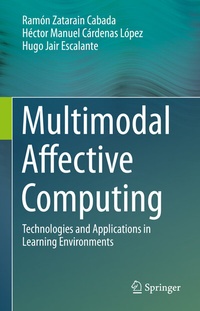
Multimodal Affective Computing
Description

This book explores AI methodologies for the implementation of affective states in intelligent learning environments. Divided into four parts, Multimodal Affective Computing: Technologies and Applications in Learning Environments begins with an overview of Affective Computing and Intelligent Learning Environments, from their fundamentals and essential theoretical support up to their fusion and some successful practical applications. The basic concepts of Affective Computing, Machine Learning, and Pattern Recognition in Affective Computing, and Affective Learning Environments are presented in a comprehensive and easy-to-read manner. In the second part, a review on the emerging field of Sentiment Analysis for Learning Environments is introduced, including a systematic descriptive tour through topics such as building resources for sentiment detection, methods for data representation, designing and testing the classification models, and model integration into a learningsystem. The methodologies corresponding to Multimodal Recognition of Learning-Oriented Emotions are presented in the third part of the book, where topics such as building resources for emotion detection, methods for data representation, multimodal recognition systems, and multimodal emotion recognition in learning environments are presented. The fourth and last part of the book is devoted to a wide application field of the combination of methodologies, such as Automatic Personality Recognition, dealing with issues such as building resources for personality recognition, methods for data representation, personality recognition models, and multimodal personality recognition for affective computing.
This book can be very useful not only for beginners who are interested in affective computing and intelligent learning environments, but also for advanced and experts in the practice and developments of the field. It complies an end-to-end treatment on these subjects, especially with educational applications, making it easy for researchers and students to get on track with fundamentals, established methodologies, conventional evaluation protocols, and the latest progress on these subjects.More details
Other editions
Additional editions
Persons
Héctor Manuel Cárdenas López . Research assistant at the Instituto Tecnológico de Culiacán, Mexico. He is currently working towards a PhD degree in Engineering Sciences with the topic Multimodal Emotion and Personality Recognition. He is a member of the Thematic Network of Applied Computational Intelligence (RedICA). His main research interest includes Multimodal deep learning techniques, human behavior classification for emotion and personality recognition, affective tutoring systems, and cognitive oriented emotions.
Hugo Jair Escalante . Senior researcher scientist INAOE, Mexico and member of the board of directors of ChaLearn USA, Chair officer of the IAPR Technical Committee 12. He is a regular member of the Mexican Academy of Sciences (AMC), the Mexican Academy of Computing (AMEXCOMP) and Mexican System of Researchers Level II (SNI). He was editor of the Springer Series on Challenges in Machine Learning 2017-2023 and is Associate Editor of IEEE Transactions on Affective Computing. He has been involved in the organization of several challenges in machine learning and computer vision collocated with top venues. He has served as competition chair of NeurIPS2020, FG2020 and ICPR2020, NeurIPS2019, PAKDD2019-2018, IJCNN2019. His research interests are on machine learning, challenge organization, and its applications on language and vision.
