

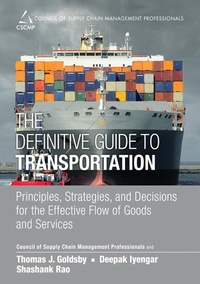
Definitive Guide to Transportation, The
Principles, Strategies, and Decisions for the Effective Flow of Goods and Services
1st Edition
Published on 3. January 2014
264 pages
978-0-13-344911-2 (ISBN)
Description

This is the most authoritative and complete guide to planning, implementing, measuring, and optimizing world-class supply chain transportation processes. Straight from the Council of Supply Chain Management Professionals (CSCMP), it brings together up-to-the-minute principles, strategies, and decisions for cost-efficiently and effectively moving goods between sellers and buyers. CSCMP and Thomas Goldsby introduce crucial concepts including transportation modes, execution, and control; outsourcing, modal and carrier selection, and 3PLs; TMS technologies; ocean shipping, international air, customs, and regulation; and much more. Step by step, The Definitive Guide to Transportation helps you optimize all facets of transportation, one of the highest-cost, highest-impact areas of supply chain management. Coverage includes:
Basic transportation management concepts and their essential roles in demand fulfillment
Key elements, processes, and interactions of transportation operations management
Design principles and strategies for establishing efficient, effective, and sustainable transportation operations
The critical role of technology in managing transportation operations and product flows
Requirements and challenges of planning and moving goods between countries
Best practices for assessing performance using standard metrics and frameworks
Basic transportation management concepts and their essential roles in demand fulfillment
Key elements, processes, and interactions of transportation operations management
Design principles and strategies for establishing efficient, effective, and sustainable transportation operations
The critical role of technology in managing transportation operations and product flows
Requirements and challenges of planning and moving goods between countries
Best practices for assessing performance using standard metrics and frameworks
More details
Series
Edition
1. Auflage
Language
English
Place of publication
NJ
United States
Publishing group
Pearson Education (US)
Target group
College/higher education
File size
14,98 MB
ISBN-13
978-0-13-344911-2 (9780133449112)
Copyright in bibliographic data and cover images is held by Nielsen Book Services Limited or by the publishers or by their respective licensors: all rights reserved.
Schweitzer Classification
Other editions
Additional editions
CSCMP | Thomas Goldsby | Deepak Iyengar
Definitive Guide to Transportation, The
Principles, Strategies, and Decisions for the Effective Flow of Goods and Services
Book
03/2014
Pearson FT Press
€82.31
Article exhausted; check different version
Persons
Dr. Thomas J. Goldsby is Professor of Logistics at The Ohio State University. Dr. Goldsby has published more than 50 articles in academic and professional journals and serves as a frequent speaker at academic conferences, executive education seminars, and professional meetings around the world. He is co-author of Lean Six Sigma Logistics: Strategic Development to Operational Success and Global Macrotrends and Their Impact on Supply Chain Management. He serves as Associate Director of the Center for Operational Excellence, research associate of the Global Supply Chain Forum, and a Research Fellow of the National Center for the Middle Market, all with The Ohio State University. Dr. Goldsby has received recognitions for excellence in teaching and research at Iowa State University, The Ohio State University, and the University of Kentucky. He is co-editor of the Transportation Journal and co-executive editor of Logistics Quarterly magazine. He serves on the boards for the American Society of Transportation & Logistics and Supply Chain Leaders in Action, the Research Strategies Committee of CSCMP, and as a reviewer for the Gartner Top 25 Supply Chains, LQ Sustainability Awards, SCLA Circle of Excellence Award, CSCMP Supply Chain Innovation Award, and University of Kentucky Corporate Sustainability Award programs. He has conducted workshops and seminars throughout North America, South America, Europe, Asia, and Africa.
Dr. Deepak Iyengar received his Ph.D. in the area of Logistics and Supply Chain Management from the University of Maryland, College Park. His areas of research and teaching include logistics and sustainability in supply chains. He is currently an Assistant Professor at Central Washington University, Ellensburg in the Department of Supply Chain Management. Dr. Iyengar has published works in leading supply chain and logistics journals like Journal of Business Logistic, I nternational Journal of Physical Distribution & Logistics Management, and Transportation Journal, to name a few. In addition, he has mentored students and led projects using the methodology of Lean Six Sigma to various 3PLs.
Dr. Shashank Rao is the Jim W. Thompson Assistant Professor of Supply Chain Management at Auburn University. He holds a B.S. in Environmental Engineering, an M.B.A. in Marketing, and a Ph.D. in Operations and Supply Chain Management. Along with his academic training, Dr. Rao has several years of industry experience in the banking and engineering sectors. He has also served as a consultant to manufacturers and retailers on issues like order fulfillment and distribution management. His research interests focus on retailing, order fulfillment, and logistics customer service. He has published several articles in academic and professional journals of repute such as the Journal of Operations Management, Journal of Business Logistics, International Journal of Logistics Management, International Journal of Physical Distribution and Logistics Management, Industrial Management, Industrial Engineer, and more. He also serves on the Editorial Review Board of the Journal of Business Logistics, the Journal of Supply Chain Management, and the Journal of Operations Management, along with serving as an Associate Editor at the Journal of Organizational Computing and Electronic Commerce. He is a frequent speaker at academic conferences, executive education seminars, and professional meetings, and also conducts hands-on training on supply chain technologies like TMS, ERP, and Routing Systems.
The Council of Supply Chain Management Professionals (CSCMP) is the preeminent worldwide professional association dedicated to the advancement and dissemination of research and knowledge on supply chain management. With nearly 10,000 members representing nearly all industry sectors, government, and academia from 67 countries, CSCMP members are the leading practitioners and authorities in the fields of logistics and supply chain management.
Dr. Deepak Iyengar received his Ph.D. in the area of Logistics and Supply Chain Management from the University of Maryland, College Park. His areas of research and teaching include logistics and sustainability in supply chains. He is currently an Assistant Professor at Central Washington University, Ellensburg in the Department of Supply Chain Management. Dr. Iyengar has published works in leading supply chain and logistics journals like Journal of Business Logistic, I nternational Journal of Physical Distribution & Logistics Management, and Transportation Journal, to name a few. In addition, he has mentored students and led projects using the methodology of Lean Six Sigma to various 3PLs.
Dr. Shashank Rao is the Jim W. Thompson Assistant Professor of Supply Chain Management at Auburn University. He holds a B.S. in Environmental Engineering, an M.B.A. in Marketing, and a Ph.D. in Operations and Supply Chain Management. Along with his academic training, Dr. Rao has several years of industry experience in the banking and engineering sectors. He has also served as a consultant to manufacturers and retailers on issues like order fulfillment and distribution management. His research interests focus on retailing, order fulfillment, and logistics customer service. He has published several articles in academic and professional journals of repute such as the Journal of Operations Management, Journal of Business Logistics, International Journal of Logistics Management, International Journal of Physical Distribution and Logistics Management, Industrial Management, Industrial Engineer, and more. He also serves on the Editorial Review Board of the Journal of Business Logistics, the Journal of Supply Chain Management, and the Journal of Operations Management, along with serving as an Associate Editor at the Journal of Organizational Computing and Electronic Commerce. He is a frequent speaker at academic conferences, executive education seminars, and professional meetings, and also conducts hands-on training on supply chain technologies like TMS, ERP, and Routing Systems.
The Council of Supply Chain Management Professionals (CSCMP) is the preeminent worldwide professional association dedicated to the advancement and dissemination of research and knowledge on supply chain management. With nearly 10,000 members representing nearly all industry sectors, government, and academia from 67 countries, CSCMP members are the leading practitioners and authorities in the fields of logistics and supply chain management.
Content
SECTION 1 TRANSPORTATION: THE BASICS 1
Chapter 1 Transportation in Business and the Economy 3
Transportation and Logistics 4
Transportation and the Supply Chain 6
Transportation and the Economy 7
Transportation, Society, and the Environment 10
Summary 12
Endnotes 12
Chapter 2 A Survey of Transportation Modes 15
An Overview of the Modes 15
The Five Modes of Transportation 17
Road Transportation 17
Rail Transportation 25
Water Transportation 31
Air Transportation 36
Pipeline Transportation 37
Intermodal Transportation 38
Summary 44
Endnotes 45
Chapter 3 The Economics of Transportation 47
Accounting Costs and Economic Costs 47
Fixed Costs and Variable Costs 48
Carrier Cost Metrics 50
Carrier Pricing and Costs for Shippers 54
Expressions of Transportation Rates 56
Additional Services and Fees 59
Summary 61
Endnotes 62
Chapter 4 The Transportation Services Market 63
Private Transportation 63
Private Road Fleets 63
Advantages of Private Road Fleets 65
Other (Nonroad) Private Fleets 66
Outsourcing Transportation 67
Contract Carriage (2PLs) 67
Third-Party Logistics Providers (3PLs) 67
Lead Logistics Providers/Integrators (4PLs) 70
Freight Forwarders 71
Difference Between 3PLs and Freight Forwarders 72
Brokers 73
Summary 74
Endnotes 74
SECTION 2 TRANSPORTATION FOR MANAGERS 77
Chapter 5 An Overview of Transportation Management 79
Transportation Management Decision Making 79
Network Design 80
Typology of Transport Networks 81
Optimization 83
Heuristics and Simulations 84
Lane Analysis 85
Mode and Carrier Selection 90
Service Negotiations 94
Shipper-Receiver Negotiations 94
Shipper-Carrier Negotiations 96
Contract Versus Spot Rates 96
Contractual Provisions 97
Service Evaluation 99
Dock- and Movement-Level Decisions 102
Transportation Documentation 103
Documents Common to Domestic and International Transportation 104
Documents Exclusive to International Transportation 106
Summary 108
Endnotes 109
Chapter 6 Transportation Technologies 111
Understanding the Need for Technology: The Bullwhip Effect 113
Technology Architecture 115
Hosted Systems/Hosted Software 115
Software as a Service (SaaS) 115
Electronic Data Interchange (EDI) 116
What Is EDI? 116
Benefits and Applications of EDI 118
EDI Implementation 118
Transportation Management System (TMS) 119
Benefits and Applications of TMS 120
TMS Implementation 124
Routing and Scheduling (R&S) Systems 125
What Are R&S Systems? 125
Benefits and Applications of R&S Systems 126
R&S System Implementation 128
Automatic Identification 129
What Is Automatic Identification? 129
Bar Codes 129
The Serial Shipping Container Code (SSCC): A Special Tool in Transportation Management 130
Radio Frequency Identification (RFID) 133
Control and Monitoring Systems 136
What Are Control and Monitoring Systems? 136
Location Monitoring Systems 136
Temperature Control and Monitoring Systems 138
Summary 140
Endnote 141
For Further Reading 141
Chapter 7 Transportation's Role in Logistics and Supply Chain Strategy 143
Lean Logistics 143
Shared Transportation Resources 146
Merge-in-Transit (MIT) 147
Vendor-Managed Inventory (VMI) 149
Collaborative Planning, Forecasting, and Replenishment (CPFR) 150
Collaborative Transportation Management (CTM) 151
Summary 154
Endnotes 155
Chapter 8 Transportation and Global Supply Chains 157
Need for Global Supply Chains 160
International Modes of Transportation 161
International Ocean Transportation 162
International Air Transportation 168
Intermodal Transportation 174
Enablers and Key Players in Transporting Goods to Global Supply Chains 179
Incoterms 180
Key Documents Used in Enabling Transportation for Global Supply Chains 185
Summary 187
Endnotes 188
Chapter 9 Transportation and Sustainability 189
Transportation's Role in Sustainable Supply Chain Management 190
The Need for Sustainability in Transportation 191
Triple Bottom Line (TBL) 197
Potential Solutions to Make Transportation More Sustainable 199
Summary 202
Endnotes 203
SECTION 3 TRANSPORTATION IN 2013 AND BEYOND 205
Chapter 10 The Future of Transportation 207
Changes Affecting Consumer Shopping Behavior 209
Internet Retailing (IR) 209
Additive Manufacturing/3D Printing 210
Changes in Technology 213
Self-Driven Vehicles 213
Intelligent Transport System (ITS) 216
Geopolitical, Legislative, and Societal Changes 217
Rising and Erratic Fuel Prices 217
Global Warming and Greenhouse Gases 219
The Need for Infrastructure to Support Growing Populations 219
Increasing Demands for Security and Safety in Transportation 221
Summary 222
Endnotes 223
For Further Reading 223
Index 225
The most authoritative, up-to-the-minute guide to planning, running, measuring, and improving supply chain processes and operations related to transportation
Chapter 1 Transportation in Business and the Economy 3
Transportation and Logistics 4
Transportation and the Supply Chain 6
Transportation and the Economy 7
Transportation, Society, and the Environment 10
Summary 12
Endnotes 12
Chapter 2 A Survey of Transportation Modes 15
An Overview of the Modes 15
The Five Modes of Transportation 17
Road Transportation 17
Rail Transportation 25
Water Transportation 31
Air Transportation 36
Pipeline Transportation 37
Intermodal Transportation 38
Summary 44
Endnotes 45
Chapter 3 The Economics of Transportation 47
Accounting Costs and Economic Costs 47
Fixed Costs and Variable Costs 48
Carrier Cost Metrics 50
Carrier Pricing and Costs for Shippers 54
Expressions of Transportation Rates 56
Additional Services and Fees 59
Summary 61
Endnotes 62
Chapter 4 The Transportation Services Market 63
Private Transportation 63
Private Road Fleets 63
Advantages of Private Road Fleets 65
Other (Nonroad) Private Fleets 66
Outsourcing Transportation 67
Contract Carriage (2PLs) 67
Third-Party Logistics Providers (3PLs) 67
Lead Logistics Providers/Integrators (4PLs) 70
Freight Forwarders 71
Difference Between 3PLs and Freight Forwarders 72
Brokers 73
Summary 74
Endnotes 74
SECTION 2 TRANSPORTATION FOR MANAGERS 77
Chapter 5 An Overview of Transportation Management 79
Transportation Management Decision Making 79
Network Design 80
Typology of Transport Networks 81
Optimization 83
Heuristics and Simulations 84
Lane Analysis 85
Mode and Carrier Selection 90
Service Negotiations 94
Shipper-Receiver Negotiations 94
Shipper-Carrier Negotiations 96
Contract Versus Spot Rates 96
Contractual Provisions 97
Service Evaluation 99
Dock- and Movement-Level Decisions 102
Transportation Documentation 103
Documents Common to Domestic and International Transportation 104
Documents Exclusive to International Transportation 106
Summary 108
Endnotes 109
Chapter 6 Transportation Technologies 111
Understanding the Need for Technology: The Bullwhip Effect 113
Technology Architecture 115
Hosted Systems/Hosted Software 115
Software as a Service (SaaS) 115
Electronic Data Interchange (EDI) 116
What Is EDI? 116
Benefits and Applications of EDI 118
EDI Implementation 118
Transportation Management System (TMS) 119
Benefits and Applications of TMS 120
TMS Implementation 124
Routing and Scheduling (R&S) Systems 125
What Are R&S Systems? 125
Benefits and Applications of R&S Systems 126
R&S System Implementation 128
Automatic Identification 129
What Is Automatic Identification? 129
Bar Codes 129
The Serial Shipping Container Code (SSCC): A Special Tool in Transportation Management 130
Radio Frequency Identification (RFID) 133
Control and Monitoring Systems 136
What Are Control and Monitoring Systems? 136
Location Monitoring Systems 136
Temperature Control and Monitoring Systems 138
Summary 140
Endnote 141
For Further Reading 141
Chapter 7 Transportation's Role in Logistics and Supply Chain Strategy 143
Lean Logistics 143
Shared Transportation Resources 146
Merge-in-Transit (MIT) 147
Vendor-Managed Inventory (VMI) 149
Collaborative Planning, Forecasting, and Replenishment (CPFR) 150
Collaborative Transportation Management (CTM) 151
Summary 154
Endnotes 155
Chapter 8 Transportation and Global Supply Chains 157
Need for Global Supply Chains 160
International Modes of Transportation 161
International Ocean Transportation 162
International Air Transportation 168
Intermodal Transportation 174
Enablers and Key Players in Transporting Goods to Global Supply Chains 179
Incoterms 180
Key Documents Used in Enabling Transportation for Global Supply Chains 185
Summary 187
Endnotes 188
Chapter 9 Transportation and Sustainability 189
Transportation's Role in Sustainable Supply Chain Management 190
The Need for Sustainability in Transportation 191
Triple Bottom Line (TBL) 197
Potential Solutions to Make Transportation More Sustainable 199
Summary 202
Endnotes 203
SECTION 3 TRANSPORTATION IN 2013 AND BEYOND 205
Chapter 10 The Future of Transportation 207
Changes Affecting Consumer Shopping Behavior 209
Internet Retailing (IR) 209
Additive Manufacturing/3D Printing 210
Changes in Technology 213
Self-Driven Vehicles 213
Intelligent Transport System (ITS) 216
Geopolitical, Legislative, and Societal Changes 217
Rising and Erratic Fuel Prices 217
Global Warming and Greenhouse Gases 219
The Need for Infrastructure to Support Growing Populations 219
Increasing Demands for Security and Safety in Transportation 221
Summary 222
Endnotes 223
For Further Reading 223
Index 225
The most authoritative, up-to-the-minute guide to planning, running, measuring, and improving supply chain processes and operations related to transportation
