

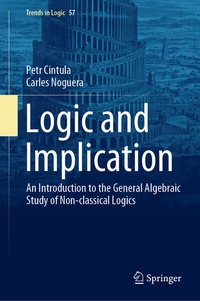
Logic and Implication
Description

This monograph presents a general theory of weakly implicative logics, a family covering a vast number of non-classical logics studied in the literature, concentrating mainly on the abstract study of the relationship between logics and their algebraic semantics. It can also serve as an introduction to (abstract) algebraic logic, both propositional and first-order, with special attention paid to the role of implication, lattice and residuated connectives, and generalized disjunctions.
Based on their recent work, the authors develop a powerful uniform framework for the study of non-classical logics. In a self-contained and didactic style, starting from very elementary notions, they build a general theory with a substantial number of abstract results. The theory is then applied to obtain numerous results for prominent families of logics and their algebraic counterparts, in particular for superintuitionistic, modal, substructural, fuzzy, and relevant logics.
The bookmay be of interest to a wide audience, especially students and scholars in the fields of mathematics, philosophy, computer science, or related areas, looking for an introduction to a general theory of non-classical logics and their algebraic semantics.
More details
Other editions
Additional editions
Persons
Petr Cintula is a senior researcher at the Institute of Computer Science of the Czech Academy of Sciences. He is co-author of over 60 publications mainly on mathematical fuzzy logic and abstract algebraic logic. Furthermore, he has co-edited the three volumes of Handbook of Mathematical Fuzzy Logic and has been principal (co-)investigator of numerous research projects.
Carles Noguera is a senior researcher at the Institute of Information Theory and Automation of the Czech Academy of Sciences, where he has led several research projects on topics of mathematical fuzzy logic, many-valued logics, and abstract algebraic logic. He obtained his degrees in Mathematics and Philosophy and a PhD in Logic at the University of Barcelona.
Content
