

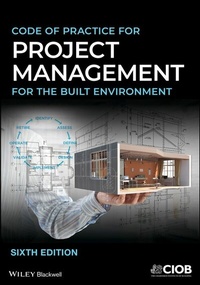
Code of Practice for Project Management for the Built Environment
Description

The newly revised sixth edition of the Code of Practice for Project Management for the Built Environment, prepared by the Chartered Institute of Building, is an up-to-date and comprehensive reference covering the principles and practice of project management in construction and development. This latest edition covers the new technologies, internationalisation, changing legislation, and productivity and profitability challenges faced by contractors which all combine to drive significant change in the industry.
The book demonstrates the application of systematic documentation and quality control to complex construction projects and offers guidance and tools that link key principles to practical project management. It is worldwide in scope and widely recognised as the industry standard on the subject.
With fresh discussions of quality assurance, global codes and standards, time management, joint ventures, contract compliance, supply chain integration, design digitisation, and much more, the Code of Practice for Project Management for the Built Environment also includes:
* A thorough introduction to project inception, feasibility analysis, strategy, and the pre-construction process
* Comprehensive explorations of the construction stage of projects, as well as testing and commissioning, and project completion, handover, and operation
* Practical discussions of post-completion review
* A glossary and index of essential terms in construction project management
Perfect for project management professionals in construction contracting and client organisations, Code of Practice for Project Management for the Built Environment will also earn a place in the libraries of undergraduate and postgraduate students of project management and construction-related subjects.
The Chartered Institute of Building is the world's largest professional body for construction management and leadership. It has a Royal Charter to promote the science and practice of building and construction for the benefit of society. Members across the world work in the development, conservation, and improvement of the built environment.
More details
Other editions
Additional editions
Person
The Chartered Institute of Building is the world's largest professional body for construction management and leadership. It has a Royal Charter to promote the science and practice of building and construction for the benefit of society. Members across the world work in the development, conservation, and improvement of the built environment.
Content
Foreword
Acknowledgements
Working group for the revision of the Code of Practice
List of Figures and Tables
Chapter 0 Introduction
Purpose
Core concepts
Environmental mandates (including social value and carbon net zero aspirations)
Strategic drivers
Guiding principles
Themes
Structure of the Code of Practice
Application to practice
GUIDANCE NOTES in the Appendix to the Code of Practice
In summary
Chapter 1 Identify: needs and benefits
Purpose
Activities
Decisions
Chapter 2 Assess: options and feasibility
Purpose
Activities
Decisions
Chapter 3 Define: delivery approach and procurement strategy
Purpose
Activities
Decisions
Chapter 4 Design: specifications and functionality
Purpose
Activities
Decisions
Chapter 5 Implement: manufacture and construction
Purpose
Activities
Decisions
Validate: integrate and handover
Purpose
Activities
Decisions
Chapter 7 Operate: use and maintain
Purpose
Activities
Decisions
Chapter 8 Retire: repurpose or demolish
Purpose
Activities
Decisions
Guidance note 1
Funding mechanisms
Guidance note 2
Risk appetite and delegated limits of authority
Guidance note 3
Assurance and the three lines model
Guidance note 4
Design of the project organisation
Guidance note 5
Consenting considerations
Guidance note 6
Stakeholder analysis and mapping
Guidance note 7
Benefit mapping
Guidance note 8
Benefit measurement and realisation
Guidance note 9
Soft landings framework
Guidance Note 10
Information Management using BS EN ISO 19650 series of standards
Guidance note 11
Project Mandate indicative contents
Guidance note 12
Investment appraisal
Guidance note 13
Business case
Guidance note 14
Estimating
Guidance note 15
Materials selection
Guidance note 16
Options analysis and decision-making process
Guidance note 17
Design in early lifecycle
Guidance note 18
Site Selection and Acquisition
Guidance note 19
Site investigations
Guidance note 20
Project Brief indicative contents
Guidance note 21
Delivery Model Assessments
Guidance note 22
Choice of project management approach/method
Guidance note 23
Impact of Design for Manufacturing and Assembly (DfMA) on delivery approach
Guidance note 24
Forms of contract
Guidance note 25
Behavioural procurement
Guidance note 26
Tender procedures
Guidance note 27
Dispute Resolution
Guidance note 28
Project Execution Plan indicative content
Guidance note 29
Scope and quality planning and management
Guidance note 30
Time planning and management
Guidance note 31
Resource planning and management
Guidance note 32
Cost and budget planning and management
Guidance note 33
Risk identification
Guidance note 34
Risk analysis and evaluation
Guidance note 35
Quantitative risk analysis and evaluation
Guidance note 36
Contingency planning and management
Guidance note 37
Progress monitoring, measuring and reporting
Guidance note 38
Risk treatment
Guidance Note 39
Issue resolution and problem solving
Guidance note 40
Health and Safety Plan
Guidance note 41
Preparation for stage gate reviews
Guidance note 42
Change control
Guidance note 43
Stakeholder engagement and communication
Guidance note 44
Overview of the UK Health and Safety at Work etc Act, 1974 (HSWA 1974)
Guidance note 45
Overview of the UK Construction (Design and Management) Regulations 2015 (CDM 2015)
Guidance note 46
Overview of the UK Dangerous Substances and Explosive Atmospheres Regulations, 2002 (DSEAR, 2002)
Guidance note 47
Overview of the UK Housing Acts
Guidance note 48
Overview of the UK Town and Country Planning Act 1990
Guidance note 49
Implications of the Housing Grants, Construction and Regeneration Act 1996, Amended 2011.
Guidance note 50
Overview of the Building Safety Bill (2021) and the UK Fire Safety Act (2021)
Guidance note 51
Design management fundamentals
Guidance note 52
Detailed design
Guidance note 53
Off-site/on-site considerations
Guidance note 54
Operations and maintenance (O&M) manual indicative content
Guidance note 55
Client handover checklist: indicative content
Guidance note 56
Client commissioning checklist - building services example
Guidance Note 57
Post occupancy evaluation of buildings
Guidance Note 58
Monitoring obsolescence
Glossary
Past working groups of Code of Practice for Project Management
Index
0
Introduction
Purpose
The purpose of this sixth edition of the Code of Practice for Project Management for the Built Environment is to bring together:
- best practice associated with the management of projects in the built environment, with
- the strategic imperatives of the sector to drive a 'step change' in performance in terms of health, safety, well-being, sustainability, quality, productivity and value and
- to assist users with guidance and advice related to efficient and effective project management.
The construction industry is advancing and accelerating as we incorporate improvements into our built environment focusing on the whole life cycle of an asset, including the implications of climate change. It is therefore imperative to continually monitor and validate key changes in UK Government policies and corporate strategies and that the CIOB Code of Practice is used to improve our construction operational capability.
The vision of the Chartered Institute of Building (CIOB) is to lead and inspire excellence in the built environment, focused on the CIOB Royal Charter. It is important to follow the national and internationally agreed standards, i.e. BREEAM, LEED, GreenStar etc. This will help reduce consumer demand for heavily polluting goods and services, the aim being to promote cleaner energy and transport systems with non-fossil fuels producing at least 60% of the required energy output by 2050 in order to achieve the required drastic reductions of carbon emissions. It could also be suggested that user/client/organisational behaviour/expectations need to change significantly to achieve this. This edition of the Code of Practice consolidates latest thinking on the part project management plays in achieving the vision, considering the whole life of assets. It provides a guide for practitioners at all stages of their professional development and career.
Core concepts
There are many different definitions in existence for the core concepts and ideas used throughout this Code of Practice, including what is meant by the 'built environment', what is a 'project' and what is meant by the term 'life cycle'. A description of core concepts is provided as follows:
Built environment
The term 'built environment' relates to man-made assets and infrastructure, regardless of client type, funding, size, scale or complexity. Built assets and infrastructure exist in transportation (road, rail, airports, maritime ports), power and utilities (nuclear, oil and gas, tidal lagoons, offshore wind, solar, water, electricity, telecommunications), natural defences (flood defences, dams), as well as buildings (homes, hospitals, schools, factories, warehouses, offices, hotels) and the parks, plazas and other spaces that create the environment in which people interact. All sectors continue to advance at a pace, a full and separate awareness of progress and improvements is imperative for an efficient and effective project manager.
Project
The term 'project' describes the multiple ways over the entire life cycle of a built environment asset, in which clients organise the work to create, repurpose and eventually retire built assets in order to achieve objectives and realise the desired value for end users, clients and funding bodies. Projects are delivered by temporary organisations: teams of people, from multiple organisations, working collaboratively in a structured way:
- to achieve defined objectives and quality standards
- in a context of competing time and cost constraints
- navigating significant uncertainty and risk
- to operate in an environmentally friendly manner
- to provide feedback and learn lessons
- to evaluate the performance of the project stakeholders
Life cycle
The term 'life cycle' refers to the key stages of the whole life of a built asset and the objectives and decisions associated with each stage. The Code of Practice is structured around eight life cycle stages that address the work necessary to identify, assess, define, design, implement, validate, operate and retire assets. The scope of some projects will address only parts of the asset life cycle, but the client nevertheless has the responsibility to decide how to organise the work across the whole life cycle, including the governance required to decide to move from one life cycle stage to the next. The life cycle is best considered as a closed loop as shown in Figure 0.1 with a final decision-point culminating at the end of life of an asset whether to (1) extend life by continuing to use and maintain to the original design or to (2) retire the original design and repurpose all or parts of the asset. The latter scenario would trigger a new project. It is important to map out what stages of the life cycle apply to your projects in the identification phase of your scheme. If relevant actions and project data are applied to each stage and continually monitored via updated programmes and plans, it will be possible to manage each element of the life cycle before moving onto the next stage. It is recommended that a validated and logic linked plan with a critical path is developed as early as possible in the project life cycle.
Figure 0.1 Project life cycle.
Different parts of the sector use different terminology for the life cycle stages as shown in Table 0.1. Some focus on the whole life of the asset, others on a more limited set of stages reflecting a particular technical discipline or specialist viewpoint. The rationale for the life cycle stages chosen is to reflect the broadest application of project management in the built environment and to focus the stage titles on the work undertaken in each stage.
It is important in the current climate to include an awareness of the sustainability life cycle. The below Table 0.2 highlights the stages and activities that should be considered in addition to the project life cycle stages described in the table above.
Sustainability overview
Sustainability and sustainable development have advanced greatly since the fifth edition of the Code of Practice. Climate science has improved the understanding of how the planet has reacted negatively to industrial practices and unsustainable consumerism.
Sustainability encompasses the three core elements, namely economic, social and environmental. It is relevant that a project manager in the built environment appreciates these issues, familiarises themselves with innovative and more environmentally friendly ways of working and, where relevant, recommends or appoints the necessary expertise to ensure that the correct sustainability criteria and governance is embedded in projects and programmes of work.
The CIOB will be producing a separate document to complement the sixth edition of the Code of Practice for Project Management that specialises in climate and environmental risk matters.
As a minimum, the sustainability expert should be able to inform and advise from a sustainability perspective on the following criteria:
- Understanding the project's core and supporting processes (and sub-processes)
- Understanding and communicating the benefits of a sustainable supply chain
- Identifying the primary and secondary supply chain stakeholders
- Undertaking a stakeholder analysis and establishing who has the greatest impact on the sustainable supply chain (using techniques such as Pareto analysis)
- Knowing where products are coming from and controlling product/component variety
- Benchmarking performance using science-based targets
- Treating a sustainable supply chain as a systemic risk to the project
- Creating a communication system to capture lessons learned and to facilitate the exchange of best practice
- Recommend and advise in the use of clean technology energy in the construction life cycle
Table 0.1 Comparison of project life cycle stages
Sixth Edition of CIOB Code of Practice for Project Management for the Built Environment Royal Institute of British Architects (RIBA) Plan of Work 2020 ISO 55000:2014 Asset management - Overview, principles and terminology BS 6079:2019 Project management. Principles and guidance for the management of projects Fifth Edition of CIOB Code of Practice for Project Management for the Built Environment (reference only)- Identify: needs and benefits. What are the needs and benefits for your specific project?
- Strategic definition
- Preparation and brief
- Assess: options and feasibility (for the project(s))
- Concept design
- Define: approach and procurement strategy, logic linked to a defined programme
- Design: specifications and functionality ensuring a coordinated design
- Spatial...
