

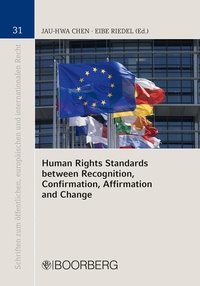
Human Rights Standards between Recognition, Confirmation, Affirmation and Change
1st Edition
Published on 23. March 2026
240 pages
978-3-415-07859-8 (ISBN)
Description

Focus on Human Rights
In this book Professors Jau-hwa Chen of Soochow University, Taipei, and Eibe Riedel of the University of Mannheim present 10 contributions from a joint human rights project. The problems faced by marginalized and disadvantaged individuals and groups are examined, with an emphasis on everyday life experiences. Persistent human rights violations are scoped, such as those relating to LGBTIQ+ issues, women's sexual and reproductive health, and the social exclusion and marginalization of Indigenous tribes in Taiwan. Other contributions address forced evictions and housing rights, unresolved transitional justice issues, as well as constitutional court jurisprudence in Taiwan.
Finally, as a warning, the book portrays negative developments in Hungary, where a shift away from parliamentary democratic representation toward increasingly authoritarian rule can be observed, and examines how opposition action outside Parliament may nevertheless succeed despite state interventions.
Menschenrechte im Fokus
In diesem englischsprachigen Buch präsentieren die Professoren Jau-hwa Chen von der Soochow University, Taipeh, und Eibe Riedel von der Universität Mannheim zehn Beiträge aus einem gemeinsamen Menschenrechtsprojekt. Die Probleme, mit denen marginalisierte und benachteiligte Individuen und Gruppen konfrontiert sind, werden unter besonderer Berücksichtigung ihrer Alltagserfahrungen untersucht. Auch anhaltende Menschenrechtsverletzungen werden analysiert, beispielsweise im Zusammenhang mit LGBTIQ+-Themen, der sexuellen und reproduktiven Gesundheit von Frauen sowie der sozialen Ausgrenzung und Marginalisierung indigener Stämme in Taiwan.
Weitere Beiträge behandeln Zwangsräumungen und Wohnrechte, ungelöste Fragen der Übergangsjustiz sowie die Rechtsprechung der Verfassungsgerichte in Taiwan. Abschließend stellt das Buch als Warnung negative Entwicklungen in Ungarn dar, wo eine Abkehr von parlamentarischer demokratischer Vertretung hin zu zunehmend autoritärer Herrschaft zu beobachten ist, und untersucht, wie Oppositionsaktionen außerhalb des Parlaments trotz staatlicher Eingriffe dennoch erfolgreich sein können.
More details
Other editions
Additional editions
Jau-hwa Chen | Eibe Riedel
Human Rights Standards between Recognition, Confirmation, Affirmation and Change
Book
03/2026
Boorberg
€45.00
Available immediately
Persons
Content
- Cover
- Titel
- Imprint
- Table of content
- ACKNOWLEDGEMENTS
- Introduction
- A. Contemporary Challenges on Human Rights and Global Justice
- I. Gender Matters: Personal is Political
- 1. In the Irish Senate
- 2. Cases in Court
- 3. Participation in Public Life
- II. Human Rights Protection
- 1. 1997 Reform Package of Kofi Annan: The Holistic Nature of Human Rights
- 2. Embedding Human Rights Within Local Culture
- 3. The Global Compact on Business and Human Rights
- III. Global Justice and Local Context
- 1. Global Warming: Climate Justice Approach
- 2. Geopolitical Segregation: Challenges to the Values of Human Rights
- 3. Domination of Social Media
- IV. Concluding Remarks
- B. Witnessing an Era of the Gender Equality in Taiwan
- I. Introduction
- II. The evolution of the women's movement in Taiwan: Awakening of women's awareness
- III. Revision of laws from the private to the public sphere
- IV. Peng Wanru's Case: Transforming women's movement to national system
- V. Signing CEDAW to align with international standards
- VI. The long road to the same sex marriage
- VII. Current challenges
- C. Dignity, Non-discrimination, and Rights of LGBTIQ+ - Challenges of Same-Sex Family Relations
- I. International Approaches to Human Dignity, Non-Discrimination and LGBTIQ+ Rights
- 1. The Historical Setting of LGBTIQ+ Rights
- 2. Sexual Orientation and Gender Identity
- 3. Yogyakarta Principles
- 4. Non-Discrimination and Specific Human Rights Relating to LGBT and the Practice of UN Bodies
- 5. National and Regional European Level: Challenges Posed for Same-Sex Families
- a) Germany
- b) European Court of Human Rights (ECtHR)
- c) European Union Law
- d) Taiwan
- II. The Legal Position of Transgender People
- III. Conclusion
- D. The quest for equality: Changes in the Taiwanese legal landscape for LGBTQ+ rights
- I. Introduction
- II. Legalization of same-sex marriage
- 1. The quest for same-sex marriage legislation
- 2. The concept of equality for LGBTQ+ people in the Constitutional Court
- III. The ongoing journey from same-sex marriage to LBGTQ+ rights
- 1. "Forced coming out" and the problem of a comparator
- 2. Evolving conceptions of gender equality and the need for an Equality Act
- IV. Conclusion
- E. Making "Intersectionality" Through Human Rights Reporting: Sexual and Reproductive Health of Disabled Women
- I. Introduction: Legal and policy contexts of reproductive rights
- II. Intersectional discrimination against women with disabilities
- III. Presenting "intersectionality" through human rights reporting
- 1. Before 2014: Disabled women as a "category" of disadvantage
- 2. Turning point: The CEDAW and CRPD review in 2014 and 2017
- 3. "Intersectionality" being highlighted: The CRPD review in 2021
- 4. Intersectional concerns voiced through SRH rights monitoring
- IV. Concluding remarks
- F. The Dialogue Between Indigenous Persons with Disabilities in Taiwan and the CRPD: An Investigation of an Atayal Tribe
- I. Introduction
- II. Literature Review
- 1. Core Values of the CRPD and Accessibility of Community Services
- a) Core Principles and Values of the CRPD
- b) Accessible Community Services for PWDs: The Implementation of CRPD Core Values
- 2. CRPD Perspectives on Disability Policies vs. Indigenous Policies
- a) The Impact of Capitalist Exploitation on the Global South
- b) CRPD and the Social Model May Not Be Universally Applicable
- 3. Indigenous Studies vs. Disability Studies: Core Conceptual Differences
- a) Social Disability vs. Social Suffering
- b) Individual Rights vs. Collective Rights
- c) Universal Welfare vs. Anti-Welfare Colonialism
- d) The Challenges of Implementing CRPD in Indigenous Peoples
- 4. Indigenous Peoples and the Implementation of the CRPD in Canada, Australia, and New Zealand
- 5. CRPD-Implementation in Taiwan's Indigenous Peoples
- III. Research Methodology
- 1. Secondary Data Analysis
- 2. Qualitative Interviews
- IV. Research Findings
- 1. Harms Caused by Capitalism and State Hegemony
- a) The Impact of Capitalism and Colonialism on Indigenous Disadvantage
- b) The Absence of Community Services in Atayal Peoples in Yilan
- c) The Main Causes of Acquired Disabilities: Beyond the Social Model-The Experience of Social Suffering in Indigenous Peoples
- d) Disabilities Caused by Illness
- e) Disabilities Caused by Traffic Accidents
- f) Mental Disabilities and Substance Abuse
- g) Alcohol Consumption and Strokes
- h) A Tribe Lacking Support: Social Exclusion Beyond the Concept of Social Barriers?
- i) Inconvenient Transportation and Lack of Resources
- j) Interrupted Education
- k) Informal Labor and Poverty
- l) Family Separation and Social Isolation
- 2. The Concept of Social Discrimination: Absent from the Lives of Atayal Persons with Disabilities
- a) Compassion vs. CRPD's Concept of Social Barriers
- b) The Use of the Term "Disabled": Does Language Matter?
- 3. Unnecessary CRPD Community Services: As Long as There Is Family, No Outside Help Is Needed
- a) Western Community Services vs. The Needs of Atayal Persons with Disabilities
- b) "As Long as Family Is Here, We Don't Need Outside Help"
- c) Survival First: Financial Aid Over Services
- V. Conclusion and Discussion
- 1. Perceptions of Social Discrimination and Barriers Among Atayal Persons with Disabilities
- 2. Social Suffering as a Primary "Disabling" Factor
- 3. Limited Priority for Accessibility to CRPD Community Services
- 4. Indigeneity and Poverty Outweigh Disability-Related Inconveniences
- 5. Tailoring CRPD Implementation to Indigenous Contexts
- G. The Right to Housing and Forced Evictions - Recent Developments
- I. Introduction
- II. Forced Evictions as a Worldwide Problem
- 1. Numbers and Facts
- 2. Reasons for Evictions
- 3. Impact on Human Rights
- III. The Right to Housing in (Inter)national Law
- IV. General Comments as a Cornerstone
- V. The CESCR's Jurisprudence on Housing Rights
- 1. Implementation of the Optional Protocol
- 2. Right to Housing as a Core Competence of the CESCR
- 3. The Views of the Committee as a Concretization of the Right to Housing
- a) The State as the Duty-Bearer Under the Covenant
- b) Concretization of the Requirements for a Lawful Eviction Towards a Proportionality Test
- c) Adequate Alternative Housing and Procedural Requirements
- VI. General Comment No. 26 and (the Right to) Land
- VII. Enforcement and Monitoring Problems
- 1. Lack of Data
- 2. The Enforceability Problem
- VIII. Conclusion
- H. The Concluding Report of Taiwan's Transitional Justice Commission - A Holistic Approach to Transitional Justice?
- I. Introduction
- II. The Case of Bo Yang and the Challenges it Posed to Taiwan's Transitional Justice
- III. The Significance of a Holistic Approach to Transitional Justice as Underscored by the UN
- IV. The Misreading of a Holistic Approach by the Commission and its Impact on the Concluding Report
- V. Challenges of Taiwan's Transitional Justice
- VI. Concluding Remarks
- I. Assessing a Delayed Truth Commission: Progress and Challenges of the Taiwanese Transitional Justice Commission and Its Follow-up Mechanism
- I. Introduction
- II. Transitional Justice Commission and Its Follow-up Mechanisms
- 1. Creation of the Transitional Justice Commission
- 2. Follow-up Mechanisms Since 2022
- III. Progress and Challenges
- 1. Progress
- a) Transitional Justice Commission
- aa) Political archive collection and public access
- bb) Handling of authoritarian symbols
- cc) Preservation of sites of injustice
- dd) Rectification of judicial injustices
- b) Follow-Up Mechanism
- c) Impact of the Incorporation of International Human Rights Laws on Transitional Justice
- 2. Continuity and Challenges of Taiwan's Transitional Justice Process
- a) Institutional Challenges
- b) Insufficient Involvement of the National Human Rights Commission and Civil Society
- c) Lack of Women's Presence
- d) Lack of Social Dialogue
- IV. Conclusion
- J. From Representation to Resistance: Democratic Practices Under Authoritarian Rule in the EU Context
- I. Introduction
- II. Conceptual Framework and Methodology
- III. Copying Putin by Hungarian Standards
- 1. System Opposition vs Anti-System (Real) Opposition
- 2. Dismantling of the Free Press
- 3. The Foreign Agent Label Against NGOs
- 4. The 2013 Russian Anti-LGBTQ+ Law as a Model for Hungary
- 5. Attacks on Academic Freedom and University Autonomy
- IV. Making It Hard for the Rivals: Resisting Autocratic Forces
- V. Nontraditional Representative Tasks
- VI. Conclusions: Oppositional Parliamentary Activities in an Autocratic System in Light of International Human Rights Standards
- K. Concluding remarks
