

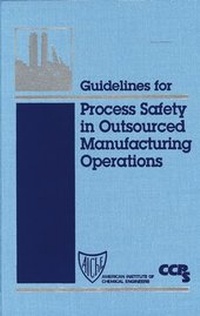
Guidelines for Process Safety in Outsourced Manufacturing Operations
Description

More details
Other editions
New editions
Additional editions
Person
Content
Acknowledgments.
Acronyms and Abbreviations.
1. Introduction.
1.1 This Guideline's Scope.
1.2 The Guideline's Audience.
1.3 What Is Outsource Manufacturing?
1.4 Why Toll? Business, Technical and Safety Considerations.
1.5 Advantages and Disadvantages of Tolling.
1.6 Joint Responsibilities.
1.7 Using Process Safety to Ensure Safety, Product Quality, and Environmental Compliance.
1.8 How to use This Guideline.
2. The Toller Selection Process.
2.1 Potential Candidates: How to Find One-How to Be One.
2.1.1 Identifying Technical Specialties and Expertise.
2.1.2 Prequalified Tollers-The Preferred Route.
2.1.3 Finding a New Toller-Technical and Trade Association Networking.
2.2 The Initial Qualification Process.
2.2.1 Assessing the Candidates-Lines of Communication.
2.2.2 A Typical Questionnaire.
2.2.3 Weighing Special technical Competencies.
2.2.4 Financial.
2.2.5 Consider Location.
2.2.6 Consider the Environmental Baseline.
2.2.7 Verifying Safety, Quality, and Contractual Obligations.
2.2.8 Process Equipment Capabilities.
2.2.9 Personnel Capabilities and Expertise.
2.2.10 Capability to Scale-up Production.
2.2.11 Process Safety.
2.2.12 Security.
2.2.13 Corporate Health, Safety, and Environmental Policies.
2.2.14 Housekeeping and Appearance.
2.2.15 Insurance Review and Experience Modifiers.
2.2.16 Conducting a Site Visit.
2.2.17 Compatibility with Ongoing Operations.
2.2.18 Initial Qualification of International Tollers.
2.3 Making the Final Selection.
2.3.1 Comparing and Ranking the Initial Qualification Information.
2.3.2 Audit and Verification Process.
2.3.3 Confidentially Agreements.
2.3.4 Finalizing the Technology Package.
2.3.5 Evaluating Proposals.
2.3.6 Contract Award ands Negotiation.
3. Mutual Agreements, Obligations, and Contract Considerations.
3.1 Defining the Rights and Expectations of the Parties.
3.2 Legal Obligations, Defining Boundaries, Contract Topics.
3.3 Technology Transfer.
3.5 Knowledge Enhancement for Both Parties.
3.5.1 New Learning about Processing Hazards and Production Efficiency.
3.6 Roles and Responsibilities.
3.6.1 What Is Contained in a Detailed Technology Package?
3.6.2 Scale Up Technology.
3.6.3 Emergency Response Considerations.
3.6.4 Wastes and Emissions.
3.6.5 Establishing and Maintaining Communication.
3.6.6 Participation in PHAs: Resolving the Issues.
3.6.7 Training Requirements.
3.7 Health, Safety, and Environmental Considerations.
3.8 Management Systems.
3.8.1 Management of Change, Including Change of Personal.
3.8.2 Defining and Executing Training Requirements.
3.9 Access and Right to Audit.
3.10 Requalification: The Time Frame Issue.
3.11 Equipment Selection, Preparation, and Decontamination.
3.12 Performance Clauses and Bonuses.
3.13 Insurance Requirements.
3.14 Permit Requirements: Required Filings.
3.15 Escape and Termination Clauses.
3.16 Notification of Accidents, Incidents, Releases and Agency Inspections.
3.17 Right to Assist in Investigation.
3.18 Pre-startup Safety Review (PSR).
3.19 Formalizing Agreements, Obligations, and Other Considerations.
4. Pre-Startup and Startup Activities.
4.1 The Path to a Successful Toll.
4.2 Establishing Specifications and Analytical Techniques.
4.3 Developing or Revising Required Procedures.
4.3.1 Operating Procedures.
4.3.2 Maintenance Procedures.
4.3.3 Material Control/Purchasing Procedures.
4.3.4 Emergency Response Plan Procedures.
4.3.5 Safe Work Practice Procedures.
4.3.6 Laboratory Procedures.
4.4 Process Hazard Analysis.
4.4.1 Defining the PHA Team.
4.4.2 Selecting the PHA Method.
4.4.3 Performing the PHA.
4.5 Training Startup Team.
4.6 Performing a Pre-startup Safety Review.
4.6.1 Resolving PSSR Issues and Action Items.
4.6.2 Considerations for Restart after Extended Downtime.
4.6.3 Defining When the Process IS Ready for Startup.
4.6.4 Confirming Permits are Complete.
5. Ongoing Operations: Audits and Follow-Up.
5.1 Audit as Appropriate for the Process and Product.
5.1.1 Regulatory Requirements: PSM, RMP, and Others.
5.1.2 Management Systems.
5.1.3 Documenting the Audits.
5.1.4 Auditing as Specified in the Technical Package.
5.2 Consulting.
5.2.1 Points of Contact.
5.2.2 Communication.
5.2.3 Periodic Visits.
5.3 Managing Issues: Guidelines and Suggestions.
5.3.1 Management of Change Issues.
5.3.2 Process Issues.
5.3.3 Personnel Issues.
5.3.4 Acquisition of a Toller by Another Company.
5.3.5 Regulatory Issues.
5.3.6 Handling, Transporting, and Storing Materials and Waste.
5.3.7 Incident Investigations.
5.3.8 Analysis of New Hazards.
5.4 Performance Monitoring.
6. Closure and Audit.
6.1 Health, Safety, and Environmental Considerations.
6.1.1 Decommissioning and Clean Up.
6.1.2 Proper Waste Disposal.
6.2 Business and Contractual Concerns.
6.2.1 Return of Proprietary Documents.
6.2.2 Governmental Notification.
6.2.3 Sample Retention and Record Retention.
6.3 Closure Review Checklist.
6.4 Analysis of the Operation.
6.5 Tolling Operations: Final Evaluation.
Appendix A. Sample Toller Pre-Assessment Questionnaire.
Appendix B. Sample Toller HS&E Assessmaent.
Appendix C. Sample Toller Assessment: Quantitative Format.
Appendix D. The ISD Model and Job Task Analysis Techniques.
Appendix E. List of Referenced Regulations.
Appendix F. Selected Resources.
Bibliography.
Glossary.
Index.
