

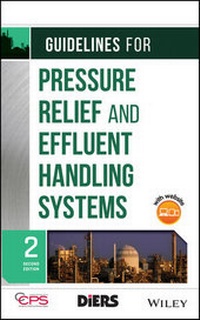
Guidelines for Pressure Relief and Effluent Handling Systems
2nd Edition
Published on 22. June 2017
784 pages
978-1-119-33029-5 (ISBN)
Description

Providing in-depth guidance on how to design and rate emergency pressure relief systems, Guidelines for Pressure Relief and Effluent Handling Systems incorporates the current best designs from the Design Institute for Emergency Relief Systems as well as American Petroleum Institute (API) standards. Presenting a methodology that helps properly size all the components in a pressure relief system, the book includes a CD with the CCFlow suite of design tools and the new Superchems for DIERS Lite software, making this an essential resource for engineers designing chemical plants, refineries, and similar facilities.
Access to Software
Access the Guidelines for Pressure Relief and Effluent Handling Software and documents using a web browser at:
http://www.aiche.org/ccps/PRTools
Each folder will have a readme file and installation instructions for the program.
After downloading SuperChems(TM) for DIERS Lite the purchaser of this book must contact the AIChE Customer Service with the numeric code supplied within the book. The purchaser will then be supplied with a license code to be able to install and run SuperChems(TM) for DIERS Lite. Only one license per purchaser will be issued.
More details
Other editions
Additional editions
CCPS (Center for Chemical Process Safety)
Guidelines for Pressure Relief and Effluent Handling Systems
Book
06/2017
2nd Edition
Wiley-AIChE
€309.00
Article not available at the moment
Person
Since 1985, the Center for Chemical Process Safety (CCPS) has been the world leader in developing and disseminating information on process safety management and technology. CCPS, an industry technology alliance of the American Institute of Chemical Engineers (AIChE), has published over 90 books in its process safety guidelines and process safety concepts series.
Content
List of Figures xxi
List of Tables xxvii
Preface xxix
Acknowledgements xxxi
In Memoriam xxxiii
Files on the Web Accompanying This Book xxxv
Introduction 1
1.1 Objective 1
1.2 Scope 2
1.3 Design Codes and Regulations, and Sources of Information 3
1.4 Organization of This Book 5
1.5 General Pressure and Relief System Design Criteria 7
Relief Design Criteria and Strategy 13
2.1 Limitations of the Technology 14
2.2 General Pressure Relief Strategy 14
2.3 Codes, Standards, and Guidelines 19
2.4 Relief Device Types and Operation 40
2.5 Relief System Layout 75
2.6 Design Flows and Code Provisions 90
2.7 Scenario Selection Considerations 100
2.8 Fluid Properties and System Characterization 104
2.9 Fluid Behavior in Vessel 113
2.10 Flow of Fluids Through Relief Systems 116
2.11 Relief System Reliability 122
Requirements for Relief System Design 131
3.1 Introduction 131
3.2 Vessel Venting Background 133
3.3 Venting Requirements for Nonreacting Cases 171
3.4 Calorimetry for Emergency Relief System Design 190
3.5 Venting Requirements for Reactive Cases 259
Methods for Relief System Design 283
4.1 Introduction 283
4.2 Manual and Spreadsheet Methods for Relief Valve Sizing 285
4.3 Miscellaneous 317
4.4 Piping 321
4.5 Rupture Disk Device Systems 349
4.6 Multiple Devices 350
4.7 Worked Example Index 352
Additional Considerations for Relief System Design 355
5.1 Introduction 355
5.2 Reaction Forces 356
5.3 Background 357
5.4 Selection of Design Case 363
5.5 Design Methods 363
5.6 Selection of Design Flow Rate and Dynamic Load Factor 367
5.7 Transient Forces on Relief Device Discharge Piping 372
5.8 Pipe Tension 385
5.9 Real Gases 390
5.10 Changes in Pipe Size 390
5.11 Location of Anchors 390
5.12 Exit Geometry 391
5.13 Worked Examples 392
Handling Emergency Relief Effluents 393
6.1 General Strategy 395
6.2 Basis for Selection of Equipment 399
6.3 Determining if Direct Discharge to Atmosphere is Acceptable 401
6.4 Factors That Influence Selection of Effluent Treatment Systems 403
6.5 Methods of Effluent Handling 411
Design Methods for Handling Effluent from Emergency Relief Systems 437
7.1 Design Basis Selection 438
7.2 Total Containment Systems 439
7.3 Relief Devices, Discharge Piping, and Collection Headers 442
7.4 Vapor-Liquid Gravity Separators 445
7.5 Cyclone Separators 465
7.6 Quench Pools 476
Acronyms and Abbreviations 513
Glossary 517
Nomenclature 529
Appendix A: SuperChems(TM) for DIERS Lite - Description and Instructions 541
A.1 Scope 541
A.2 Software Functions 543
A.3 Installing and Running SuperChems(TM) 547
Appendix B: CCFlow, TPHEM and COMFLOW Description and Instructions 549
B.1 Scope 549
B.2 CCFlow Calculation Options 550
B.3 TPHEM Calculation Options 556
B.4 COMFLOW Calculation Options 562
Appendix C: SuperChems(TM) for DIERS - Description and Instructions 565
C.1 Scope 565
C.2 Software Functions 567
C.3 Installing and Running SuperChems(TM) 576
Appendix D: Venting Requirements 577
D.1 Worked Examples - Emergency Venting 579
D.2 Venting Requirements for Reactive Cases 597
D.3 Relief Valve Sizing Examples 599
D.4 Piping Flow Examples 634
D.5 Reaction Forces 658
Appendix E: Worked Examples - Effluent Handling 681
E.1 Phase Separator and Quench Tank Design Examples 681
References 717
Index 743
CONTENTS
- List of Figures
- List of Tables
- Preface
- Acknowledgements
- In Memoriam
- Files on the Web Accompanying This Book
- Introduction
- Relief Design Criteria and Strategy
- 2.1 Limitations of the Technology
- 2.2 General Pressure Relief Strategy
- 2.3 Codes, Standards, and Guidelines
- 2.4 Relief Device Types and Operation
- 2.5 Relief System Layout
- 2.6 Design Flows and Code Provisions
- 2.7 Scenario Selection Considerations
- 2.8 Fluid Properties and System Characterization
- 2.9 Fluid Behavior in Vessel
- 2.10 Flow of Fluids Through Relief Systems
- 2.11 Relief System Reliability
- Requirements for Relief System Design
- 3.1 Introduction
- 3.2 Vessel Venting Background
- 3.2.1 General Considerations
- 3.2.2 Schematics and Principle Variables, Properties and Parameters
- 3.2.3 Basic Mass and Energy Balances
- 3.2.4 Physical and Thermodynamic Properties
- 3.2.5 Energy Input or Output
- 3.2.6 Solution Methods Using Computer Tools
- 3.2.7 Mass and Energy Balance Simplifications
- 3.2.8 Limiting Cases
- 3.2.9 Vapor/Liquid Disengagement
- 3.3 Venting Requirements for Nonreacting Cases
- 3.4 Calorimetry for Emergency Relief System Design
- 3.5 Venting Requirements for Reactive Cases
- Methods for Relief System Design
- 4.1 Introduction
- 4.2 Manual and Spreadsheet Methods for Relief Valve Sizing
- 4.3 Miscellaneous
- 4.4 Piping
- 4.4.1 Piping - Fundamental Equations
- 4.4.2 Piping - Pipe Friction Factors
- 4.4.3 Incompressible (Liquid) Flow
- 4.4.4 Piping Adiabatic Compressible Flow
- 4.4.5 Isothermal Compressible Flow
- 4.4.6 Homogeneous Two-Phase Pipe Flow
- 4.4.7 Piping - Separated Two-Phase Flows
- 4.4.8 Slip/Holdup
- 4.4.9 Piping - Temperature Effects
- 4.5 Rupture Disk Device Systems
- 4.6 Multiple Devices
- 4.7 Worked Example Index
- Additional Considerations for Relief System Design
- 5.1 Introduction
- 5.2 Reaction Forces
- 5.3 Background
- 5.4 Selection of Design Case
- 5.5 Design Methods
- 5.6 Selection of Design Flow Rate and Dynamic Load Factor
- 5.7 Transient Forces on Relief Device Discharge Piping
- 5.8 Pipe Tension
- 5.9 Real Gases
- 5.10 Changes in Pipe Size
- 5.11 Location of Anchors
- 5.12 Exit Geometry
- 5.13 Worked Examples
- Handling Emergency Relief Effluents
- 6.1 General Strategy
- 6.2 Basis for Selection of Equipment
- 6.3 Determining if Direct Discharge to Atmosphere is Acceptable
- 6.4 Factors That Influence Selection of Effluent Treatment Systems
- 6.4.1 Physical and Chemical Properties
- 6.4.2 Two-Phase Flow and Foaming
- 6.4.3 Passive or Active Systems
- 6.4.4 Technology Status and Reliability
- 6.4.5 Discharging to a Common Collection System
- 6.4.6 Plant Geography
- 6.4.7 Space Availability
- 6.4.8 Turndown
- 6.4.9 Vapor-Liquid Separation
- 6.4.10 Possible Condensation and Vapor-Condensate Hammer
- 6.4.11 Time Availability
- 6.4.12 Capital and Continuing Costs
- 6.5 Methods of Effluent Handling
- Design Methods for Handling Effluent from Emergency Relief Systems
