

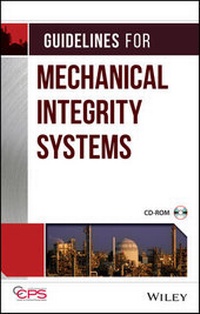
Guidelines for Mechanical Integrity Systems
Description

Reviews / Votes
"...an excellent overview of all aspects of mechanicalintegrity systems...should be very useful for anyengineer..." (Journal of Loss Prevention in the ProcessIndustries, January 2007) "...a thorough introduction to MI Systems for managers,quality control engineers and those who are responsible formaintaining systems." (E-STREAMS, September 2007)More details
Other editions
Additional editions
Person
Content
List of Tables xiii
List of Figures xv
Items on the CD Accompanying This Book xvii
Acronyms and abbreviations xxi
Glossary xxv
Acknowledgments xxix
Preface xxxi
Management Overview of the Guidelines xxxiii
1 INTRODUCTION 1
1.1 What is Mechanical Integrity? 2
1.2 Relationship to Other Programs 3
1.3 Expectations for the Ml Program 3
1.4 The Effect of RAGAGEPs 5
1.5 Structure of this Guidelines Book 6
1.6 References 8
2 MANAGEMENT RESPONSIBILITY 9
2.1 Facility Leadership's Roles and Responsibilities 9
2.1.1 Organizational Roles and Responsibilities 10
2.1.2 Roles and Responsibilities Matrix 10
2.1.3 Reporting Mechanisms 11
2.1.4 Auditing 14
2.2 Technical Assurance Responsibilities 14
2.2.1 Defining Acceptance Criteria 14
2.2.2 Providing Technical Content 15
2.2.3 Establishing Metrics 15
2.2.4 Ensuring Technical Review 16
3 EQUIPMENT SELECTION 17
3.1 Reviewing Program Objectives 17
3.2 Establishing Equipment Selection Criteria 18
3.3 Defining Level of Detail 21
3.4 Documenting the Equipment Selection 22
3.5 Equipment Selection Roles and Responsibilities 23
Apendix 3A, Sample Guidelines for Selecting Equipment for the MI Program 25
4 INSPECTION, TESTING, AND PREVENTIVE MAINTENANCE 29
4.1 ITPM Task Planning 30
4.1.1 ITPM Task Selection 30
4.1.2 Developing Sampling Criteria 42
4.1.3 Other ITPM Task Planning Considerations 44
4.1.4 ITPM Task Scheduling 45
4.2 Task Execution and Monitoring 46
4.2.1 Defining Acceptance Criteria 46
4.2.2 Equipment and ITPM Task Results Documentation 47
4.2.3 ITPM Task Implementation and Execution 49
4.2.4 ITPM Task Results Management 49
4.2.5 Task Schedule Management 51
4.2.6 ITPM Program Monitoring 52
4.3 ITPM Program Roles and Responsibilities 53
4.4 References 53
Appendix 4A. Common Predictive Maintenance and Nondestructive Testing Techniqes 58
Appendix 5 A. Sample Training Survey
5 Ml TRAINING PROGRAM
5.1 Skills/Knowledge Assessment 61
5.2 Training For New and Current Workers 64
5.3 Verification and Documentation of Training Effectiveness 64
5.4 Certification 66
5.5 Ongoing and Refresher Training 69
5.6 Training for Technical Personnel 69
5.7 Contractor Issues 71
5.8 Roles and Responsibilities
5.9 References
6 Ml PROGRAM PROCEDURES 77
6.1 Types of Procedures Supporting the Ml Program 79
6.2 Identification of MI Procedure Needs 81
6.3 Procedure Development Process 83
6.4 MI Procedure Format and Content 87
6.5 Other Sources of MI Procedures 90
6.6 Implementing and Maintaining MI Procedures91
6.7 Procedure Program Roles and Responsibilities 92
6.8 References 92
7 QUALITY ASSURANCE 95
7.1 Design 96
7.2 Procurement 97
7.3 Fabrication 98
7.4 Receiving 99
7.5 Storage and Retrieval 99
7.6 Construction and Installation 100
7.7 In-service Repairs, Alterations, and Rerating 101
7.8 Temporary Installations and Temporary Repairs 102
7.9 Decommissioning/Reusc 103
7.10 Used Equipment 103
7.11 Spare Parts 104
7.12 Contractor-Supplied Equipment and Materials 104
7.13 QA Program Roles and Responsibilities 104
7.14 References 104
Appendix 7A. Design Review Suggestions 107
Appendix 7B. Sample Vendor QA Plan 110
Appendix 7C. Positive Material Identification 112
Appendix 7D. Sample Service QA Plan 116
Appendix 8A. Fitness for Service (FS) 131
8 EQUIPMENT DEFICIENCY MANAGEMENT 119
8.1 Equipment Deficiency Management Process 119
8.2 Acceptance Criteria 120
8.3 Equipment Deficiency Identification 122
8.4 Responding to Equipment Deficiencies 123
8.5 Equipment Deficiency Communication 127
8.6 Permanent Correction of Equipment Deficiencies 127
8.7 Deficiency Management Roles and Responsibilities 128
8.8 Reference 128
9 EQUIPMENT-SPECIFIC INTEGRITY MANAGEMENT 135
9.1 Fixed Equipment 137
9.2 Relief and Vent Systems 142
9.3 Instrumentation and Controls 144
9.4 Rotating Equipment 145
9.5 Fired Equipment 151
9.6 Electrical Systems 151
9.7 Fire Protection Systems 153
9.8 Miscellaneous Equipment 154
9.8.1 Ventilation and Purge Systems 154
9.8.2 Protective Systems 155
9.8.3 Solids-handling Systems 156
9.8.4 Safety-critical Utilities 157
9.8.5 Other Safety Equipment 157
9.9 Equipment-specific MI Activity Matrices 158
9.10 References 182
10 Ml PROGRAM IMPLEMENTATION 183
10.1 Budgeting and Resources 183
10.1.1 Program Development Resources 183
10.1.2 Initial Implementation Resources 187
10.1.3 Ongoing Efforts 193
10.2 Use of Software in Ml Programs 196
10.2.1 Use of CMMS 197
10.2.2 Other Software Used in MI Programs 198
10.3 Return on Investment (ROI) 200
10.3.1 Improved Equipment Reliability 200
10.3.2 Cost Avoidance 201
10.3.3 Regulatory Compliance and Industry Association Commitments 202
10.3.4 Reduced Liability and Reduced Damage to Corporate Reputation 202
10.4 References 202
11 RISK MANAGMENT TOOLS 203
11.1 Introduction to Common Risk-based Analytical Techniques Used in MI Programs 205
11.2 Incorporating Risk into MI Decisions 210
11.3 FMEA/FMECA 212
11.4 RCM 213
11.5 Risk-based Inspection 218
11.5.1 Equipment and Process Data 221
11.5.2 Risk Modeling 221
11.5.3 Inspection Planning Strategies/Guidelines 222
11.5.4 Other RBI Program Issues 223
11.6 Protection Layer Analysis Techniques 225
11.7 References 229
12 CONTINUOUS IMPROVEMENT OF Ml PROGRAMS 231
12.2 Program Audits 233
12.3 Performance Measurement and Monitoring 238
12.4 Equipment Failure and Root Cause Analyses 240
12.4.1 Failure Analysis 243
12.4.2 Root Cause Analysis 245
12.5 References 248
Index 249
Glossary
- Acceptance criteria
- Technical basis used to determine whether equipment is deficient (e.g., when analyzing inspection, testing, and preventive maintenance [ITPM] results).
- Causal factor (CF)
- Equipment failure or human error that caused an incident or allowed incident consequences to be worse.
- Causal factor chart
- A sequence diagram that graphically depicts an incident from beginning to end; typically used to organize incident data and identify causal factors.
- Certification
- Completion of the formal training and qualification requirements specified by applicable codes and standards.
- Computerized maintenance management system (CMMS)
- Computer software for planning, scheduling, and documenting maintenance activities. A typical CMMS includes work order generation, work instructions, parts and labor expenditure tracking, parts inventories, and equipment histories.
- Condition monitoring (CM)
- Observing, measuring, and/or trending of indicators with respect to some independent parameter (usually time or cycles) to indicate the current and future ability of a structure, system, or component to function within acceptance criteria.
- Cost avoidance
- Return (often expressed in monetary terms) resulting from actions that prevent an incident from occurring.
- Critical operating parameter
- Process condition (e.g., flow rate, temperature) that can lead to an equipment failure if limits are exceeded.
- Damage/failure mechanism
- The mechanical, chemical, physical, or other process that results in equipment degradation. Identifying and inspecting for indications of the damage mechanism can be used to predict future failures.
- Decision tree
- A logic tree used in reliability-centered maintenance (RCM) to help determine the correct type of maintenance (e.g., predictive, preventive) to perform to reduce the likelihood of equipment failures.
- Equipment class
- A grouping of individual equipment items with similar design and operation, such that facilities should perform similar ITPM activities on all of the items.
- Equipment deficiency
- A condition that does not meet the acceptance criteria.
- Equipment failure analysis
- A systematic approach for analyzing equipment failures to determine the failure mechanism(s) and the root cause(s) that resulted in the failure.
- Failure mode
- A symptom, condition, or fashion in which equipment fails. A failure mode might be identified as loss of function, premature function (function without demand), an out-of-tolerance condition, or a simple physical condition such as a leak.
- Failure modes and effects analysis (FMEA)
- A systematic method for evaluating and documenting the causes and impacts of known types of equipment/component failures.
- Failure modes, effects, and criticality analysis (FMECA)
- A variation of FMEA that includes a quantitative estimate of the significance of the consequence of a failure mode.
- Fault tree
- A method for representing the logical combinations of failures that can lead to a specific main event (i.e., failure or accident of interest).
- Fitness for service (FFS)
- A systematic approach for evaluating the current condition of a piece of equipment in order to determine if the equipment item is capable of operating at defined operating conditions (e.g., temperature, pressure).
- Gantt chart
- A manner of depicting multiple, time-based project activities (usually on a bar chart with a horizontal time scale).
- Hazard and operability (HAZOP) analysis
- A systematic method in which process hazards and potential operating problems are identified using a series of guide words to investigate process deviations.
- Inspection, testing, and preventive maintenance (ITPM)
- Scheduled proactive maintenance activities intended to (1) assess the current condition and/or rate of degradation of equipment, (2) test the operation/functionality of equipment, and/or (3) prevent equipment failure by restoring equipment condition.
- ITPM program
- A management system that develops, maintains, monitors, and manages inspection, testing, and preventive maintenance activities.
- Layer of protection analysis (LOPA)
- A process of evaluating the effectiveness of independent protection layer(s) in reducing the likelihood or severity of an undesired event.
- Management of change (MOC)
- A management system for ensuring that changes to processes are properly analyzed (e.g., for potential adverse impacts), documented, and communicated to affected personnel.
- Mechanical integrity (MI)
- A management system for ensuring the ongoing durability and functionality of equipment.
- Nondestructive testing/examination (NDT/NDE)
- Evaluation of an equipment item with the intention of measuring an equipment parameter without damaging or destroying the equipment item.
- Operating window
- The parameters (i.e., safe upper and lower limits, run time) under which equipment can function without failure.
- Owner-user
- Person, plant, or corporation legally responsible for the safe operation of a pressure-retaining item (e.g., a pressure vessel).
- Performance measure
- A metric used to monitor or evaluate the operation of a program activity or management system.
- Positive material identification (PMI)
- The determination of the materials of construction of an equipment item or component (e.g., piping).
- Predictive maintenance
- An equipment maintenance strategy based on measuring the condition of equipment in order to assess whether it will fail during some future period, and then taking appropriate action to avoid the consequences of that failure.
- Prestartup safety review (PSSR)
- A management system for ensuring that new or modified processes are ready for startup by verifying that equipment is installed in a manner consistent with the design intent.
- Process hazard analysis (PHA)
- A systematic evaluation of process hazards with the purpose of ensuring that sufficient safeguards are in place to manage the inherent risks.
- Process safety information
- A compilation of chemical hazard, technology, and equipment documentation needed to manage process safety.
- Quality assurance (QA)
- Activities to ensure that equipment is designed appropriately and to ensure that the design intent is not compromised throughout the equipment's entire life cycle.
- Recommended and generally accepted good engineering practice (RAGAGEP)
- A document that provides guidance on engineering, operating, or maintenance activities based on an established code, standard, published technical report, or recommended practice (or a document of a similar name).
- Reliability-centered maintenance (RCM)
- A systematic analysis approach for evaluating equipment failure impacts on system performance and determining specific strategies for managing the identified equipment failures. The failure management strategies may include preventive maintenance, predictive maintenance, inspections, testing, and/or one-time changes (e.g., design improvements, operational changes).
- Remaining life
- An estimate, based on inspection results, of the time it will take for an equipment item to reach a defined retirement criterion (e.g., minimum wall thickness).
- Risk
- A measure of potential loss (e.g., human injury, environmental insult, economic penalty) in terms of the magnitude of the loss and the likelihood that the loss will occur.
- Risk analysis
- The development of a qualitative and/or quantitative estimate of risk based on engineering evaluation and mathematical techniques (quantitative only) for combining estimates of event consequences and frequencies.
- Risk-based inspection (RBI)
- A systematic approach for identifying credible failure mechanisms and using equipment failure consequences and likelihood to determine inspection strategies for equipment.
- Root cause analysis (RCA)
- A method used to (1) describe what happened leading up to and during a particular event, (2) determine how it happened, and (3) identify the underlying reasons the event was allowed to occur so that workable corrective actions can be implemented to help prevent recurrence of the event (or occurrence of similar events).
- Safety instrumented functions (SIF)
- A system composed of servers, logic servers, and final control elements for the purpose of taking the process to a safe state when predetermined conditions are violated.
- Safety instrumented system (SIS)
- One or more SIFs combined to protect a process or a key process component.
- Safety integrity level (SIL)
- Criterion defining the acceptable probability of failure...
