

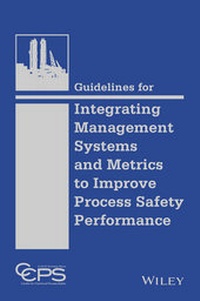
Guidelines for Integrating Management Systems and Metrics to Improve Process Safety Performance
Published on 3. February 2016
216 pages
978-1-118-79510-1 (ISBN)
Description

This book combines the synergies between performance improvement systems to help ensure safe and reliable operations, streamline procedures and cross-system auditing, and supporting regulatory and corporate compliance requirements. Many metrics are common to more than one area, such that a well-designed and implemented integrated management system will reduce the load on the Process Safety, SHE, Security and Quality groups, and improve manufacturing efficiency and customer satisfaction. Systems to improve performance include: process safety; traditional safety, health and environment; and, product quality.
Chapters include: Integrating Framework; Securing Support & Preparing for Implementation; Establishing Common Risk Management Systems - How to Integrate PSM into Other EH; Testing Implementation Approach; Developing and Agreeing on Metrics; Management Review; Tracking Integration Progress and Measuring Performance; Continuous Improvement; Communication of Results to Different Stakeholders; Case Studies; and Examples for Industry.
More details
Other editions
Additional editions
CCPS (Center for Chemical Process Safety)
Guidelines for Integrating Management Systems and Metrics to Improve Process Safety Performance
Book
04/2016
Wiley-AIChE
€103.50
Shipment within 15-20 days
CCPS
Guidelines for Integrating Management Systems and Metrics to Improve Process Safety Performance
Software
01/2016
Wiley
€112.18
Shipment within 15-20 days
Person
Since 1985, the Center for Chemical Process Safety (CCPS) has been the global leader in developing and disseminating information on process safety management and technology. CCPS, an industry technology alliance of the American Institute of Chemical Engineers (AIChE), has published over 100 books in its process safety guidelines and process safety concepts series, and over 100 training modules through its Safety in Chemical Engineering Education (SACHE) series.
Content
List of Figures xi
List of Tables xv
Acronyms and Abbreviations xvii
Glossary xix
Acknowledgments xxv
Preface xxvii
1 INTRODUCTION 1
1.1 The Need for Integration 1
1.2 The Purpose of this Guideline 4
1.3 The Scope of this Guideline 4
1.4 The Approach used in this Guideline 4
1.5 How Established Models can be used in Integrated Systems 8
1.6 Exclusions to the Scope 9
1.7 Key Audience for this Guideline 9
1.8 Some Recent Advances in Process Safety Metrics 10
2 SECURE LEADERSHIP SUPPORT ACROSS GROUPS 11
2.1 The Need for Securing Support 11
2.2 Securing Support to Optimize Resource Allocation 14
2.3 Developing a Preliminary Plan 16
2.4 The Importance of a Safety Culture 23
2.5 Identifying Stakeholders 24
2.6 Sharing Resources across Groups 27
2.7 The Case for a SHEQ&S program 27
2.8 Surveying for Competency Gaps 28
3 EVALUATE HAZARDS AND RISKS ACROSS GROUPS 31
3.1 The Need for Evaluating Hazards and Risks 31
3.2 Identifying and Prioritizing Key Processes and Risks 32
3.3 Selecting Potential Metrics 33
3.4 Focusing on Process Safety Performance 35
3.5 Re-evaluating Metrics for Continuous Improvement 35
3.6 Examples of Performance Effects across SHEQ&S Groups 38
4 IDENTIFY COMMON METRICS ACROSS GROUPS 41
4.1 The Need for Identifying Common Metrics 41
4.2 Define the System Integration Process 43
4.3 Identify the Program Requirements 43
4.4 Develop the Program 43
4.5 Identify Overlapping Metrics 46
4.6 Prioritize the Program Installation 66
4.7 Document the Program Baseline 72
4.8 Continuous Improvements 73
4.9 Some Management System Assessment Tools 73
4.10 Other Metrics Worth Considering 82
5 IMPLEMENT THE SHEQ&S PROGRAM 83
5.1 The Need for Proper Implementation 86
5.2 How to Apply the Plan, Do, Check, Act (PDCA) Approach 86
5.3 Piloting the SHEQ&S program 95
5.4 Communication 103
6 MONITOR THE SHEQ&S PROGRAM PERFORMANCE 105
6.1 The Need for Reviewing and Assessing Program Performance 106
6.2 How to Reinforce the Integrated Framework 108
6.3 How to Use Management Reviews to Respond to Gaps 108
6.4 How to Engage Leadership 109
6.5 The Roadmap and Process Improvement Plan 110
6.6 Auditing and Verifying the Program 110
6.7 Tracking Corrective Actions 111
6.8 Statistical Methods and Tools 112
6.9 Capturing Early Success 114
6.10 Improving Performance in All SHEQ&S Management Systems 115
6.11 How and When to Communicate the Information 115
6.12 Obtaining Stakeholder Feedback 118
6.13 Metric Communication Examples 119
7 IMPLEMENT CHANGES TO THE SHEQ&S PROGRAM 121
7.1 The Need for Continuous Improvement 122
7.2 Ensuring Management Responsibility 122
7.3 Addressing Non-Conformities 122
7.4 Using Statistical Methods 126
8 EXAMPLES FROM INDUSTRY 127
8.1 Case Studies 129
8.2 Examples of the SHEQ&S program 129
APPENDIX A: REFERENCE LISTS FOR GLOBAL PROCESS SAFETY LEGISLATION AND SHEQ&S ORGANIZATIONS 131
APPENDIX B: RECENT ADVANCES IN PROCESS SAFETY METRICS 139
APPENDIX C: POTENTIAL ANSWERS DESCRIBING THE NEED FOR SECURING SUPPORT 145
APPENDIX D: DETAILED CASE STUDY FOR DESIGNING AND IMPLEMENTING A SHEQ&S PROGRAM 147
APPENDIX E: EQUIPMENT INTEGRITY IN THE EQUIPMENT LIFE CYCLE 158
APPENDIX F: THE SHEQ&S MANAGEMENT SYSTEM MAPPING SURVEY 160
APPENDIX G: THE PROCESS SAFETY PERSONNEL COMPETENCY SURVEY 167
REFERENCES 179
INDEX 185
GLOSSARY
This Glossary is current at the time of publication. Please access the CCPS website for the latest Glossary.
Accident Prevention Pillar A group of mutually supporting RBPS elements. The RBPS management system is composed of four accident prevention pillars: (1) commit to process safety, (2) understand hazards and risk, (3) manage risk, and (4) learn from experience. Administrative Control Procedures that will hold human and/or equipment performance within established limits. Barrier Anything used to control, prevent, or impede energy flows. Includes engineering (physical, equipment design) and administrative (procedures and work processes). See also Layer of Protection. Basic Process Control System (BPCS) A system that responds to input signals fromthe process and its associated equipment, other programmable systems, and/or from an operator, and generates output signals causing the process and its associated equipment to operate in the desired manner and within normal production limits. Bow Tie Adiagram for visualizing the types of preventive and mitigative barriers which can be used to manage risk. These barriers are drawn with the threats on the left, the unwanted event at the center, and the consequences on the right, representing the flow of the hazardous materials or energies through its barriers to its destination. The hazards or threats can be proactively addressed on the left with specific barriers (safeguards, layers of protection) to help prevent a hazardous event from occurring; barriers reacting to the event to help reduce the event's consequences are shown on the right. Consequence The direct, undesirable result of an accident sequence usually involving a fire, explosion, or release of toxic material. Consequence descriptions may be qualitative or quantitative estimates of the effects of an accident. Consequence Analysis The analysis of the expected effects of incident outcome cases, independent of frequency or probability. Containment A system condition in which under no condition reactants or products are exchanged between the chemical system and its environment. Engineered Control A specific hardware or software system designed to maintain a process within safe operating limits, to safely shut it down in the event of a process upset, or to reduce human exposure to the effects of an upset. Environmental Group In context of this guideline, the environmental group manages the air, water and land permits, including hazardous waste storage and disposal. Equipment A piece of hardware which can be defined in terms of mechanical, electrical or instrumentation components contained within its boundaries. Equipment Reliability The probability that, when operating under stated environment conditions, process equipment will perform its intended function adequately for a specified exposure period. Event An occurrence involving a process that is caused by equipment performance or human action or by an occurrence external to the process. Explosion A release of energy that causes a pressure discontinuity or blast wave. Explosive A chemical that causes a sudden, almost instantaneous release of pressure, gas, and heat when subjected to sudden shock, pressure, or high temperature. (OSHA 1994) Facility The physical location where the management system activity is performed. In early life-cycle stages, a facility may be the company's central research laboratory or the engineering offices of a technology vendor. In later stages, the facility may be a typical chemical plant, storage terminal, distribution center, or corporate office. Site is used synonymously with facility when describing RMP audit criteria. Failure An unacceptable difference between expected and observed performance. Fire A combustion reaction accompanied by the evolution of heat, light and flame. Fire Protection Methods of providing for fire control or fire extinguishment. (NFPA 850) Flammable A gas that can burn with a flame if mixed with a gaseous oxidizer such as air or chlorine and then ignited. The term "flammable gas" includes vapors from flammable or combustible liquids above their flash points. Frequency Number of occurrences of an event per unit time (e.g., 1 event in 1000 yrs. = 1 x 10⁻³ events/yr.). Hazard An inherent chemical or physical characteristic that has the potential for causing damage to people, property, or the environment. In this document it is the combination of a hazardous material, an operating environment, and certain unplanned events that could result in an accident. Hazard Analysis The identification of undesired events that lead to the materialization of a hazard, the analysis of the mechanisms by which these undesired events could occur, and usually the estimation of the consequences. Hazard Evaluation Identification of individual hazards of a system, determination of the mechanisms by which they could give rise to undesired events, and evaluation of the consequences of these events on health (including public health), environment, and property. Uses qualitative techniques to pinpoint weaknesses in the design and operation of facilities that could lead to incidents. Hazardous Material In a broad sense, any substance or mixture of substances having properties capable of producing adverse effects to the health or safety of human beings or the environment. Material presenting dangers beyond the fire problems relating to flash point and boiling point. These dangers may arise from, but are not limited to, toxicity, reactivity, instability, or corrosivity. Health Group In context of this guideline, the group administering the Occupational Safety and Health programs. Incident An event, or series of events, resulting in one or more undesirable consequences, such as harm to people, damage to the environment, or asset/business losses. Such events include fires, explosions, releases of toxic or otherwise harmful substances, and so forth. Independent Protection Layer (IPL) A device, system, or action that is capable of preventing a postulated accident sequence from proceeding to a defined, undesirable endpoint. An IPL is independent of the event that initiated the accident sequence and independent of any other IPLs. IPLs are normally identified during layer of protection analyses. Layer of Protection A device, system, or action, supported by a management system that is capable of preventing an initiating event from propagating to a specific loss event or impact. Layer of Protection Analysis (LOPA) An approach that analyzes one incident scenario (causeconsequence pair) at a time, using predefined values for the initiating event frequency, independent protection layer failure probabilities, and consequence severity, in order to compare a scenario risk estimate to risk criteria for determining where additional risk reduction ormore detailed analysis is needed. Scenarios are identified elsewhere, typically using a scenario-based hazard evaluation procedure such as a HAZOP Study. Likelihood A measure of the expected probability or frequency of occurrence of an event. This may be expressed as an event frequency (e.g., events per year), a probability of occurrence during a time interval (e.g., annual probability) or a conditional probability (e.g., probability of occurrence, given that a precursor event has occurred). Mitigation Lessening the risk of an accident event sequence by acting on the source in a preventive way by reducing the likelihood of occurrence of the event, or in a protective way by reducing the magnitude of the event and/or the exposure of local persons or property Normal Process Any process operations intended to be performed between startup and shutdown to support continued operations within the safe upper and lower operating limits. Occupational Safety and Health In context of this guideline, the discipline that focuses on the prevention and mitigation of adverse health effects on people working with hazardous materials and energies, such as industrial hygiene and personal protective equipment. This discipline also addresses safe work practices, such as confined space entry, electrical energy isolation, line breaks and fall protection. (Compare to the process safety...