

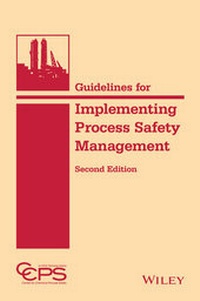
Guidelines for Implementing Process Safety Management
2nd Edition
Published on 30. June 2016
344 pages
978-1-119-24376-2 (ISBN)
Description

The 2nd edition provides an update of information since the publication of the first edition including best practices for managing process safety developed by industry as well as incorporate the additional process safety elements. In addition the book includes a focus on maintaining and improving a Process Safety Management (PSM) System. This 2nd edition also provides "how to information to" determine process safety performance status, implement one or more new elements into an existing PSM system, maintain or improve an existing PSM system, and manage future process safety performance.
More details
Other editions
Additional editions
CCPS (Center for Chemical Process Safety)
Guidelines for Implementing Process Safety Management Systems
Book
09/2016
2nd Edition
Wiley-AIChE
€131.50
Shipment within 15-20 days
Software
08/2016
Wiley
€145.87
No shipping information available
Person
Since 1985, the Center for Chemical Process Safety (CCPS) has been the global leader in developing and disseminating information on process safety management and technology. CCPS, an industry technology alliance of the American Institute of Chemical Engineers (AIChE), has published over 100 books in its process safety guidelines and process safety concepts series, and over 100 training modules through its Safety in Chemical Engineering Education (SACHE) series.
Content
Files on the Web Accompanying this Book xi
List of Figures xiii
List of Tables xv
Acronyms and Abbreviations xvii
Glossary xxi
Acknowledgments xlix
Preface li
1 INTRODUCTION 1
1.1 Overview 1
1.2 Background/History of PSM 5
1.3 Process Safety Resources 7
1.4 PSM Implementation Lessons 11
1.5 The Business Case for Process Safety 12
1.6 Importance of Integrating PSM with Business Systems 14
1.7 Intended Audience and How to Use These Guidelines 16
1.8 References 18
2 EVALUATING PSM SYSTEM IMPLEMENTATION AND PERFORMANCE 19
2.1 The Modified Safety Triangle 19
2.2 Common Indicators at Each Level of the Triangle 21
2.3 Process Stages in the Company/Facility Life Cycle 22
2.4 Documenting Conclusions 31
2.5 References 35
3 PREPARING FOR PROCESS SAFETY MANAGEMENT CHANGE 37
3.1 Securing Management Commitment 37
3.2 Establishing a Culture for Change 44
3.3 References 48
4 IMPLEMENTING A NEW PSM SYSTEM 49
4.1 Develop the Design Specification for the PSM System 49
4.2. Create Element and System Workflows 67
4.3 Estimate the Workloads and Resources 76
4.4 Develop Written Programs/Procedures 87
4.5 Roll Out the Elements and System 98
4.6 Monitor the PSM System's Implementation, Initial Performance, and Progress 113
4.7 References 115
5 INTEGRATING NEW ELEMENTS INTO AN EXISTING PSM SYSTEM 117
5.1 Developing a New Element 117
5.2 Integrating New Element Activities into Existing Elements 118
5.3 Implementing New RBPS Elements 118
5.4 Monitoring New Elements or Activities 133
5.5 References 134
6 IMPROVING AN EXISTING PSM ELEMENT OR SYSTEM 137
6.1 Determining Which Elements to Improve 137
6.2 Assessing the Program and Determining the Root Causes of Poor Performance 142
6.3 Improving the PSM Program 159
6.4 Developing the Solution for an Element or System 162
6.5 Monitoring Improvement of an Element or System 163
6.6 References 166
7 INTEGRATING PSM/HSE WITH A BUSINESS MANAGEMENT SYSTEM 167
7.1 Values and Policy Interfaces/Conflicts with Business Enterprise 168
7.2 Types of BMS Activities 168
7.3 Company and Regional Politics 179
7.4 Workflows/Processes of Existing BMS 179
7.5 Planned Changes to Existing BMS 179
7.6 Interfaces with Existing BMS 179
7.7 Resolving BMS Conflicts 179
7.8 References 180
8 MANAGING FUTURE PROCESS SAFETY PERFORMANCE 181
8.1 Ensure a Robust PSM System 181
8.2 Avoid Past PSM System Failure Modes 183
8.3 Watch for Early Warning Signs 186
8.4 Consider Other Enhancements 188
8.5 References 189
APPENDIX I: GLOBAL PSM REGULATIONS/GOOD INDUSTRY PRACTICES 191
APPENDIX II: ELI LILLY AND COMPANY PSM IMPLEMENTATION CASE STUDY 223
APPENDIX III: RISK BASED PROCESS SAFETY (RBPS) IMPLEMENTATION TOOLS 241
APPENDIX IV: THE BUSINESS CASE FOR PROCESS SAFETY 251
APPENDIX V: EXAMPLE FACILITY RANKING PROCESS 267
APPENDIX VI: EXAMPLE PRESENTATION ON PSM PLAN 271
APPENDIX VII: MAPPING PERFORMANCE ISSUES TO CULTURE FEATURES 275
INDEX 283
Acceptable Risk The average rate of loss that is considered tolerable for a given activity. Accident An unplanned event or sequence of events that results in an undesirable consequence. Accountability The obligation to explain and answer for one's actions that are related to expectations, objectives, and goals. In this context, those that are accountable for PS M activities are answerable to the one person who has the ultimate responsibility for the program. There may be multiple persons accountable for an activity but only one person with the ultimate responsibility. Accordingly, it is a powerful element of an effective process safety management system. Action Tracking A method of logging progress when implementing a task or set of tasks. Administrative Controls Procedural mechanisms, such as lockout/tagout procedures, for directing and/or checking human performance on plant tasks. Adverse Reaction Undesirable effect of a drug, vaccine, or medical device; it can be as mild as a short-term injection- siteirritation or as serious as a life - threatening acute onset of anaphylaxis; also referred to as adverse event. Alternative Release Scenario (ARS) The basis for an offsite consequence analysis required by the EPA RMP rule. This release scenario is less conservative, and more likely to occur than the worst- case scenario. Anecdotal Verbal evidence that is not supported by other, corroborating evidence. For example, the results of an interview with one person are not the basis for issuing a finding. Antecedent-behavior- consequence (ABC) Analysis A human performance analysis tool that examines how human behavior is influenced by previous experiences with similar situations and expectations of reward or punishment. As Low As Reasonably Practicable (ALARP) The concept that efforts to reduce risk should be continued until the incremental sacrifice (in terms of cost, time, effort, or other expenditure of resources) is grossly disproportionate to the incremental risk reduction achieved. The term as low as reasonably achievable (ALARA) is often used synonymously. Asset Any person, environment, facility, material, information, business reputation, or activity that has positive value to an owner. The asset may have value to an adversary, as well as an owner, although the nature and magnitude of those values may differ. Asset Integrity A PSM program element involving work activities that help ensure that equipment is properly designed, installed in accordance with specifications, and remains fit for purpose over its life cycle. Also asset reliability. Audit A systematic, independent review to verify conformance with prescribed standards of care using a well-defined review process to ensure consistency and to allow the auditor to reach defensible conclusions. Audit (Process Safety Audit) An inspection of a plant or process unit, drawings, procedures, emergency plans, and/or management systems, etc., usually by an independent, impartial team. Benchmarking The comparison of current operating practices to internal or external company practices, industry best practices, and regulatory standards. Catastrophic A loss with major consequences and unacceptable lasting effects, usually involving significant harm to humans, substantial damage to the environment, and/or loss of community trust with possible loss of franchise to operate. Catastrophic Release An uncontrolled loss of containment of toxic, reactive, or flammable materials from a process that has the potential for causing onsite or offsite acute health effects, significant environmental effects (e.g., compromise of a public drinking water supply), or significant onsite or offsite property damage. Causal Factor (CF) Equipment failure or human error that caused an incident or allowed incident consequences to be worse. Certification Completion of the formal training and qualification requirements specified by applicable codes and standards. Checklist A list of items requiring verification of completion; typically, a procedure format in which each critical step is marked off (or otherwise acknowledged or verified) as it is performed. Checklists are often appended to procedures that provide a more detailed description of each step, including information regarding hazards, and a more complete description of the controls associated with the hazards. Checklists are also used in conjunction with formal hazard evaluation techniques to ensure thoroughness. Chemical Any element, chemical compound, or mixture of elements and/or compounds. (OSHA 1994) Chemical Process Industry The phrase is used loosely to include facilities which manufacture, handle, and use chemicals. Chemical Reactivity Hazard A situation with the potential for an uncontrolled chemical reaction that can result directly or indirectly in serious harm to people, property, or the environment. The uncontrolled chemical reaction might be accompanied by a temperature increase, pressure increase, gas evolution, or other form of energy release. Code Written requirements that affect a facility and/or the process safety requirements that apply to a facility. Codes contain requirements that apply to the design and implementation of management systems, design and operation of process equipment, or similar activities. The difference between a code and a standard is that codes have become part of a law or regulation, and therefore their requirements become mandatory within the jurisdictions that have adopted the code requirements in their laws or regulations. This usually occurs at the state level, but may also occur in local or federal laws or regulations. Combustible Dust Any finely divided solid material that is 420 microns or smaller in diameter (material passing through a U.S. No. 40 standard sieve) and presents a fire or explosion hazard when dispersed and <->ignitedin air or other gaseous oxidizer. Combustible Liquid Aterm used to classify certain liquids that will burn on the basis of flash points. The National Fire Protection Association (NFPA) defines a combustible liquid as any liquid that has a closed- cup flash point above 100°F (37.8°C) (NFPA 30). The re are three subclasses, as follows; Class II liquids have flash points at or above 100°F (37.8°C) but below 140°F (60°C). Class III liquids are subdivided into two additional subclasses; Class IIIA: Those having flash points at or above 140°F (60°C) but below 200°F (93.4°C), Class IIIB: Those having flash points at or above 200°F (93.4°C). The Department of Transportation (DOT) defines degcombustible liquids deg as those having flash points above 140°F (60.5°C) and below 200 °F (93.4°C). Competency A PSM program element associated with efforts to maintain, improve, and broaden knowledge and expertise. Computerized Maintenance Management System (CMMS) Computer software for planning, scheduling, and documenting maintenance activities. A typical CMMS includes work order generation, work instructions, parts and labor expenditure tracking, parts inventories, and equipment histories. Conduct of Operations (COO) The embodiment of an organization's values and principles in management systems that are developed, implemented, and maintained to (1) structure operational tasks in a manner consistent with the organization's risk tolerance, (2) ensure that every task is performed deliberately and correctly, and (3) minimize variations in performance. Consequence Analysis The analys is of the expected effects of incident outcome cases, independent of frequency or probability. Consequences The direct, undesirable result of an accident sequence usually involving a fire, explosion, or release of toxic material. Consequence descriptions may be qualitative or quantitative estimates of the effects of an accident. Consistency Continued uniformity, during a period or from one period to another. Continuous Improvement Doing better as a result of regular, consistent efforts rather than episodic or step-wise changes, producing tangible positive improvements either in performance, efficiency, or both. Continuous improvement efforts usually involve a formal evaluation of the status of an activity or management system,...
GLOSSARY
Acceptable Risk The average rate of loss that is considered tolerable for a given activity. Accident An unplanned event or sequence of events that results in an undesirable consequence. Accountability The obligation to explain and answer for one's actions that are related to expectations, objectives, and goals. In this context, those that are accountable for PS M activities are answerable to the one person who has the ultimate responsibility for the program. There may be multiple persons accountable for an activity but only one person with the ultimate responsibility. Accordingly, it is a powerful element of an effective process safety management system. Action Tracking A method of logging progress when implementing a task or set of tasks. Administrative Controls Procedural mechanisms, such as lockout/tagout procedures, for directing and/or checking human performance on plant tasks. Adverse Reaction Undesirable effect of a drug, vaccine, or medical device; it can be as mild as a short-term injection- siteirritation or as serious as a life - threatening acute onset of anaphylaxis; also referred to as adverse event. Alternative Release Scenario (ARS) The basis for an offsite consequence analysis required by the EPA RMP rule. This release scenario is less conservative, and more likely to occur than the worst- case scenario. Anecdotal Verbal evidence that is not supported by other, corroborating evidence. For example, the results of an interview with one person are not the basis for issuing a finding. Antecedent-behavior- consequence (ABC) Analysis A human performance analysis tool that examines how human behavior is influenced by previous experiences with similar situations and expectations of reward or punishment. As Low As Reasonably Practicable (ALARP) The concept that efforts to reduce risk should be continued until the incremental sacrifice (in terms of cost, time, effort, or other expenditure of resources) is grossly disproportionate to the incremental risk reduction achieved. The term as low as reasonably achievable (ALARA) is often used synonymously. Asset Any person, environment, facility, material, information, business reputation, or activity that has positive value to an owner. The asset may have value to an adversary, as well as an owner, although the nature and magnitude of those values may differ. Asset Integrity A PSM program element involving work activities that help ensure that equipment is properly designed, installed in accordance with specifications, and remains fit for purpose over its life cycle. Also asset reliability. Audit A systematic, independent review to verify conformance with prescribed standards of care using a well-defined review process to ensure consistency and to allow the auditor to reach defensible conclusions. Audit (Process Safety Audit) An inspection of a plant or process unit, drawings, procedures, emergency plans, and/or management systems, etc., usually by an independent, impartial team. Benchmarking The comparison of current operating practices to internal or external company practices, industry best practices, and regulatory standards. Catastrophic A loss with major consequences and unacceptable lasting effects, usually involving significant harm to humans, substantial damage to the environment, and/or loss of community trust with possible loss of franchise to operate. Catastrophic Release An uncontrolled loss of containment of toxic, reactive, or flammable materials from a process that has the potential for causing onsite or offsite acute health effects, significant environmental effects (e.g., compromise of a public drinking water supply), or significant onsite or offsite property damage. Causal Factor (CF) Equipment failure or human error that caused an incident or allowed incident consequences to be worse. Certification Completion of the formal training and qualification requirements specified by applicable codes and standards. Checklist A list of items requiring verification of completion; typically, a procedure format in which each critical step is marked off (or otherwise acknowledged or verified) as it is performed. Checklists are often appended to procedures that provide a more detailed description of each step, including information regarding hazards, and a more complete description of the controls associated with the hazards. Checklists are also used in conjunction with formal hazard evaluation techniques to ensure thoroughness. Chemical Any element, chemical compound, or mixture of elements and/or compounds. (OSHA 1994) Chemical Process Industry The phrase is used loosely to include facilities which manufacture, handle, and use chemicals. Chemical Reactivity Hazard A situation with the potential for an uncontrolled chemical reaction that can result directly or indirectly in serious harm to people, property, or the environment. The uncontrolled chemical reaction might be accompanied by a temperature increase, pressure increase, gas evolution, or other form of energy release. Code Written requirements that affect a facility and/or the process safety requirements that apply to a facility. Codes contain requirements that apply to the design and implementation of management systems, design and operation of process equipment, or similar activities. The difference between a code and a standard is that codes have become part of a law or regulation, and therefore their requirements become mandatory within the jurisdictions that have adopted the code requirements in their laws or regulations. This usually occurs at the state level, but may also occur in local or federal laws or regulations. Combustible Dust Any finely divided solid material that is 420 microns or smaller in diameter (material passing through a U.S. No. 40 standard sieve) and presents a fire or explosion hazard when dispersed and <->ignitedin air or other gaseous oxidizer. Combustible Liquid Aterm used to classify certain liquids that will burn on the basis of flash points. The National Fire Protection Association (NFPA) defines a combustible liquid as any liquid that has a closed- cup flash point above 100°F (37.8°C) (NFPA 30). The re are three subclasses, as follows; Class II liquids have flash points at or above 100°F (37.8°C) but below 140°F (60°C). Class III liquids are subdivided into two additional subclasses; Class IIIA: Those having flash points at or above 140°F (60°C) but below 200°F (93.4°C), Class IIIB: Those having flash points at or above 200°F (93.4°C). The Department of Transportation (DOT) defines degcombustible liquids deg as those having flash points above 140°F (60.5°C) and below 200 °F (93.4°C). Competency A PSM program element associated with efforts to maintain, improve, and broaden knowledge and expertise. Computerized Maintenance Management System (CMMS) Computer software for planning, scheduling, and documenting maintenance activities. A typical CMMS includes work order generation, work instructions, parts and labor expenditure tracking, parts inventories, and equipment histories. Conduct of Operations (COO) The embodiment of an organization's values and principles in management systems that are developed, implemented, and maintained to (1) structure operational tasks in a manner consistent with the organization's risk tolerance, (2) ensure that every task is performed deliberately and correctly, and (3) minimize variations in performance. Consequence Analysis The analys is of the expected effects of incident outcome cases, independent of frequency or probability. Consequences The direct, undesirable result of an accident sequence usually involving a fire, explosion, or release of toxic material. Consequence descriptions may be qualitative or quantitative estimates of the effects of an accident. Consistency Continued uniformity, during a period or from one period to another. Continuous Improvement Doing better as a result of regular, consistent efforts rather than episodic or step-wise changes, producing tangible positive improvements either in performance, efficiency, or both. Continuous improvement efforts usually involve a formal evaluation of the status of an activity or management system,...
