

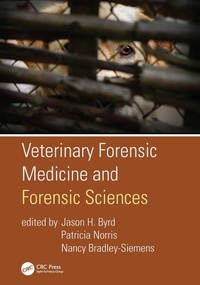
Veterinary Forensic Medicine and Forensic Sciences
1st Edition
Published on 19. July 2020
496 pages
978-1-351-34860-7 (ISBN)
Description

While there are several recent books on this emerging field, Veterinary Forensic Medicine and Forensic Sciences sets the bar, covering all relevant aspects in a succinct, easy-to-read, comprehensive format designed to be taught in a single-semester course. Intended to be the premier textbook on veterinary forensic sciences, the book covers the application of veterinary forensic medicine to cases, including the medical perspective as well as law enforcement response, crime scene management, and evidence recovery issues.
Coverage includes the scientific and legal principles for veterinary forensic evidence. This clearly delineates it from veterinary-only practices, since the forensic aspects present additional challenges that include evidence recovery and preservation, report writing, and maintaining an evidentiary chain of custody, all the way through expert witness testimony. Some emerging topics that are covered include DNA and genetic evidence, entomological evidence in support of veterinary forensics, animal fighting, situational deaths, including poisonings, domestic violence, and cruelty, sharp and blunt force trauma, gunshot and wound ballistics, sexual assault, nonhuman odontology and osteology, and more.
Features
Details a process for forensic science case management for humane law enforcement agencies
Presents multiple chapters on specific types of trauma analysis in animals
Provides developments on current trends in forensic entomology as applied to wildlife crime and minimum postmortem interval determinations
Explores national and international considerations in combating organized animal fighting
Offers DNA applications for wildlife crime and environmental monitoring
Outlines current animal and environmental forensic toxicology legal casework
This text offers a straightforward presentation of current practices and includes several real-world case examples throughout to illustrate concepts. Fully illustrated with more than 280 full-color images, Veterinary Forensic Medicine and Forensic Sciences provides the latest in advances and up-to-date field techniques, applicable for student instruction in the classroom and beyond.
Coverage includes the scientific and legal principles for veterinary forensic evidence. This clearly delineates it from veterinary-only practices, since the forensic aspects present additional challenges that include evidence recovery and preservation, report writing, and maintaining an evidentiary chain of custody, all the way through expert witness testimony. Some emerging topics that are covered include DNA and genetic evidence, entomological evidence in support of veterinary forensics, animal fighting, situational deaths, including poisonings, domestic violence, and cruelty, sharp and blunt force trauma, gunshot and wound ballistics, sexual assault, nonhuman odontology and osteology, and more.
Features
Details a process for forensic science case management for humane law enforcement agencies
Presents multiple chapters on specific types of trauma analysis in animals
Provides developments on current trends in forensic entomology as applied to wildlife crime and minimum postmortem interval determinations
Explores national and international considerations in combating organized animal fighting
Offers DNA applications for wildlife crime and environmental monitoring
Outlines current animal and environmental forensic toxicology legal casework
This text offers a straightforward presentation of current practices and includes several real-world case examples throughout to illustrate concepts. Fully illustrated with more than 280 full-color images, Veterinary Forensic Medicine and Forensic Sciences provides the latest in advances and up-to-date field techniques, applicable for student instruction in the classroom and beyond.
More details
Edition
1. Auflage
Language
English
Place of publication
London
United Kingdom
Publishing group
Taylor & Francis Ltd
Target group
College/higher education
Illustrations
18 Tables, color; 20 Line drawings, color; 278 Halftones, color; 316 Illustrations, color
ISBN-13
978-1-351-34860-7 (9781351348607)
Copyright in bibliographic data and cover images is held by Nielsen Book Services Limited or by the publishers or by their respective licensors: all rights reserved.
Schweitzer Classification
Other editions
Additional editions
Jason H. Byrd | Patricia Norris | Nancy Bradley-Siemens
Veterinary Forensic Medicine and Forensic Sciences
Book
10/2024
1st Edition
CRC Press
€86.00
Shipment within 10-20 days
Jason H. Byrd | Patricia Norris | Nancy Bradley-Siemens
Veterinary Forensic Medicine and Forensic Sciences
Book
07/2020
1st Edition
CRC Press
€186.01
Shipment within 10-20 days
Persons
Jason H. Byrd, PhD, D-ABFE, is a board certified forensic entomologist and diplomate of the American Board of Forensic Entomology. He is the current vice president of the American Board of Forensic Entomology, and the current president of the North American Forensic Entomology Association. Dr. Byrd is a bureau chief with the Florida Division of Agriculture and Consumer Services, and he serves as the associate director of the William R. Maples Center for Forensic Medicine, University of Florida College of Medicine. At the University of Florida, he instructs courses in forensic science at the University of Florida's nationally recognized Hume Honors College. He is also a faculty member of the Virginia Institute of Forensic Science and Medicine. Outside of academics Dr. Byrd serves as an administrative officer within the National Disaster Medical System, Disaster Mortuary Operational Response Team, Region IV. He also serves as the logistics chief for the Florida Emergency Mortuary Operations Response System. Dr. Byrd is a fellow of the American Academy of Forensic Sciences.
Patricia Norris, DVM, is director of the Veterinary Division Animal Welfare Section of the NC Department of Agriculture and Consumer Services in North Carolina. She was previously the staff veterinarian for the Dona Ana County Sheriff's Office, the only position of its kind in the country. She provided veterinary forensic services for their cases of animal cruelty and animal crime, and was commonly asked to assist other law enforcement agencies throughout New Mexico. She has served as veterinarian for the New Mexico Animal Sheltering Board since its inception in 2007 and was a member of the DASO Mounted Patrol Horseback Search and Rescue team. Dr. Norris was in private veterinary practice for 25 years in Virginia, North Carolina, and New Mexico. She served as veterinarian at the Duke University Primate Center to provide care for their colony of endangered lemurs. She also served as veterinarian for the Pitt County Board of Health and on the County Animal Response Teams for Pitt and Madison counties.
Nancy Bradley-Siemens, DVM, has been a veterinarian for 24 years. She started out in private practice and eventually ended up in emergency medicine. The majority of her career has been in shelter medicine working for both animal control agency and a nonprofit humane society. She was the chief veterinarian at Maricopa County Animal Care & Control for 2 years and the chief veterinarian and eventually the medical director for the Arizona Humane Society. She served as a reserve police officer for over 12 years; 3 of those years as a detective with the Maricopa County Sheriff's Office Animal Crimes Unit in the Phoenix area. She was an adjunct assistant clinical professor at Midwestern University College of Veterinary Medicine for 2 years. More recently, she has been a full-time assistant clinical professor of Shelter Medicine at MWU.
Patricia Norris, DVM, is director of the Veterinary Division Animal Welfare Section of the NC Department of Agriculture and Consumer Services in North Carolina. She was previously the staff veterinarian for the Dona Ana County Sheriff's Office, the only position of its kind in the country. She provided veterinary forensic services for their cases of animal cruelty and animal crime, and was commonly asked to assist other law enforcement agencies throughout New Mexico. She has served as veterinarian for the New Mexico Animal Sheltering Board since its inception in 2007 and was a member of the DASO Mounted Patrol Horseback Search and Rescue team. Dr. Norris was in private veterinary practice for 25 years in Virginia, North Carolina, and New Mexico. She served as veterinarian at the Duke University Primate Center to provide care for their colony of endangered lemurs. She also served as veterinarian for the Pitt County Board of Health and on the County Animal Response Teams for Pitt and Madison counties.
Nancy Bradley-Siemens, DVM, has been a veterinarian for 24 years. She started out in private practice and eventually ended up in emergency medicine. The majority of her career has been in shelter medicine working for both animal control agency and a nonprofit humane society. She was the chief veterinarian at Maricopa County Animal Care & Control for 2 years and the chief veterinarian and eventually the medical director for the Arizona Humane Society. She served as a reserve police officer for over 12 years; 3 of those years as a detective with the Maricopa County Sheriff's Office Animal Crimes Unit in the Phoenix area. She was an adjunct assistant clinical professor at Midwestern University College of Veterinary Medicine for 2 years. More recently, she has been a full-time assistant clinical professor of Shelter Medicine at MWU.
Content
1. Animal Crime Scene Investigation. 2. General Principles of Veterinary Forensic Sciences and Medicine. 3. Humane Law Enforcement: From Initial Report to Final Appeal. 4. Animal Genetic Evidence and DNA Analysis. 4. Forensic Entomology. 5. Forensic Entomology. 6. Animal Sexual Assault. 7. Blunt Force Trauma. 8. Sharp Force Trauma. 9. Gunshot Wounds and Wound Ballistics. 10. The Forensice Necropsy. 11. Forensic Veterinary Osteology. 12. Environmental and Situational Injuries/Death: Thermal, Chemical, Electrical, Hyperthermia, and Drowning. 13. Animal Fighting and Hoarding. 14. Veterinary Forensic Toxicology. 15. Animal Abuse and Interpersonal Violence. 16. Animal Neglect and Abuse. 17. Processing Forensic Cases Involving Agricultural Animal Species. 18. Veterinary Forensic Radiology and Imaging. 19. Legal Investigations in Shelter Medicine. 20. Animal Law.
