

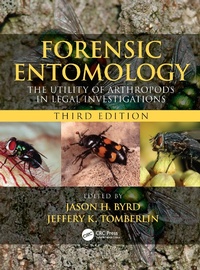
Forensic Entomology
The Utility of Arthropods in Legal Investigations, Third Edition
3rd Edition
Published on 27. November 2019
620 pages
978-1-351-16375-0 (ISBN)
Description

Forensic Entomology: The Utility of Arthropods in Legal Investigations, Third Edition continues in the tradition of the two best-selling prior editions and maintains its status as the single-most comprehensive book on Forensic Entomology currently available. It includes current, in-the-field best practices contributed by top professionals in the field who have advanced it through research and fieldwork over the last several decades.
The use of entomology in crime scene and forensic investigations has never been more prevalent or useful given the work that can be done with entomological evidence. The book recounts briefly the many documented historical applications of forensic entomology over several thousand years. Chapters examine the biological foundations of insect biology and scientific underpinnings of forensic entomology, the principles that govern utilizing insects in legal and criminal investigations. The field today is diverse, both in topics studied, researched and practiced, as is the field of professionals that has expanded throughout the world to become a vital forensic sub-discipline.
Forensic Entomology, Third Edition celebrates this diversity by including several new chapters by premier experts in the field that covers such emerging topics as wildlife forensic entomology, microbiomes, urban forensic entomology, and larval insect identification, many of which are covered in depth for the first time. The book will be an invaluable reference for investigators, legal professionals, researchers, practicing and aspiring forensic entomologists, and for the many students enrolled in forensic science and entomology university programs.
The use of entomology in crime scene and forensic investigations has never been more prevalent or useful given the work that can be done with entomological evidence. The book recounts briefly the many documented historical applications of forensic entomology over several thousand years. Chapters examine the biological foundations of insect biology and scientific underpinnings of forensic entomology, the principles that govern utilizing insects in legal and criminal investigations. The field today is diverse, both in topics studied, researched and practiced, as is the field of professionals that has expanded throughout the world to become a vital forensic sub-discipline.
Forensic Entomology, Third Edition celebrates this diversity by including several new chapters by premier experts in the field that covers such emerging topics as wildlife forensic entomology, microbiomes, urban forensic entomology, and larval insect identification, many of which are covered in depth for the first time. The book will be an invaluable reference for investigators, legal professionals, researchers, practicing and aspiring forensic entomologists, and for the many students enrolled in forensic science and entomology university programs.
More details
Edition
3rd edition
Language
English
Place of publication
London
United Kingdom
Publishing group
Taylor & Francis Ltd
Target group
Professional and scholarly
Illustrations
24 Tables, color; 104 Line drawings, color; 479 Halftones, color
ISBN-13
978-1-351-16375-0 (9781351163750)
Copyright in bibliographic data and cover images is held by Nielsen Book Services Limited or by the publishers or by their respective licensors: all rights reserved.
Schweitzer Classification
Other editions
Additional editions
Jason H. Byrd | Jeffery K. Tomberlin
Forensic Entomology
The Utility of Arthropods in Legal Investigations, Third Edition
Book
01/2020
3rd Edition
CRC Press
€117.50
Shipment within 15-20 days
Jason H. Byrd | Jeffery K. Tomberlin
Forensic Entomology
The Utility of Arthropods in Legal Investigations, Third Edition
Book
12/2019
3rd Edition
CRC Press
€215.40
Shipment within 15-20 days
Previous edition
E-Book
03/2015
1st Edition
CRC Press
€67.49
Available for download
Persons
Dr. Jason H. Byrd, PhD, D-ABFE, is a board-certified forensic entomologist and diplomate of the American Board of Forensic Entomology. He is the current vice president of the American Board of Forensic Entomology, and the current president of the North American Forensic Entomology Association. He is the first person to be elected president of both professional North American forensic entomology associations. Dr. Byrd is a bureau chief with the Florida Division of Agriculture and Consumer Services, and he serves as the associate director of the William R. Maples Center for Forensic Medicine, University of Florida College of Medicine. At the University of Florida, he instructs courses in forensic science at the University of Florida's nationally recognized Hume Honors College. He is also a faculty member of the Virginia Institute of Forensic Science and Medicine. Outside of academics Dr. Byrd serves as an administrative officer within the National Disaster Medical System, Disaster Mortuary Operational Response Team, Region IV. He also serves as the logistics chief for the Florida Emergency Mortuary Operations Response System. Currently he serves as a subject editor for the Journal of Medical Entomology. He has published numerous scientific articles on the use and application of entomological evidence in legal investigations. Dr. Byrd has combined his formal academic training in entomology and forensic science to serve as a consultant and educator in both criminal and civil legal investigations throughout the United States and internationally. Dr. Byrd specializes in the education of law enforcement officials, medical examiners, coroners, attorneys, and other death investigators on the use and applicability of arthropods in legal investigations. His research efforts have focused on the development and behavior of insects that have forensic importance, and he has over 15 years experience in the collection and analysis of entomological evidence. Dr. Byrd is a fellow of the American Academy of Forensic Sciences.
Dr. Jeffery Keith Tomberlin is an associate professor and co-director of the Forensic & Investigative Sciences Program and principal investigator of the Forensic Laboratory for Investigative Entomological Sciences (FLIES) facility at Texas A&M University. Research in the FLIES facility examines species interactions on ephemeral resources such as vertebrate carrion, decomposing plant material, and animal wastes to better understand the mechanisms regulating arthropod behavior related to arrival, colonization, and succession patterns. His research is also focused on waste management in confined animal facilities and the production of alternate protein sources for use as livestock, poultry, and aquaculture feed.
Dr. Jeffery Keith Tomberlin is an associate professor and co-director of the Forensic & Investigative Sciences Program and principal investigator of the Forensic Laboratory for Investigative Entomological Sciences (FLIES) facility at Texas A&M University. Research in the FLIES facility examines species interactions on ephemeral resources such as vertebrate carrion, decomposing plant material, and animal wastes to better understand the mechanisms regulating arthropod behavior related to arrival, colonization, and succession patterns. His research is also focused on waste management in confined animal facilities and the production of alternate protein sources for use as livestock, poultry, and aquaculture feed.
Content
In Memoriam
Foreword
Preface
Acknowledgments
Prologue
Editors
Contributors
Introduction: Current Perceptions and Status of Forensic Entomology
Chapter 1 General Entomology and Basic Arthropod Biology
Adrienne Brundage
Chapter 2 Insects of Forensic Importance
Jason H. Byrd and Jeffery K. Tomberlin
Chapter 3 Entomological Evidence Collections Methods: American Board of Forensic Entomology Approved Protocols
Michelle R. Sanford, Jason H. Byrd, Jeffery K. Tomberlin, and John R. Wallace
Chapter 4 Laboratory-Rearing of Forensic Insects
Jason H. Byrd and Jeffery K. Tomberlin
Chapter 5 Factors That Influence Insect Succession on Carrion
Gail S. Anderson
Chapter 6 Invertebrate Succession in Natural Terrestrial Environments
Philip S. Barton, Melanie S. Archer, Maria-Martina Quaggiotto, and James F. Wallman
Chapter 7 The Role of Aquatic Organisms in Forensic Investigations
John R. Wallace and Richard W. Merritt
Chapter 8 Recovering Buried Bodies and Surface Scatter: The Associated Anthropological, Botanical, and
Entomological Evidence
Heather A. Walsh-Haney, Alison Galloway, and Jason H. Byrd
Chapter 9 Estimating the Postmortem Interval
Jeffrey D. Wells and Lynn R. LaMotte
Chapter 10 Insect Development as It Relates to Forensic Entomology
Aaron M. Tarone and Joshua B. Benoit
Chapter 11 Molecular Genetic Methods for Forensic Entomology
Jamie R. Stevens, Christine J. Picard, and Jeffrey D. Wells
Chapter 12 The Soil Environment and Forensic Entomology
Sasha C. Voss, Shari L. Forbes, and Ian R. Dadour
Chapter 13 Advances in Entomotoxicology: Weaknesses and Strengths
Carlo P. Campobasso, Valentina Bugelli, Anna Carfora, Renata Borriello, and Martin Villet
Chapter 14 Is PMI the Hypothesis or the Null Hypothesis?
Michelle R. Sanford and Aaron M. Tarone
Chapter 15 The Forensic Entomologist as Expert Witness
Robert D. Hall
Chapter 16 Livestock Entomology
Justin Talley and Erika Machtinger
Chapter 17 Ecological Theory of Community Assembly and Its Application in Forensic Entomology
Sherah L. VanLaerhoven
Chapter 18 Forensic Meteorology: The Science of Applying Weather Observations to Civil and Criminal Litigation
John R. Scala and John R. Wallace
Chapter 19 Entomological Alteration of Bloodstain Evidence
M. Anderson Parker, Stacey L. Sneider, Shayne A. Smithey, Mark Benecke, and Jason H. Byrd
Chapter 20 Keys to the Genera and Species of Blow Flies (Diptera: Calliphoridae) of America, North of Mexico
Terry Whitworth
Chapter 21 The Use of Entomological Evidence in Analyzing Cases of Neglect and Abuse in Humans and Animals
Gail S. Anderson
Chapter 22 Acarology in Crimino-Legal Investigations: The Human Acarofauna During Life and Death
M. Alejandra Perotti and Henk R. Braig
Chapter 23 Wildlife Forensic Entomology
Gail S. Anderson and Jason H. Byrd
Chapter 24 The Role of Decomposition Volatile Organic Compounds in Chemical Ecology
Helene N. LeBlanc, Katelynn A. Perrault, and Julie Ly
Chapter 25 Forensic Entomology and the Microbiome
M. Eric Benbow and Jennifer L. Pechal
Chapter 26 Urban Entomology
Robert T. Puckett and Jeffery K. Tomberlin
Chapter 27 Larvae of the North American Calyptratae Flies of Forensic Importance
Krzysztof Szpila and Andrzej Grzywacz
Chapter 28 The Professional History of Forensic Entomology
M. Denise Gemmellaro and Lauren M. Weidner
Chapter 29 Practical Considerations for Teaching Forensic Entomology
Elizabeth Butin, David Rivers, and John R. Wallace
Foreword
Preface
Acknowledgments
Prologue
Editors
Contributors
Introduction: Current Perceptions and Status of Forensic Entomology
Chapter 1 General Entomology and Basic Arthropod Biology
Adrienne Brundage
Chapter 2 Insects of Forensic Importance
Jason H. Byrd and Jeffery K. Tomberlin
Chapter 3 Entomological Evidence Collections Methods: American Board of Forensic Entomology Approved Protocols
Michelle R. Sanford, Jason H. Byrd, Jeffery K. Tomberlin, and John R. Wallace
Chapter 4 Laboratory-Rearing of Forensic Insects
Jason H. Byrd and Jeffery K. Tomberlin
Chapter 5 Factors That Influence Insect Succession on Carrion
Gail S. Anderson
Chapter 6 Invertebrate Succession in Natural Terrestrial Environments
Philip S. Barton, Melanie S. Archer, Maria-Martina Quaggiotto, and James F. Wallman
Chapter 7 The Role of Aquatic Organisms in Forensic Investigations
John R. Wallace and Richard W. Merritt
Chapter 8 Recovering Buried Bodies and Surface Scatter: The Associated Anthropological, Botanical, and
Entomological Evidence
Heather A. Walsh-Haney, Alison Galloway, and Jason H. Byrd
Chapter 9 Estimating the Postmortem Interval
Jeffrey D. Wells and Lynn R. LaMotte
Chapter 10 Insect Development as It Relates to Forensic Entomology
Aaron M. Tarone and Joshua B. Benoit
Chapter 11 Molecular Genetic Methods for Forensic Entomology
Jamie R. Stevens, Christine J. Picard, and Jeffrey D. Wells
Chapter 12 The Soil Environment and Forensic Entomology
Sasha C. Voss, Shari L. Forbes, and Ian R. Dadour
Chapter 13 Advances in Entomotoxicology: Weaknesses and Strengths
Carlo P. Campobasso, Valentina Bugelli, Anna Carfora, Renata Borriello, and Martin Villet
Chapter 14 Is PMI the Hypothesis or the Null Hypothesis?
Michelle R. Sanford and Aaron M. Tarone
Chapter 15 The Forensic Entomologist as Expert Witness
Robert D. Hall
Chapter 16 Livestock Entomology
Justin Talley and Erika Machtinger
Chapter 17 Ecological Theory of Community Assembly and Its Application in Forensic Entomology
Sherah L. VanLaerhoven
Chapter 18 Forensic Meteorology: The Science of Applying Weather Observations to Civil and Criminal Litigation
John R. Scala and John R. Wallace
Chapter 19 Entomological Alteration of Bloodstain Evidence
M. Anderson Parker, Stacey L. Sneider, Shayne A. Smithey, Mark Benecke, and Jason H. Byrd
Chapter 20 Keys to the Genera and Species of Blow Flies (Diptera: Calliphoridae) of America, North of Mexico
Terry Whitworth
Chapter 21 The Use of Entomological Evidence in Analyzing Cases of Neglect and Abuse in Humans and Animals
Gail S. Anderson
Chapter 22 Acarology in Crimino-Legal Investigations: The Human Acarofauna During Life and Death
M. Alejandra Perotti and Henk R. Braig
Chapter 23 Wildlife Forensic Entomology
Gail S. Anderson and Jason H. Byrd
Chapter 24 The Role of Decomposition Volatile Organic Compounds in Chemical Ecology
Helene N. LeBlanc, Katelynn A. Perrault, and Julie Ly
Chapter 25 Forensic Entomology and the Microbiome
M. Eric Benbow and Jennifer L. Pechal
Chapter 26 Urban Entomology
Robert T. Puckett and Jeffery K. Tomberlin
Chapter 27 Larvae of the North American Calyptratae Flies of Forensic Importance
Krzysztof Szpila and Andrzej Grzywacz
Chapter 28 The Professional History of Forensic Entomology
M. Denise Gemmellaro and Lauren M. Weidner
Chapter 29 Practical Considerations for Teaching Forensic Entomology
Elizabeth Butin, David Rivers, and John R. Wallace
