

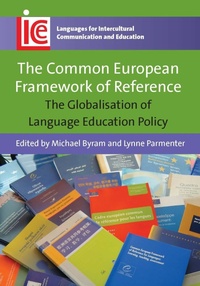
The Common European Framework of Reference
The Globalisation of Language Education Policy
Published on 6. June 2012
296 pages
978-1-84769-732-5 (ISBN)
Description

The Common European Framework of Reference for Languages was published a decade ago and has been influential ever since, not only in its European 'home' but throughout the world. This book traces the processes of the influence by inviting authors from universities and ministries in 11 countries to describe and explain what happened in their case. There are everyday factors of curriculum development - which sometimes include coincidence and happenstance - and there are also traditions of resistance or acceptance of external influences in policy-making. Such factors have always existed in bilateral borrowing from one country to another but the CEFR is a supra-national document accessible through globalised communication. The book is thus not only focused on matters of language education but is also a Comparative Education case-study of policy borrowing under new conditions.
Reviews / Votes
Read either in its entirety or as a country-level reference, the succinct overviews of a range of historical and contemporary language policy contexts and their challenges is useful for policy makers, researchers, and practitioners alike. Overall, this edited book is an important academic contribution demonstrating how fundamental language education is to broader issues related to the globalisation of higher education and will hopefully be followed up with a second volume discussing these issues further. -- Elise S. Ahn, KIMEP University, Kazakhstan * Language Policy (2015) 14:293-295 * An original and timely addition to the CEFR literature, this comparative analysis of the factors and complex challenges associated with the use of the CEFR in different contexts and traditions considerably enriches our understanding of its influence both in Europe and other continents. The commentaries draw on a widely contrasting range of case studies to explore how the widespread application of the CEFR is leading to a new kind of policy and a new kind of policy borrowing - not from country to country as in the past, but as an international phenomenon which almost disseminates itself, rather than being disseminated. * Joe Sheils, formerly Head of the Department of Language Education and Policy, Council of Europe * At last, we have an excellent empirical study on the international impact of CEFR. The underlining of the similarities and differences in the reception and usage of the document offers much food for thought for language and comparative education specialists. A real success! * Daniel Coste, Professor Emeritus, Ecole Normale Sup * A great virtue of this book is how it encapsulates the three mutually producing forces in education today: regionalisation, globalisation and localisation. The CEFR originated in Europe but then spread far and wide in the inevitable interlinked processes of globalisation that characterise so much of education today. However, when applied in contexts very different from the originating reality of Europe the CEFR underwent the process of adaptation that we can call localisation. The discussion powerfully traces the role of influence, borrowing, demonstration in public policy in the crucial area of communication in education. * Joseph Lo Bianco, University of Melbourne, Australia * The book contains many further interesting data about the impact of the CEFR in various countries that may be of interest to everybody interested in international language policy issues. * Ge Stoks, Locarno in Babylonia, no. 1 (2013) *More details
Series
Language
English
Place of publication
Bristol
United Kingdom
Publishing group
Channel View Publications Ltd
Target group
Professional and scholarly
ISBN-13
978-1-84769-732-5 (9781847697325)
Copyright in bibliographic data and cover images is held by Nielsen Book Services Limited or by the publishers or by their respective licensors: all rights reserved.
Schweitzer Classification
Other editions
Additional editions
Michael Byram | Lynne Parmenter
The Common European Framework of Reference
The Globalisation of Language Education Policy
Book
06/2012
Multilingual Matters
€48.10
Shipment within 10-20 days
Persons
Michael Byram taught languages in secondary school and adult education. At Durham University since 1980, now emeritus, he has researched the education of linguistic minorities and foreign language education. His most recent book is From Foreign Language Education to Education for Intercultural Citizenship (Multilingual Matters) and he is the editor of the Routledge Encyclopedia of Language Teaching and Learning.
Lynne Parmenter is a Principal Lecturer in International Education at the Institute of Education, Manchester Metropolitan University. Until 2010, she spent 17 years teaching in schools and universities in Japan. Her main research interests are in global citizenship education and the negotiation of education policy and practice in the context of globalization.
Lynne Parmenter is a Principal Lecturer in International Education at the Institute of Education, Manchester Metropolitan University. Until 2010, she spent 17 years teaching in schools and universities in Japan. Her main research interests are in global citizenship education and the negotiation of education policy and practice in the context of globalization.
Content
Series Editor's Preface
Introduction - Michael Byram and Lynne Parmenter
The Common European Framework of Reference: Learning, Teaching, Assessment
1. John Trim: The Common European Framework of Reference for Languages and its Background: A Case Study of Cultural Politics and Educational Influences
Part 1: The CEFR in Europe
France
2. Francis Goullier: Policy Perspectives from France
3. Veronique Castellotti: Academic Perspectives from France
Germany
4. Henny Roenneper: Policy Perspectives from Germany
5. Adelheid Hu: Academic Perspectives from Germany
Bulgaria
6. Maria Stoicheva: Policy Perspectives from Bulgaria
7. Maria Stoicheva and Pavlina Stefanova: Academic Perspectives from Bulgaria
Poland
8. Pawel Poszytek: Policy Perspectives from Poland
9. Hanna Komorowska: Academic Perspectives from Poland
Commentary on the European Cases - Michael Byram and Lynne Parmenter
Part 2: The CEFR beyond Europe
America
Argentina
10. Melina Porto and Silvana Barboni: Policy Perspectives from Argentina
11. Melina Porto: Academic Perspectives from Argentina
Colombia
12. Beatriz Pena Dix and Anne-Marie de Mejia: Policy Perspectives from Colombia
13. Anne-Marie de Mejia: Academic Perspectives from Colombia
USA
14. Jacqueline Van Houten: Policy Perspectives from the USA
15. Heidi Byrnes: Academic Perspectives from the USA
Asia-Pacific
China
16. Weicheng Zou: Perspectives from China
Japan
17. Masako Sugitani and Yuichi Tomita: Perspectives from Japan
Taiwan
18. Jessica Wu: Policy Perspectives from Taiwan
19. Hintat Cheung: Academic Perspectives from Taiwan
New Zealand
20. Glenda Koefoed: Policy Perspectives from New Zealand
21. Adele Scott and Martin East: Academic Perspectives from New Zealand
Commentary on Cases beyond Europe - Lynne Parmenter and Michael Byram
Conclusion - Lynne Parmenter and Michael Byram
Introduction - Michael Byram and Lynne Parmenter
The Common European Framework of Reference: Learning, Teaching, Assessment
1. John Trim: The Common European Framework of Reference for Languages and its Background: A Case Study of Cultural Politics and Educational Influences
Part 1: The CEFR in Europe
France
2. Francis Goullier: Policy Perspectives from France
3. Veronique Castellotti: Academic Perspectives from France
Germany
4. Henny Roenneper: Policy Perspectives from Germany
5. Adelheid Hu: Academic Perspectives from Germany
Bulgaria
6. Maria Stoicheva: Policy Perspectives from Bulgaria
7. Maria Stoicheva and Pavlina Stefanova: Academic Perspectives from Bulgaria
Poland
8. Pawel Poszytek: Policy Perspectives from Poland
9. Hanna Komorowska: Academic Perspectives from Poland
Commentary on the European Cases - Michael Byram and Lynne Parmenter
Part 2: The CEFR beyond Europe
America
Argentina
10. Melina Porto and Silvana Barboni: Policy Perspectives from Argentina
11. Melina Porto: Academic Perspectives from Argentina
Colombia
12. Beatriz Pena Dix and Anne-Marie de Mejia: Policy Perspectives from Colombia
13. Anne-Marie de Mejia: Academic Perspectives from Colombia
USA
14. Jacqueline Van Houten: Policy Perspectives from the USA
15. Heidi Byrnes: Academic Perspectives from the USA
Asia-Pacific
China
16. Weicheng Zou: Perspectives from China
Japan
17. Masako Sugitani and Yuichi Tomita: Perspectives from Japan
Taiwan
18. Jessica Wu: Policy Perspectives from Taiwan
19. Hintat Cheung: Academic Perspectives from Taiwan
New Zealand
20. Glenda Koefoed: Policy Perspectives from New Zealand
21. Adele Scott and Martin East: Academic Perspectives from New Zealand
Commentary on Cases beyond Europe - Lynne Parmenter and Michael Byram
Conclusion - Lynne Parmenter and Michael Byram
