

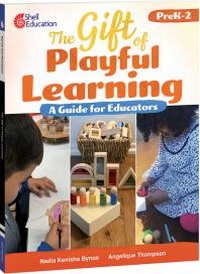
The Gift of Playful Learning
A Guide for Educators
Published on 7. February 2023
232 pages
978-1-0876-4908-5 (ISBN)
Description

Explore the power of play-based culturally relevant curriculum in early childhood classrooms! This teacher resource provides practical strategies that create playful learning opportunities for diverse students. From authors Nadia Kenisha Bynoe and Angelique Thompson, this book serves as a comprehensive guide to using play-based learning experiences to introduce curriculum content. With these useful strategies and tips, educators can create equitable learning environments that support the diverse needs of learners and speak to multiple identities and lived experiences. Engage children in purposeful learning that is designed to provoke thought, curiosity, and wonder with the help of this book!
More details
Series
Language
English
Place of publication
Huntington Beach
United States
Target group
Professional and scholarly
US School Grade: From Preschool to Second Grade
File size
125,20 MB
ISBN-13
978-1-0876-4908-5 (9781087649085)
Copyright in bibliographic data and cover images is held by Nielsen Book Services Limited or by the publishers or by their respective licensors: all rights reserved.
Schweitzer Classification
Other editions
Additional editions
Book
02/2023
Shell Educational Publishing
€42.00
Shipment within 5-8 weeks
Content
- Cover
- Copyright page
- Page v - Table of Contents
- Page Vi -Table of Contents
- Page Vii - Table of Contents
- Page Viii - Table of Contents Cont.
- Page ix - Acknowledgments
- Page 1 - Introduction: The Invitation
- Page 2 -Responding to the Invite and Wrapping the Gift
- Page 3 -Accepting the Invite
- Page 4 - Unwrapping the Gift
- Page 5 - How to Unwrap This Gift
- Page 9 - Chapter 1. Exploring the Landscape of Play
- Page 10 - Play as a Right
- Page 11 - What Is Play?
- Page 13 - Why Is Play Important?
- Page 15 - What Are Play-Based Approaches to Learning?
- Page 20 - Culturally Relevant Pedagogy in Play
- Page 25 - Uncovering Biases and Assumptions
- Page 27 - Additional Considerations
- Page 30 - Gifts of Learning
- Page 33 - Chapter 2. Creating Spaces That Speak
- Page 34 - Mapping Memories
- Page 35 - The Environment Is a Teacher
- Page 36 - Elements of the Learning Environment
- Page 44 - Disrupting Spaces That Silence
- Page 45 - Rights to Spaces
- Pge 54 - Designing Spaces
- Page 62 - Living within Spaces That Speak
- Page 63 - Shifting Spaces
- Page 64 - Additional Considerations
- Page 67 - Gifts of Learning
- Page 71 - Chapter 3. Playful Pieces
- Page 72 - The Theory of Loose Parts
- Page 72 - The Great Debate: Toys versus Loose Parts
- Page 74 - The Power to Manipulate
- Page 75 - Leveraging Loose Parts
- Page 78 - Loose Parts and Culturally Relevant Pedagogy
- Page 79 - The Seven Types of Loose Parts
- Page 80 - The Language of Schema
- Page 82 - Creating Conditions for Play with Loose Parts
- Page 83 - Scaffolding Loose Parts
- Page 83 - Creating Intentional Experiences with Loose Parts
- Page 88 - Comprehensive Loose Parts Programming
- Page 89 - Strategic Actions for Loose Parts
- Page 90 - Engaging with Loose Parts
- Page 91 - Safety in the Learning Environment
- Page 92 - Additional Considerations
- Page 95 - Gifts of Learning
- Page 97 - Chapter 4. Inviting Learning
- Page 98 - What Is an Invitation for Learning?
- Page 100 - Preparing the Gift
- Page 104 - What Are the Components of an Invitation for Learning?
- Page106 - Opportunities for Learning
- Page 108 - How Should We Offer Invitations in Our Learning Spaces?
- Page 110 - Responsive Learning Opportunities
- Page 111 - Identifying De-invitations
- Page 117 - Additional Considerations
- Page 120 - Gifts of Learning
- Page 123 - Chapter 5. Planning with Purpose
- Page 124 - The Gift That Keeps on Giving
- Page 127- Follow Learners' Interests
- Page 128 - Select a Text, a Photo, or an Artifact, and Connect It to the Curriculum
- Page 129 - Develop a Question
- Page 132 - Consider the Materials
- Page 133 - Organize and Market
- Page 135 - Assess and Reflect
- Page.135 - A Call to Action
- Page 139 - Regifting Invitations for Learning
- Page 144 - Additional Considerations
- Page 148 - Gifts of Learning
- Page 151 - Chapter 6. Playful Assessments
- Page 156 - What Moments Should We Capture?
- Page 157 - How Can We Capture the Moment?
- Page 157 - What Is Pedagogical Documentation?
- Page 158 - The Process of Pedagogical Documentation
- Page 161 - Biases and Assumptions
- Page163 - Reducing Bias in Assessments
- Page 164 - Stages of Pedagogical Documentation
- Page 166 - Honoring Student Voices in Documentation
- Page 167 - Sharing a Child's Story
- Page 169 - Self-Documentation
- Page 170 - Responding to, Challenging, and Extending Thinking
- Page 172 - Noticing and Naming the Learning
- Page 173 - Conferencing
- Page 173 - Sharing and Celebrating Learning
- Page 175 - Additional Considerations
- Page 178 - Gifts of Learning
- Page 181 - Chapter 7. Playful Partnerships
- Page 182 - Our Views of Families
- Page 183 - Key Characteristics of Family Partnerships
- Page 185 - Family Engagement
- Page 187 - Building and Sustaining Connections
- Page 191 - Opening the Doors to Play
- Page 197 - Additional Considerations
- Page 200 - Gifts of Learning
- Page 203 - Afterword
- Page 207 - Children's Literature
- Page 209 - References
- Page 213 - Index
- Page 219 - Digital Resources
- BackCover
