

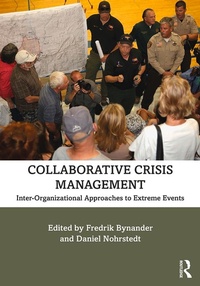
Collaborative Crisis Management
Inter-Organizational Approaches to Extreme Events
1st Edition
Published on 27. November 2019
180 pages
978-0-429-52104-1 (ISBN)
Description

Public organizations are increasingly expected to cope with crisis under the same resource constraints and mandates that make up their normal routines, reinforced only through collaboration. Collaborative Crisis Management introduces readers to how collaboration shapes societies' capacity to plan for, respond to, and recover from extreme and unscheduled events.
Placing emphasis on five conceptual dimensions, this book teaches students how this panacea works out on the ground and in the boardrooms, and how insights on collaborative practices can shed light on the outcomes of complex inter-organizational challenges across cases derived from different problem areas, administrative cultures, and national systems. Written in a concise, accessible style by experienced teachers and scholars, it places modes of collaboration under an analytical microscope by assessing not only the collaborative tools available to actors but also how they are used, to what effect, and with which adaptive capacity. Ten empirical chapters span different international cases and contexts discussing:
Natural and "man-made" hazards: earthquakes, hurricanes, wildfires, terrorism, migration flows, and violent protests
Different examples of collaborative institutions, such as regional economic communities in Africa, and multi-level arrangements in Canada, the Netherlands, Turkey, and Switzerland
Application of a multimethod approach, including single case studies, comparative case studies, process-tracing, and "large-n" designs.
Collaborative Crisis Management is essential reading for those involved in researching and teaching crisis management.
Placing emphasis on five conceptual dimensions, this book teaches students how this panacea works out on the ground and in the boardrooms, and how insights on collaborative practices can shed light on the outcomes of complex inter-organizational challenges across cases derived from different problem areas, administrative cultures, and national systems. Written in a concise, accessible style by experienced teachers and scholars, it places modes of collaboration under an analytical microscope by assessing not only the collaborative tools available to actors but also how they are used, to what effect, and with which adaptive capacity. Ten empirical chapters span different international cases and contexts discussing:
Natural and "man-made" hazards: earthquakes, hurricanes, wildfires, terrorism, migration flows, and violent protests
Different examples of collaborative institutions, such as regional economic communities in Africa, and multi-level arrangements in Canada, the Netherlands, Turkey, and Switzerland
Application of a multimethod approach, including single case studies, comparative case studies, process-tracing, and "large-n" designs.
Collaborative Crisis Management is essential reading for those involved in researching and teaching crisis management.
Reviews / Votes
"Crisis collaboration across geographical and administrative borders is a must. It is also extremely hard. Under the guidance of Bynander and Nohrstedt, crisis experts pursue the Holy Grail of crisis collaboration in an exciting set of case studies. Extremely relevant for both academics and practitioners. A welcome addition to the crisis literature!" -Arjen Boin, Leiden University"Collaborative Crisis Management addresses collective action dilemma in response to major crises and disasters such as terrorism, wildfires, and earthquakes in different geographies, cultures, and political and administrative settings. This timely volume provides conceptually and analytically valuable perspectives from experts in the field in applying network governance in dealing with crises and disasters. The volume is an essential resource for both scholars and practitioners." -Naim Kapucu, Ph.D., Pegasus Professor & Director of the School of Public Administration, University of Central Florida
"Emergency management is, above all, a social process. This authoritative book provides a valuable structure for analyzing the participation of people and organizations in crisis response. Its coverage of hazards and geographical areas is broad and eclectic. In responding to disasters and major incidents, collaboration is becoming more and more necessary. Many different agencies are likely to be involved, and hence the interorganizational perspective brought by the authors of this book is particularly welcome." -David Alexander, Professor of Risk and Disaster Reduction, University College London
More details
Edition
1. Auflage
Language
English
Place of publication
London
United Kingdom
Publishing group
Taylor & Francis Ltd
Target group
College/higher education
Professional and scholarly
Illustrations
18 Tables, black and white; 6 Line drawings, black and white
ISBN-13
978-0-429-52104-1 (9780429521041)
Copyright in bibliographic data and cover images is held by Nielsen Book Services Limited or by the publishers or by their respective licensors: all rights reserved.
Schweitzer Classification
Other editions
Additional editions
Fredrik Bynander | Daniel Nohrstedt
Collaborative Crisis Management
Inter-Organizational Approaches to Extreme Events
Book
12/2019
1st Edition
Routledge
€54.55
Shipment within 15-20 days
Fredrik Bynander | Daniel Nohrstedt
Collaborative Crisis Management
Inter-Organizational Approaches to Extreme Events
Book
12/2019
1st Edition
Routledge
€179.81
Shipment within 15-20 days
Persons
Fredrik Bynander is Director of the Center for Societal Security and Chairman of the Board of the Center of Natural Hazards and Disaster Science (CNDS). Prior to this appointment, Fredrik was head of strategic planning at the Prime Minister's Office Secretariat for Crisis Coordination. His current research interests include crisis management studies, leadership succession, and foreign policy analysis. Frederik is a member of the Royal Academy of War Sciences and the Swedish Society for International Affairs.
Daniel Nohrstedt is Associate Professor of Political Science at Uppsala University, Sweden. He studies processes of inter-organizational collaboration, learning, change, and performance in the context of crisis management and natural hazards planning. His other research interests include policy process theory (particularly the Advocacy Coalition Framework), governance, policy network theory, and collaborative public management.
Daniel Nohrstedt is Associate Professor of Political Science at Uppsala University, Sweden. He studies processes of inter-organizational collaboration, learning, change, and performance in the context of crisis management and natural hazards planning. His other research interests include policy process theory (particularly the Advocacy Coalition Framework), governance, policy network theory, and collaborative public management.
Content
Acknowledgments
List of Figures
Appendices
List of Tables
List of Contributors
1. Collaborative Crisis Management: Inter-Organizational Approaches to Extreme Events
Fredrik Bynander and Daniel Nohrstedt
2. Upscaling Collaborative Crisis Management: A Comparison of Wildfire Responder Networks in Canada and Sweden
Daniel Nohrstedt, Julia Baird, OErjan Bodin, Ryan Plummer and Robert Summers
3. Secure Summits: Collaborative Crisis Management Before and During Global Government Conventions
Sanneke Kuipers and Marij Swinkels
4. Managing Extraordinary Influx of Migrants: The 2015 Migration Crisis in Sweden
Edward Deverell and Dan Hansen
5. Overcoming Collective-Action Problems in Collaborative Crisis Management: Meta-Governance and Security Communications Systems
Oscar L. Larsson
6. Vertical Collaboration During the 2014 Swedish Wildfire
Fredrik Bynander
7. Collaborative Crisis Management in Turkey: Perceptions and Outcomes of Collaboration During Two Earthquakes
Helena Hermansson
8. Transregional Crisis Management in Africa
Simon Hollis and Eva-Karin Olsson
9. Addressing the Challenges of Transboundary Crises: The Dutch Local Response to the Global Surge in ISIS Supporters
Scott Douglas, Aline Bos and Mirko Noordegraaf
10. Avoiding the Failures of Collaborative Crisis Management: Lessons from Research and Practice
Charles F. Parker and Bengt Sundelius
11. Under What Conditions Does an Extreme Event Deploy its Focal Power?: Toward Collaborative Governance in Swiss Flood Risk Management
Karin Ingold and Alexandra Gavilano
12. Lessons and Avenues for Future Research in Collaborative Crisis Management
Daniel Nohrstedt And Fredrik Bynander
Index
List of Figures
Appendices
List of Tables
List of Contributors
1. Collaborative Crisis Management: Inter-Organizational Approaches to Extreme Events
Fredrik Bynander and Daniel Nohrstedt
2. Upscaling Collaborative Crisis Management: A Comparison of Wildfire Responder Networks in Canada and Sweden
Daniel Nohrstedt, Julia Baird, OErjan Bodin, Ryan Plummer and Robert Summers
3. Secure Summits: Collaborative Crisis Management Before and During Global Government Conventions
Sanneke Kuipers and Marij Swinkels
4. Managing Extraordinary Influx of Migrants: The 2015 Migration Crisis in Sweden
Edward Deverell and Dan Hansen
5. Overcoming Collective-Action Problems in Collaborative Crisis Management: Meta-Governance and Security Communications Systems
Oscar L. Larsson
6. Vertical Collaboration During the 2014 Swedish Wildfire
Fredrik Bynander
7. Collaborative Crisis Management in Turkey: Perceptions and Outcomes of Collaboration During Two Earthquakes
Helena Hermansson
8. Transregional Crisis Management in Africa
Simon Hollis and Eva-Karin Olsson
9. Addressing the Challenges of Transboundary Crises: The Dutch Local Response to the Global Surge in ISIS Supporters
Scott Douglas, Aline Bos and Mirko Noordegraaf
10. Avoiding the Failures of Collaborative Crisis Management: Lessons from Research and Practice
Charles F. Parker and Bengt Sundelius
11. Under What Conditions Does an Extreme Event Deploy its Focal Power?: Toward Collaborative Governance in Swiss Flood Risk Management
Karin Ingold and Alexandra Gavilano
12. Lessons and Avenues for Future Research in Collaborative Crisis Management
Daniel Nohrstedt And Fredrik Bynander
Index
