

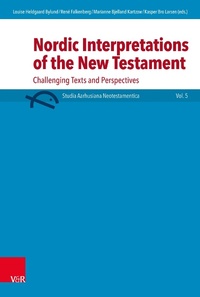
Nordic Interpretations of the New Testament
Challenging Texts and Perspectives
1st Edition
Published on 7. September 2020
308 pages
978-3-647-55456-3 (ISBN)
Description

This volume brings together contributions from the ongoing conversation among New Testament scholars from the Nordic Countries, namely Denmark, Iceland, Finland, Norway, and Sweden. The aim is to challenge the New Testament texts and their interpretations but also to be challenged by these texts and interpretation, i.e., how to read, interpret and contextualize the impact of these texts, and how to conceptualize the power and authority attributed to them.
As neighbours in peripheral Europe, partly sharing language and history, scholars of this region also aim to participatie in the broader international discourse. The fact that their common academic language is English begs the question whether many of the current essays could have been written in different settings, since they do not explicitly reflect on contextual issues. Or is this the case?
What characterizes that part of the world are social democracies with relatively high standards of living, a strong protestant past but an increasing multicultural population, public welfare systems, and gender equality. Public universities still have money and can prioritize mobility and internationalisation; accordingly, although few people live in the Nordic countries relatively many biblical scholars have roots there.
More details
Other editions
Additional editions
Louise Heldgaard Bylund | René Falkenberg | Marianne Bjelland Kartzow
Nordic Interpretations of the New Testament
Challenging Texts and Perspectives
Book
09/2020
1st Edition
Vandenhoeck & Ruprecht
€140.00
Shipment within 5-7 days
Persons
Louise Heldgaard Bylund is PhD Candidate at Aarhus University.
Content
- Intro
- Title Page
- Copyright
- Table of Contents
- Louise Heldgaard Bylund, René Falkenberg, Marianne Bjelland Kartzow' and Kasper Bro Larsen: What Makes New Testament Texts and Interpretations So Challenging?
- Body
- 1. Towards a Nordic Answer
- 2. Text, Translation, and Reception
- 3. Gender, Empire, Emotion, and Drama
- 4. Perspectives on Paul and Jesus
- 5. Current Nordic Suggestions and Answers
- Bibliography
- I. Text, Translation, and Reception
- Gitte Buch-Hansen: "Permit the Slaves to Come to Me"
- 1. Introduction: Mark's pa?d?a: Children or Slaves?
- 1.1 Mark 10:13-16: A Baptismal Text?
- 1.2 Markan pa?d?a: Children or Slaves?
- 1.3 The Intersection between pa?d??? and d????? in Aristotle's Politics
- 2. The Reception History of Mark 10:13-16
- 2.1 Mark 10:13-16 in Recent Exegesis
- 2.2 Visual Reception History of Mark 10:13-16
- 3. The Enigma of the Disciples' Reaction (Mark 10:14)
- 3.1 Threatening Children?
- 3.2 Baptism and t? pa?d?a: Any Obstacles?
- 3.3 Eucharist and t? pa?d?a: Any Obstacles?
- 4. Re-Reading Mark 10:13-16 in Context
- 4.1 Introduction
- 4.2 Mark 9:33-37
- 4.3 Mark 10:42-45
- 4.4 Mark 9:42-48
- 5. Conclusion
- Bibliography
- Halvor Moxnes: Social Scientific Interpretation of the New Testament and a Hermeneutics of Dialogue
- 1. Introduction
- 2. Purpose and Origin of Social Science Criticism
- 3. The Engaged Scholar: Biographies of Hermeneutics
- 4. Reconstructing Historical Societies: Social Worlds and Models
- 5. Bridging the Gap
- 6. From a Hermeneutics of Application to a Hermeneutics of Dialogue
- 7. Schleiermacher as a Model for Social Science Criticism and Hermeneutics
- 8. Conclusion
- Bibliography
- Gunnar Haaland: Who Are the Pharisees of Today?
- 1. Introduction
- 2. Theoretical Perspectives
- 3. Lectionary resources
- 4. Queering the Pharisees
- 5. Pharisaism and "Tax Collector Pharisaism"
- 6. Pharisee, I?
- 7. A Kind of People Described in Old Books
- 8. Comparisons and Conclusions
- Bibliography
- Morten Beckmann: Negotiating Christology
- 1. The Material
- 2. Ideology and Translation
- 3. Translation Methods and Ideology
- 4. Colossians 1:15 in NO1978
- 5. Colossians 1:15 in Bibel 2011
- 5.1 Avoiding the Solutions in the Translator's First Draft
- 5.2 Avoiding the Solutions in the Translator's Second Draft
- 5.3 Avoiding Mention of the Partitive Suggestions
- 5.4 Avoiding a Poet's Suggestion
- 6. Form and Meaning in Exegetical Commentaries on Colossians
- 7. Ideology: Consciously or Unconsciously Applied?
- 8. Last Remarks
- 9. Outlook
- Bibliography
- Bible translations
- Correspondence
- Interviews
- Archive
- II. Gender, Empire, Emotion, and Drama
- Martin Friis: Jesus, a Wise and Courageous Man
- 1. Jesus, a Masculine Man
- 2. Jesus, a Brave Man
- 3. Jesus, an Outspoken Man
- 4. Jesus, a Wise and Didactical man
- 5. Conclusion
- Bibliography
- Maria Sturesson: Voicing the Resurrection
- 1. What Is a Narrator?
- 2. The Women at the Tomb and Gospel Stories
- 3. The Gospel of Mark
- 4. The Gospel of Matthew
- 5. The Gospel of Luke
- 6. The Gospel of John
- 7. The Gospel of Peter
- 8. The Epistula Apostolorum
- 9. The Gospel of Nicodemus
- 10. Concluding Words
- Bibliography
- Niko Huttunen: After Anti-Imperial Readings
- 1. Introduction
- 2. Civil Authorities in Romans 13
- 3. Christian soldiers
- 3.1 Soldiers and Military Discourse in the New Testament
- 3.2 Soldiers in Postbiblical Early Christianity
- 4. Conclusion
- Bibliography
- Paul Linjamaa: An Early Christian View on Emotions
- 1. Introduction
- 2. A Tractate in Three Parts and Its Philosophical System
- 3. Passions and Impressions: First Movements and Blamelessness
- 4. The Savior as an Apathetic Sage
- 5. Anthropology and the Accusation of Determinism Leveled at Stoics and Valentinians
- 6. Conclusion
- Bibliography
- Louise Heldgaard Bylund: ??????S??? (John 19:28 and 30)
- 1. Introduction
- 2. ?e??? and te?e??? in John
- 3. ?e?e??? and p????? in John
- 4. ???e??? and t????
- 5. ?e??? and te?e??? in the Biblical Corpus
- 6. ?et??esta? as Reversal of Fortune
- 6.1 ?et??esta? in Ancient Greek Literature
- 6.2 Aristotle: Poetics
- 7. ?et??esta? as an Eschatological Turning Point
- 7.1 ????? in the New Testament
- 7.2 Genesis and John: ???? and t????
- 8. Conclusion
- Bibliography
- III. Perspectives on Paul and Jesus
- Magnus Zetterholm: From Jewish to Gentile "Christianity"
- 1. Introduction
- 2. The Traditional View on Paul and Judaism
- 3. A Paul within Judaism Perspective
- 4. The Disappearance of the "Jewish Christians"
- 5. Paul and the Salvation of the Nations
- 6. Conclusion
- Bibliography
- Samuel Tedder: Children of Promise
- 1. Introduction
- 2. Paul's Allegorical Practice and My Approach
- 3. Jerusalem Above, Isaiah's Vision of Restoration, and The New Creation People
- 4. Children of Promise and the Identity of God's People
- 5. Conclusions
- Bibliography
- Jacob P.B. Mortensen: Do We Uphold the Law for the "Weak"?
- 1. Background and Interpretive Foundations
- 2. Problem
- 3. Rhetorical Strategy of Chapter 3
- 3.1 3:27-31
- 3.2 3:21-3:31 - Continuity Between Law and Faith
- 4. Provisional Conclusions
- 5. The (Mosaic) Law in 14:1-15:13
- 6. Rom 14:1-15:6 - The (Primary) Purpose of the Letter
- 7. Who Are the "Strong" and the "Weak"?
- 8. A Perspective from the Inside and the Outside
- 9. Proselytes and God-fearers?
- 10. Subjective Relativity, Rhetorical Softening, or Theological Inconsistency
- 11. Do We Uphold the Law for the "Weak"?
- Bibliography
- Runar M. Thorsteinsson: Jesus as Philosopher in the Gospel of Mark
- 1. Introduction
- 2. Jesus in the Gospel of Mark
- 3. Ascetic Appearance
- 4. Abandoning One's Family
- 5. The Philosopher's Emotions
- 6. Conclusion
- Bibliography
- Lauri Thurén: The Jesus of the Text
- 1. Introduction
- 2. Why Might an Existing Parable not be Original?
- 3. Reconstructed vs. Empirical Parables
- 4. The parables fit the context of the historical Jesus
- 5. The Prodigal Son (Luke 15:11-32)
- 6. The Rich Man and Lazarus-Someone Rising from the Dead (Luke 16:19-31)
- 7. Bad Servants (Luke 12:42-48
- 19:12-27)
- 8. Prophecies against Jerusalem? (Luke 14:16-24
- 20:9-16)
- 9. The Synoptic Challenge
- 10. Impact on Other Material in the Gospels
- 11. Conclusion
- Bibliography
- Kari Syreeni: Divine or Human Emotions?
- 1. Introduction
- 2. The Metaphorical Humanity of God
- 3. The Metonymic Divinity of the Johannine Jesus
- 4. The Zeal of Jesus (John 2:13-25)
- 5. Jesus' Anger, Love and Withheld Agony (John 11-12)
- 6. "The Disciple whom Jesus Loved" (John 13-21)
- 7. Love, Sorrow, and Joy (John 13-17)
- 8. The Final Encounter (John 20-21)
- Bibliography
- List of Contributors
