

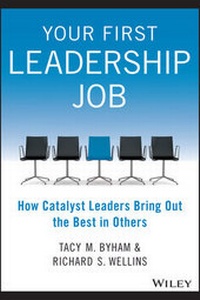
Your First Leadership Job
Description

Congratulations! You're now in charge. Perhaps it's your first time as a leader, or maybe you want to fine-tune your skills. Either way, you've begun one of the most rewarding chapters of your career. But, like many beginnings, the first few years can be challenging. Fortunately, you don't have to tackle this challenge on your own. Your First Leadership Job gives you practical advice straight from others who have walked in your shoes. Not only does it include dozens of tools to ensure your success, but it's also based on the authors' and DDI's extensive experience and research, which ultimately has led to the development of millions of leaders around the world. In fact, a quarter-million leaders will be developed this year alone via DDI training.
Your First Leadership Job is divided into two sections. Part 1 introduces the concept of catalyst leader--one who sparks energy, passion, and commitment in others. Your transition to catalyst leader is a major step in your leadership journey. This book provides essential tips to put you on the catalyst path. Ultimately, leadership is about the many conversations--frequent, clear, authentic, and occasionally difficult--that you will have daily. Your First Leadership Job builds awareness of the fundamental skills you'll come to rely on to make every one of these interactions successful.
Part 2 devotes 13 chapters to critical core leadership competencies, including coaching for success, hiring the best employees, turning dreaded appraisals into discussions that propel performance, and handling difficult employees. It also includes a chapter for first-time female leaders.
Look at Your First Leadership Job as an indispensable companion to becoming an awesome leader--one who will make a positive, lasting impact on your team, family, and career. Visit www.yourfirstleadershipjob.com to learn more.
All prices
More details
Other editions
Additional editions

Persons
RICHARD S. WELLINS, PHD, is a global expert in leadership development. Your First Leadership Job is Rich's fifth book on talent management, including the bestseller, Empowered Teams. His research has been featured in Fortune, BusinessWeek, CNBC, NPR, BBC, and Forbes.
Content
Preface xiii
Part 1: Catalyst Leadership 1
1. Now You're a Leader 3
The Journey Begins
2. Boss or Catalyst? 9
What Makes a Great Leader?
3. Navigating the Transition to Leadership 17
The Mind-Set You Need to Succeed
4. Your Leadership Brand, Part 1 28
Be Authentic
5. Your Leadership Brand, Part 2 35
Bring Out the Best in People and Be Receptive to Feedback
6. Leadership Is a Conversation, Part 1 46
How to Make People Feel Heard, Valued, and Motivated
7. Leadership Is a Conversation, Part 2 66
How to Build Trust and Ownership
8. Your Five-Step Conversation Road Map 75
Taking a Practical Approach to Get Results
9. Nothing Else Matters Unless You Get Results 87
How to Execute with Focus, Measurement, and Accountability
Part 2: Mastery and Leadership Skills 113
10. Hiring and Selecting the Best 115
Behavior Predicts Behavior
11. What Your Boss Really Wants from You 130
Become an Adviser
12. Engagement and Retention 135
Creating the Environment to Energize People
13. Meetings 149
Make Them Count!
14. Coaching 161
Learning from Success
15. Feedback Fundamentals 173
Specific, Timely, and Balanced
16. Handling Difficult Employee Situations 181
Focus on the Behavior, Not the Person
17. Delegation 191
Be a Delegator, Not a Dumper
18. Performance Management 201
An Ongoing Cycle, Not an Event
19. You and Your Network 209
Nurture Your Business Relationships
20. Influence 221
Look Up, Down, and Across
21. A Woman's First Leadership Job 229
Own the Moment
22. Leadership Changes the World 241
The Difference Is You
Part 3: Bonus Chapters and Tools 245
(available online at the DDI microsite)
Citations 247
Acknowledgments 253
About DDI 255
About the Author 256
Index 259
Great leadership takes place
every day, in the smallest of ways.
1
Now You're a Leader
The Journey Begins
So, now you're in charge.
When you accepted your first leadership job-or even seriously considered putting your hat in the ring-you took one of the most important and courageous steps in your career. You're a boss! You're going places.
How's it going? Are you sure? How do you know?
Chances are, you're perched precariously on an emotional range from "awkward excitement" to "abject terror" and back again, with a constant baseline of "stressed." This shouldn't come as a surprise; you have a lot to prove. (Or, if you've been in the position for a while, you might have a lot to repair.) For over 45 years, our firm, DDI, has been an innovator in the field of talent management, which is a fancy way of saying that we help companies transform the way they hire, promote, and develop leaders. This book is based on what we've learned from developing more than eight million frontline leaders over four decades, in virtually every country and industry around the world. First-time leaders who transition well are more able to make a positive, lasting impact on their teams, families, and careers. Our approach helps people become engaged and more productive more quickly.
Speaking of stress, our research shows that a transition to a leadership position is among life's most challenging adjustments, ranking somewhere between personal illness and managing teenagers. In fact, only one in three leaders in our first transitional study felt they were effective in handling transitional challenges.1 For first-timers, the stress can be particularly acute. You are taking on not only a new type of role, but also one that exists in a business environment defined by fast-moving challenges: volatility, uncertainty, complexity, and ambiguity. And you're in a unique position where your performance-or lack thereof-will determine whether your team will thrive or stall (along with your career). Are you as good as you need to be? Do you know what it means to get the best work from the people on your team? Will they hate you on sight? How will you determine if you're on track before it's too late?
The transition you're experiencing is profound enough for us to make a bold claim: Nobody comes to his first leadership position knowing everything he needs to know to succeed. When you get into truly unfamiliar emotional territory, your instinct might be to throw up your hands and try to do everything yourself. Perhaps you'll micromanage your team, take critical assignments away from direct reports as deadlines loom, or fail to give the kind of feedback that will help your team members do their jobs.
But let us make another bold claim: You'll find few greater rewards in your career than on the leadership journey you're about to begin. What you learn will transform the rest of your life in many wonderful ways. There are many reasons for this, not the least of which is what you'll discover about your own ability to grow and be effective in the world. We believe that over time, the skills you'll learn can help you communicate more clearly with the people you love, become a more active member of your community, and make a difference for the causes you care about. This is a journey that leads to a happier life.
When I first got the job, there was a lot of pressure, Karen told us. She became a leader by surprise and default when her own supervisor took ill and needed an extended leave. Karen was an expert telecommunications engineer, but she suddenly had 30 more-senior people to manage and a big project to finish. I could tell that there was a lot of skepticism about me. And there already had been many failures in the project, like when a contractor failed to deliver. But Karen was able to find effective ways to get the work done-on time!-through the people around her, and has earned the respect of her peers. It has been the most gratifying thing! I was able to help them work well, and I still felt like myself. And we've been able to deliver a lot, and move the project to the next level. And now the whole company knows who our team is. Best of all, she now looks at her life differently. I learned I could be a real leader. I can make a contribution in lots of places.
Joe, a supervisor in a landscaping business, learned that deep satisfaction comes from being a key part of helping others reach their true potential. The very thing that is satisfying to me is watching the guys under me grow, he said. Joe had been unable to find a job in teaching, and instead worked his way up in a national landscaping company. Many of his direct reports were untrained, non-native English speakers, and their work could be a gateway to better things for them. That's when he realized that he had a role to play in their lives. I saw the other supervisors, and all they want to do is show up every day, do the work, and go home. But Joe saw an opportunity to share what he knew about leadership and business and to develop his team in a deeper way. I got dirty with them in the field, worked with them side by side. They began to trust me. And now I'm in a position to really watch them develop. Now I see that leadership goes back to the very reason I was interested in teaching in the first place.
The real opportunity of leadership, as we see it, is a deeply human one. But precisely because humans are involved, lots of things can go wrong. As an example of the type of challenge you may encounter in your first leadership role, meet John, 42, an urban planner. I got ambushed! he says of his most problematic direct report. John ran a loosely knit team of eight, but it was one young engineer who derailed him. And he didn't see it coming. She gave me no feedback of any kind. And then called me the worst boss in the world. It was John's first attempt at leading a team-something he knew pretty well. Or, so he thought. He'd worked well as an individual contributor on interdisciplinary teams, and like most people, had strong feelings about what a leader should and shouldn't do.
At first he was hands-off, figuring that everyone liked to work independently. I don't like working for people who are looking over my back all the time. So my approach was "you go do your thing, and I'll come to you when there's a problem." When he felt the need to give input, I came in and took over, and it seemed like micromanaging. But nobody said anything to me. Until his six-month performance review. I was completely shocked when my boss told me what she [the young engineer] had said. Her complaints: John didn't set priorities, didn't pay attention to her work, took projects away from her with no explanation, and focused only on his own work. John realized too late that his hands-off style had backfired. And waiting for her to tell him what she needed out of a boss? I was told that because I was more senior, I should have known better. And I think that's right.
In our experience, it takes about 6 to 12 months for a new leader to hit stride or hit the skids. And that's exactly what happened to John. And once a major problem occurs, it might be hard to find the advocates you'll need to turn things around.
WE ASKED, LEADERS ANSWERED @Twitter
Q: The first time you managed people (not just a project) the emotion you felt was . . . ? #leadership
- @nilofer awkwardness
- @TonyTSheng terror that i would be revealed as not knowing what i was doing. Which i didn't. lol
- @Mallory_C nervous that I would royally screw it up and be that awful, clue-less boss-always want it to be a productive experience.
- @BigM5678 Overwhelmed. Many years passed before I could delegate w/o feeling I should be doing it myself or it's not going to be right.
This book is targeted to what we believe is the most critical role in any organization, the frontline leader. You're more important than you might think! And now, you're in a unique position to positively impact your entire company by working productively not only with your team, but also with other supervisors, peers in other departments, customers-everyone.
We can help you answer important questions about your ability to lead before you misstep. We can help you experience the joy of leadership sooner by managing the real and powerful human emotions that can block your success. And we'll show you how to master the new skills leaders need to work effectively, such as coaching others, engaging people, delegating, tapping into your new network, hiring, and even running a meeting.
We wrote this book to help you master your new leadership role more quickly, while avoiding some of the headaches and heartaches many people experience. And for those of you who may have already made some key mistakes, we can help you put things back on track.
"Frontline," "First-Time"-What's in a Label?
Throughout this book, we use the terms frontline leaders and first-time leaders interchangeably....
