

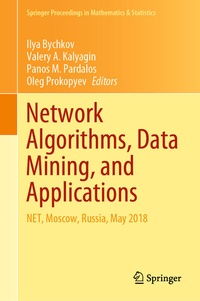
Network Algorithms, Data Mining, and Applications
Description

Contributions in this book focus on the development of network algorithms for data mining and its applications. Researchers and students in mathematics, economics, statistics, computer science, and engineering find this collection a valuable resource filled with the latest research in network analysis. Computational aspects and applications of large-scale networks in market models, neural networks, social networks, power transmission grids, maximum clique problem, telecommunication networks, and complexity graphs are included with new tools for efficient network analysis of large-scale networks. Machine learning techniques in network settings including community detection, clustering, andbiclustering algorithms are presented with applications to social network analysis.
More details
Other editions
Additional editions
Content
Part I: Network algorithms.- Obaid, H. B. and Trafalis, T: Fairness in Resource Allocation: Foundation and Applications.- Ignatov, D., Ivanova, P., Zamaletdinova, A. and Prokopyev, O: Searching for Maximum Quasi-Bicliques with Mixed Integer Programming.- Miasnikof, P., Pitsoulis, L., Bonner, A. J., Lawryshyn, Y. and Pardalos, P. M: Graph Clustering Via Intra-Cluster Density Maximization.- Shvydun, S.: Computational Complexity of SRIC and LRIC indices.- Sifaleras, A. and Konstantaras, I: A survey on variable neighborhood search methods for supply network inventory.- Part II: Network Data Mining.- Ananyeva, M. and Makarov, I: GSM: Inductive Learning on Dynamic Graph Embeddings.- Averchenkova, A., Akhmetzyanova, A., Sudarikov, K., Sulimov, P., Makarov I. and Zhukov, L. E: Collaborator Recommender System based on Co-authorship Network Analysis.- Demochkin, K. and Savchenko, A: User Preference Prediction in a Set of Photos based on Neural Aggregation Network.- Makrushin , S.: Network structure and scheme analysis of the Russian language segment of Wikipedia.- Meshcheryakova, N., Shvydun, S. and Aleskerov, F: Indirect Influence Assessment in the Context of Retail Food Network.- Sokolova, A. D. and Savchenko, A. V: Facial clustering in video data using deep convolutional neural networks.- Part III: Network Applications.- Egamov, A.: The existence and uniqueness theorem for initial-boundary value problem of the same class of integro-differential PDEs.- Gradoselskaya, G., Karpov, I. and Shcheglova, T: Mapping of politically active groups on social networks of Russian regions (on the example of Karachay-Cherkessia Republic).- Mikhailova, O., Gradoselskaya, G. and Kharlamov, A: Social Mechanisms of the Subject Area Formation. The Case of "Digital Economy.- Shcheglova, T., Gradoselskaya, G. and Karpov, I: Methodology for measuring polarization of political discourse: case of comparing oppositional and patriotic discourse in online social networks.- Zaytsev, D., Khvatsky, G., Talovsky, N. and Kuskova, V: Network Analysis Methodology of Policy Actors Identification and Power Evaluation (the case of the Unified State Exam introduction in Russia).
