

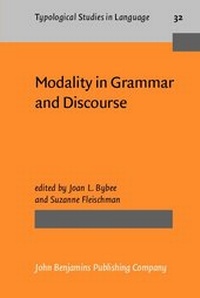
Modality in Grammar and Discourse
1st Edition
Published on 21. August 1995
VIII, 575 pages
978-90-272-8572-0 (ISBN)
Description

This volume brings together a collection of 18 papers that look into the expression of modality in the grammars of natural languages, with an emphasis on its manifestations in naturally occurring discourse. Though the individual contributions reflect a diversity of languages, of synchronic and diachronic foci, and of theoretical orientations - all within the broad domain of functional linguistics - they nonetheless converge around a number of key issues: the relationship between 'mood' and 'modality'; the delineation of modal categories and their nomenclature; the grounding of modality in interactive discourse; the elusive category 'irrealis'; and the relationship of modal notions and categories to other categories of grammar.
More details
Other editions
Additional editions
Joan L. Bybee | Suzanne Fleischman
Modality in Grammar and Discourse
Book
08/1995
John Benjamins Publishing Co
€159.00
Shipment within 10-15 days
Persons
Content
- MODALITY IN GRAMMAR AND DISCOURSE
- Editorial page
- Title page
- Copyright page
- To the memory of Dwight Bolinger
- Table of contents
- Modality in Grammar and Discourse An Introductory Essay
- Mood and modality
- Function and its relation to linguistic form
- Modal categories and their associated nomenclature
- Agent-oriented and epistemic modality
- The interactional basis of modality
- Irrealis modality and subjunctive
- Modality and other categories of grammar
- NOTES
- REFERENCES
- I. Agent-Oriented and Epistemic Modality
- Agent-Oriented vs. Epistemic Modality Some Observations on German Modals
- 1. Introduction
- 2. German modals
- 3. Context
- 4. On models
- 5. Conclusions
- NOTES
- REFERENCES
- ABBREVIATIONS
- APPENDIX
- The Expression of Root and Epistemic Possibility in English
- 1. The root/epistemic distinction
- 2. Root and epistemic possibility
- 3. The linguistic consequences of a weak root/epistemic contrast
- 4. Conclusions
- NOTES
- REFERENCES
- Contextual Conditions for the Interpretation of 'poder' and 'deber' in Spanish
- 1. Introduction
- 2. Theoretical frameworks
- 3. Poder
- 4. Deber
- 5. Modality and tense mood aspect
- 5. Conclusions
- NOTES
- REFERENCES
- The Obligation Modality in Western Nilotic Languages
- 1. Introduction
- 2. The Western Nilotic languages
- 3. Lexical sources
- 4. Semantics of the Obligation marker in Lango and Acholi
- 5. Verb sources for grammatical categories in the languages
- 6. Use of the lexical verb for 'want' for agent-oriented modalities
- 7. Conclusions
- ABBREVIATIONS
- NOTES
- REFERENCES
- The Gestural Expression of Modality in ASL
- 1. Issues in the linguistic description of ASL
- 2. Modality in ASL
- 3. Iconicity in ASL
- 4. Conclusion
- NOTES
- REFERENCES
- II. The Interaction Basis of Modality
- The Development of Epistemic Sentence-ending Modal Forms and Functions in Korean Children
- 2. Linguistic coding of evidentiality and knowledge status
- 3. The modal system in Korean
- 4. Development of SE suffixes in Korean children
- ABBREVIATIONS
- NOTES
- REFERENCES
- The Interactional Basis of the Mandarin Modal néng 'CAN'
- 1. Introduction
- 2. Data
- 3. The physical meaning category
- 4. The social meaning category
- 5. The ambiguous case category
- 6. The epistemic-like meaning category
- 7. Discussion
- NOTES
- REFERENCES
- The Discourse and Interactive Functions of Obligation Expressions
- 0. Introduction.
- 1. Preliminary considerations.
- 2. Empirical studies.
- 3. Conclusion.
- NOTES
- DATA SOURCES
- REFERENTIES
- Apprehensional Epistemics
- 1. Introduction
- 2. Apprehensional-epistemic modality in To'aba'ita
- 3. Apprehensional epistemics in other languages
- 4. The development of apprehensional epistemics
- 5. Directionality in semantic/functional change
- ABBREVIATIONS
- NOTES
- REFERENCES
- Moods and MetaMessages. Alienation as a Mood
- 0. Introduction
- 1. The sarcastive
- 2. The guiltive
- 3. The mass-productive
- 4. Proper names & common nouns
- Conclusion
- ACKNOWLEDGEMENTS
- REFERENCES
- III. Irrealis Modality and Subjunctive
- The Realis-Irrealis Distinction in Caddo, the Northern Iroquoian Languages, and English
- 0. Introduction
- 1. Caddo
- 2. The Northern Iroquoian languages
- 3. English
- 4. Conclusion
- FOOTNOTES
- REFERENCES
- On the Relativity of Irreality
- 0. Introduction
- 1. Central Porno
- 2. Some cross-linguistic differences
- 3. Conclusion
- ABBREVIATIONS
- NOTE
- REFERENCES
- The Grammaticalization of Irrealis in Tok Pisin
- 0. Introduction
- 1. Brief description of corpus
- 2. Baimbai, bai and the marking of irrealis
- 3. Discussion of syntactic developments in historical and comparative perspective
- 4. Semantic development of bai
- 5. Conclusion
- FOOTNOTES:
- REFERENCES
- The Evaluative Function of the Spanish Subjunctive
- 1. Introduction
- 2. Complementary theme/rheme analyses
- 3. Journalistic uses of the Subjunctive
- 4. Dialect variation
- 5. Other sources of instability in the mood system
- 6. The two forms of the Past Subjunctive in Spanish
- 7. Dialect variation in the use of the -se Past Subjunctive
- 8. Textual patterns of Subjunctive use
- 9. Conclusions
- NOTES
- REFERENCES
- IV. Modality and Other Categories of Grammar
- Negation and the Modals of Possibility and Necessity
- Introduction
- 1. The nature of the irregularity
- 2. The modals of possibility and necessity
- 3. The language material
- 4. Regular and irregular systems
- 5. Logical suppletion
- 6. Deontic 'not-possible' and 'necessary-not'
- 7. Function of the negative
- 8. Possible explanations
- REFERENCES
- APPENDIX
- A Functional Theory of Complementizers
- 1. Introduction
- 2. The notion of complementizer
- 3. Hypothesis
- 4. The 'null' COMP in the main clause
- 5. Two complementizers in a sequence
- 6. Two disjoint complementizers
- 7. Two complementizers in Lele
- 8. Two complementizers in Mupun
- 9. Two complementizers in Polish
- 10. Complementizers and inversion in English
- 11 Conclusions
- NOTES
- REFERENCES
- The Semantic Development of Past Tense Modals in English
- 1. Should and would in Old and Middle English.
- 2. Should and would in Shakespeare
- 3. Implications
- NOTES
- REFERENCES
- Imperfective and Irrealis
- 1. Introduction
- 2. Defining the categories
- 3. Imperfective aspect in conditional sentences
- 4. Motion-derived futures
- 5. The 'pre-ludic' imperfect
- 6. Politeness forms
- 7. The 'hypocoristic' Imperfect
- 8. Imperfective aspect and irrealis worlds
- 9. Speech and thought quotation
- 10. Habitual and irrealis
- 11. Imperfective and irrealis: why the attraction?
- 12. Conclusion
- NOTES
- REFERENCES
- Index of subjects
- Index of languages
- Author Index
