

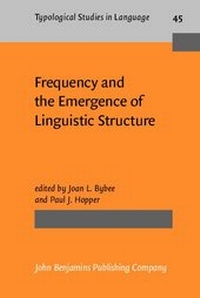
Frequency and the Emergence of Linguistic Structure
1st Edition
Published on 15. October 2001
VII, 492 pages
978-90-272-9803-4 (ISBN)
Description

mainstay of functional linguistics has been the claim that linguistic elements and patterns that are frequently used in discourse become conventionalized as grammar. This book addresses the two issues that are basic to this claim: first, the question of what types of elements are frequently used in discourse and second, the question of how frequency of use affects cognitive representations. Reporting on evidence from natural conversation, diachronic change, variability, child language acquisition and psycholinguistic experimentation the original articles in this book support two major principles. First, the content of people's interactions consists of a preponderance of subjective, evaluative statements, dominated by the use of pronouns, copulas and intransitive clauses. Second, the frequency with which certain items and strings of items are used has a profound influence on the way language is broken up into chunks in memory storage, the way such chunks are related to other stored material and the ease with which they are accessed to produce new utterances.
More details
Other editions
Additional editions
Joan L. Bybee | Paul J. Hopper
Frequency and the Emergence of Linguistic Structure
Book
10/2001
John Benjamins Publishing Co
€148.40
Shipment within 10-15 days
Persons
Content
- FREQUENCY AND THE EMERGENCE OF LINGUISTIC STRUCTURE
- Editorial page
- Title page
- LCC page
- Contents
- Acknowledgements
- Introduction to frequency and the emergence of linguistic structure
- Part I: Patterns of Use
- Transitivity, clause structure, and argument structure: Evidence from conversation
- Local patterns of subjectivity in person and verb type in American English conversation
- Paths to prepositions? A corpus-based study of the acquisition of a lexico-grammatical category
- Part II: Word-level frequency effects
- Lexical diffusion, lexical frequency, and lexical analysis
- Exemplar dynamics: Word frequency, lenition and contrast
- Emergent phonotactic generalizations in English and Arabic
- Ambiguity and frequency effects in regular verb inflection
- Frequency, regularity and the paradigm: A perspective from Russian on a complex relation
- Part III: Phrases and constructions
- Probabilistic relations between words: Evidence from reduction in lexical production
- Frequency effects and word-boundary palatalization in English
- The role of frequency in the realization of English that
- Frequency, iconicity, categorization: Evidence from emerging modals
- Frequency effects on French liaison
- The role of frequency in the specialization of the English anterior
- Hypercorrect pronoun case in English? Cognitive processes that account for pronoun usage
- Variability, frequency, and productivity in the irrealis domain of French
- Part IV: General
- Familiarity, information flow, and linguistic form
- Emergentist approaches to language
- Inflationary effects in language and elsewhere
- Subject index
- Name index
- The Series TYPOLOGICAL STUDIES IN LANGUAGE
