

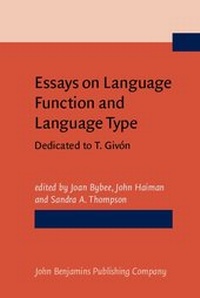
Essays on Language Function and Language Type
Dedicated to T. Givón
1st Edition
Published on 23. May 1997
VI, 480 pages
978-90-272-7421-2 (ISBN)
Description

In their subject matter and in their theoretical orientation all the papers in this volume reflect the powerful influence of T. Givón. Most of them deal with questions of morphosyntactic typology, pragmatics, and grammaticalization theory. Many of them are directly based on extensive fieldwork on local languages of the Americas, Africa, Asia, and the Pacific. Others are based on statistical analyses of extensive written and spoken corpora of texts.
More details
Other editions
Additional editions
Joan L. Bybee | John Haiman | Sandra A. Thompson
Essays on Language Function and Language Type
Dedicated to T. Givon
Book
05/1997
John Benjamins Publishing Co
€148.40
Shipment within 10-15 days
Persons
Content
- ESSAYS ON LANGUAGE FUNCTION AND LANGUAGE TYPE
- Title page
- Copyright page
- Table of contents
- Instead of an Introduction
- From His Colleagues
- Matthew Dryer
- Spike Gildea
- John Haiman
- Ken Hale
- Ron Langacker
- Charles Li
- Frank Lichtenberk
- Marianne Mithun
- Tom Payne
- Dan Slobin
- Sandy Thompson
- His Publications
- The Essays
- Semantic Aspects of Morphological Typology
- 1. The Morphological Types
- 2. Areal and Genetic Patterns
- 3. Grammaticization
- 4. Paths of Grammaticization for Tense and Aspect
- 5. Consequences for Typology
- 6. Typology and Grammaticization
- 7. Conclusion
- References
- The Typology of Predicate Case Marking
- 1. Introduction
- 2. Case Assignment to Predicate Nominals by Government, 1: Cases other than the nominative
- 3. Case assignment to predicate nominate by agreement
- 4. Case Assignment to Predicate Nominals by Governraent, 2: The Nominative
- 5. Variation between Government and Agreement
- 6. Conclusions
- Notes
- References
- Grammaticalization and the Gradience of Categories
- Relator Nouns and Postpositions in Tibetan and Burmese
- 1. Categories in Linguistic Theory
- 2. Categories in Structuralist and Generative Syntax
- 3. Syntactic Categories in Real Languages
- 4. Grammaticalization Theory
- 5. Adpositions and Relator Nouns
- 6. Towards a theory of categorial behavior
- Notes
- References
- A Typology of Argument-Determined Constructions
- 1. Argument Transferring
- 2. Argument Focusing
- 3. Argument Manipulating
- 4. Marking the Referential Status of Arguments - Inverse Systems
- 5. Comparison
- 6. Terminology
- 7. Conclusion
- Note
- References
- Are Grammatical Relations Universal?
- 1. Introduction
- 2. The Analogy of Word Classes as Crosslinguistic Categories
- 3. The Analogy of Phonemes as Crosslinguistic Categories
- 4. Language-Particular Grammatical Relations in English
- 5. Similarities and Differences among Language-particular Grammatical Relations
- 6. Four Problem Cases of Grammatical Relations
- 7. Grammatical Relations as Prototypes
- 8. Is this all much ado about nothing?
- 9. Conclusion
- Notes
- References
- Introducing Ergative Word Order via Reanalysis
- Word Order Change in the Cariban Family
- 1. Introduction: Word Order Typology and the Cariban Family
- 2. Ergative Word Order in the Cariban Family
- 3. On Nominalized Subordinate Clauses as the Source of Modern Ergative Word Order
- 4. Conclusion
- Notes
- References
- Living in Three Languages
- German
- Spanish
- English
- French
- Languages of field work
- Self-Abasement in Language
- A Case Study on the Viability of a Metaphor
- Part One: Varieties of Self-abasement
- 1. "I am small
- 2. "You thought I was serious? Ha Ha!
- 3. Cooperative Self-abasement
- Part Two: The Case of Metalanguage
- 4. The Iconicity of Style
- 5. The Paradox
- Notes
- References
- The Misumalpan Causative Construction
- 1. Introduction
- 2. The Misumalpan causative
- 3. A possible parallel in Aleut
- 4. Concluding remark
- Notes
- References
- On Attributive Possession in Kabiye
- 1. Introduction
- 2. Inalienability
- 3. Questions
- 4. Answers
- 5. Conclusions
- References
- When 'Grammar' and Discourse Clash
- The Problem of Source Conflicts
- Notes
- References
- A Dynamic Account of Grammatical Function
- References
- On Zero Anaphora
- 1. Introduction
- 2. Late Archaic Chinese
- 3. Referential Expressions
- 4. Conclusion
- Notes
- References
- Head-Marking and Objecthood
- 1. Introduction
- 2. The Nature of the Problem
- 3. Object Suffixes and Lexical Noun Phrases as Arguments
- 4. Obligatoriness of Overt Expression of Objects
- 5. Object positions
- 6. The Nature of the Evidence for Objecthood in To'aba'ita
- 7. Summary and conclusions
- Notes
- References
- Participant and Event Anaphora in Newspaper Articles
- 1. Introduction
- 2. Previous studies
- 3. Corpus and definitions
- 4. Anaphors, antecedents and referents
- 5. Distance from Antecedent
- 6. Discourse Segment Effects
- 7. Global Topic Effects
- 8. Implications
- 9. Conclusions
- Appendix A: Global Topic
- Appendix B: Discourse Segmentation
- Appendix C: Sample Article
- Notes
- References
- Lexical Affixes and Morphological Typology
- 1. Lexical Suffixes
- 2. Lexical Prefixes
- 3. Roots, Affixes, and the Sequencing of Grammaticization Effects
- References
- Versatile Nominations
- 1. Chantyal
- 2. Some Questions
- 3. Historical Considerations
- 4. A puzzle from Lahu and a potential solution
- 5. A Unified Category?
- 6. Conclusion
- Abbreviations
- Notes
- References
- The Maasai External Possessor Construction
- 1. Maasai and the Pragmatics of Possession
- 2. The Typology of External Possessor Constructions
- 3. Commonalties in EP Constructions across Maasai Dialects
- 4. Arusha Maasai: a Restrictive EP Dialect
- 5. llUaiinksshu Maasai: a Less-restrictive EP Dialect
- 6. IlKeekonyokie Maasai: a Highly Liberal EP Dialect
- 7. Discussion
- Notes
- References
- Voice in Seko Padang
- 1. Introduction
- 2. Background
- 3. Declarative mode constructions of Seko Padang
- 4. Conclusion
- Notes
- References
- Mind, Code, and Text
- 1. Path and Ground
- 2. Manner of Motion
- 3. Consequences of Typology for Language Acquisition
- 4. Conclusion
- Notes
- References
- Literary works
- Index
