

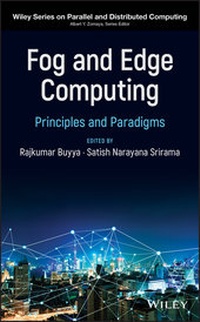
Fog and Edge Computing
Description

A comprehensive guide to Fog and Edge applications, architectures, and technologies
Recent years have seen the explosive growth of the Internet of Things (IoT): the internet-connected network of devices that includes everything from personal electronics and home appliances to automobiles and industrial machinery. Responding to the ever-increasing bandwidth demands of the IoT, Fog and Edge computing concepts have developed to collect, analyze, and process data more efficiently than traditional cloud architecture.
Fog and Edge Computing: Principles and Paradigms provides a comprehensive overview of the state-of-the-art applications and architectures driving this dynamic field of computing while highlighting potential research directions and emerging technologies.
Exploring topics such as developing scalable architectures, moving from closed systems to open systems, and ethical issues rising from data sensing, this timely book addresses both the challenges and opportunities that Fog and Edge computing presents. Contributions from leading IoT experts discuss federating Edge resources, middleware design issues, data management and predictive analysis, smart transportation and surveillance applications, and more. A coordinated and integrated presentation of topics helps readers gain thorough knowledge of the foundations, applications, and issues that are central to Fog and Edge computing. This valuable resource:
- Provides insights on transitioning from current Cloud-centric and 4G/5G wireless environments to Fog Computing
- Examines methods to optimize virtualized, pooled, and shared resources
- Identifies potential technical challenges and offers suggestions for possible solutions
- Discusses major components of Fog and Edge computing architectures such as middleware, interaction protocols, and autonomic management
- Includes access to a website portal for advanced online resources
Fog and Edge Computing: Principles and Paradigms is an essential source of up-to-date information for systems architects, developers, researchers, and advanced undergraduate and graduate students in fields of computer science and engineering.
More details
Other editions
Additional editions
Persons
Rajkumar Buyya, PhD, is Redmond Barry Distinguished Professor and Director of the Cloud Computing and Distributed Systems Laboratory, University of Melbourne, Australia and founding CEO of Manjrasoft. Dr. Buyya is author of several works including Mastering Cloud Computing and Editor-in-Chief of Wiley Software: Practice and Experience Journal.
Satish Narayana Srirama, PhD, is a Research Professor and head of the Mobile & Cloud Lab, Institute of Computer Science, University of Tartu, Estonia. He is editor of Wiley Software: Practice and Experience Journal and has co-authored over 120 scientific publications.
Content
List of Contributors xix
Preface xxiii
Acknowledgments xxvii
Part I Foundations 1
1 Internet of Things (IoT) and New Computing Paradigms 3
Chii Chang, Satish Narayana Srirama, and Rajkumar Buyya
1.1 Introduction 3
1.2 Relevant Technologies 6
1.3 Fog and Edge Computing Completing the Cloud 8
1.3.1 Advantages of FEC: SCALE 8
1.3.2 How FEC AchievesThese Advantages: SCANC 9
1.4 Hierarchy of Fog and Edge Computing 13
1.5 Business Models 16
1.6 Opportunities and Challenges 17
1.7 Conclusions 20
References 21
2 Addressing the Challenges in Federating Edge Resources 25
Ahmet Cihat Baktir, Cagatay Sonmez, CemErsoy, Atay Ozgovde, and Blesson Varghese
2.1 Introduction 25
2.2 The Networking Challenge 27
2.3 The Management Challenge 34
2.4 Miscellaneous Challenges 40
2.5 Conclusions 45
References 45
3 Integrating IoT + Fog + Cloud Infrastructures: System Modeling and Research Challenges 51
Guto Leoni Santos,Matheus Ferreira, Leylane Ferreira, Judith Kelner, Djamel Sadok, Edison Albuquerque, Theo Lynn, and Patricia Takako Endo
3.1 Introduction 51
3.2 Methodology 52
3.3 Integrated C2F2T Literature by Modeling Technique 55
3.4 Integrated C2F2T Literature by Use-Case Scenarios 65
3.5 Integrated C2F2T Literature by Metrics 68
3.6 Future Research Directions 72
3.7 Conclusions 73
Acknowledgments 74
References 75
4 Management and Orchestration of Network Slices in 5G, Fog, Edge, and Clouds 79
Adel Nadjaran Toosi, RedowanMahmud, Qinghua Chi, and Rajkumar Buyya
4.1 Introduction 79
4.2 Background 80
4.3 Network Slicing in 5G 83
4.4 Network Slicing in Software-Defined Clouds 87
4.5 Network Slicing Management in Edge and Fog 91
4.6 Future Research Directions 93
4.7 Conclusions 96
Acknowledgments 96
References 96
5 Optimization Problems in Fog and Edge Computing 103
Zoltán Ádám Mann
5.1 Introduction 103
5.2 Background / RelatedWork 104
5.3 Preliminaries 105
5.4 The Case for Optimization in Fog Computing 107
5.5 Formal Modeling Framework for Fog Computing 108
5.6 Metrics 109
5.6.5 Further Quality Attributes 112
5.7 Optimization Opportunities along the Fog Architecture 113
5.8 Optimization Opportunities along the Service Life Cycle 114
5.9 Toward a Taxonomy of Optimization Problems in Fog Computing 115
5.10 Optimization Techniques 117
5.11 Future Research Directions 118
5.12 Conclusions 119
Acknowledgments 119
References 119
Part II Middlewares 123
6 Middleware for Fog and Edge Computing: Design Issues 125
Madhurima Pore, Vinaya Chakati, Ayan Banerjee, and Sandeep K. S. Gupta
6.1 Introduction 125
6.2 Need for Fog and Edge Computing Middleware 126
6.3 Design Goals 126
6.4 State-of-the-Art Middleware Infrastructures 128
6.5 System Model 129
6.6 Proposed Architecture 131
6.7 Case Study Example 136
6.8 Future Research Directions 137
6.9 Conclusions 139
References 139
7 A Lightweight Container Middleware for Edge Cloud Architectures 145
David von Leon, LorenzoMiori, Julian Sanin, Nabil El Ioini, Sven Helmer, and Claus Pahl
7.1 Introduction 145
7.2 Background/RelatedWork 146
7.3 Clusters for Lightweight Edge Clouds 149
7.4 Architecture Management - Storage and Orchestration 152
7.5 IoT Integration 159
7.6 Security Management for Edge Cloud Architectures 159
7.7 Future Research Directions 165
7.8 Conclusions 166
References 167
8 Data Management in Fog Computing 171
Tina Samizadeh Nikoui, Amir Masoud Rahmani, and Hooman Tabarsaied
8.1 Introduction 171
8.2 Background 172
8.3 Fog Data Management 174
8.4 Future Research and Direction 186
8.5 Conclusions 186
References 188
9 Predictive Analysis to Support Fog Application Deployment 191
Antonio Brogi, Stefano Forti, and Ahmad Ibrahim
9.1 Introduction 191
9.2 Motivating Example: Smart Building 193
9.3 Predictive Analysis with FogTorch 197
9.4 Motivating Example (continued) 206
9.5 Related Work 207
9.6 Future Research Directions 214
9.7 Conclusions 216
References 217
10 Using Machine Learning for Protecting the Security and Privacy of Internet of Things (IoT) Systems 223
Melody Moh and Robinson Raju
10.1 Introduction 223
10.2 Background 234
10.3 Survey of ML Techniques for Defending IoT Devices 242
10.4 Machine Learning in Fog Computing 248
10.4.1 Introduction 248
10.5 Future Research Directions 252
10.6 Conclusions 252
References 253
Part III Applications and Issues 259
11 Fog Computing Realization for Big Data Analytics 261
Farhad Mehdipour, Bahman Javadi, AniketMahanti, and Guillermo Ramirez-Prado
11.1 Introduction 261
11.2 Big Data Analytics 262
11.3 Data Analytics in the Fog 267
11.4 Prototypes and Evaluation 272
11.4.1 Architecture 272
11.4.2 Configurations 274
11.5 Case Studies 277
11.6 Related Work 282
11.7 Future Research Directions 287
11.8 Conclusions 287
References 288
12 Exploiting Fog Computing in Health Monitoring 291
Tuan Nguyen Gia and Mingzhe Jiang
12.1 Introduction 291
12.2 An Architecture of a Health Monitoring IoT-Based System with Fog Computing 293
12.3 Fog Computing Services in Smart E-Health Gateways 297
12.4 System Implementation 304
12.5 Case Studies, Experimental Results, and Evaluation 308
12.6 Discussion of Connected Components 313
12.7 Related Applications in Fog Computing 313
12.8 Future Research Directions 314
12.9 Conclusions 314
References 315
13 Smart Surveillance Video Stream Processing at the Edge for Real-Time Human Objects Tracking 319
Seyed Yahya Nikouei, Ronghua Xu, and Yu Chen
13.1 Introduction 319
13.2 Human Object Detection 320
13.3 Object Tracking 327
13.4 Lightweight Human Detection 335
13.5 Case Study 337
13.6 Future Research Directions 342
13.7 Conclusions 343
References 343
14 Fog Computing Model for Evolving Smart Transportation Applications 347
M. Muzakkir Hussain,Mohammad Saad Alam, and M.M. Sufyan Beg
14.1 Introduction 347
14.2 Data-Driven Intelligent Transportation Systems 348
14.3 Mission-Critical Computing Requirements of Smart Transportation Applications 351
14.4 Fog Computing for Smart Transportation Applications 354
14.5 Case Study: Intelligent Traffic Lights Management (ITLM) System 359
14.6 Fog Orchestration Challenges and Future Directions 362
14.7 Future Research Directions 364
14.8 Conclusions 369
References 370
15 Testing Perspectives of Fog-Based IoT Applications 373
Priyanka Chawla and Rohit Chawla
15.1 Introduction 373
15.2 Background 374
15.3 Testing Perspectives 376
15.4 Future Research Directions 393
15.5 Conclusions 405
References 406
16 Legal Aspects of Operating IoT Applications in the Fog 411
G. Gultekin Varkonyi, Sz. Varadi, and Attila Kertesz
16.1 Introduction 411
16.2 RelatedWork 412
16.3 Classification of Fog/Edge/IoT Applications 413
16.4 Restrictions of the GDPR Affecting Cloud, Fog, and IoT Applications 414
16.5 Data Protection by Design Principles 425
16.6 Future Research Directions 430
16.7 Conclusions 430
Acknowledgment 431
References 431
17 Modeling and Simulation of Fog and Edge Computing Environments Using iFogSim Toolkit 433
Redowan Mahmud and Rajkumar Buyya
17.1 Introduction 433
17.2 iFogSim Simulator and Its Components 435
17.3 Installation of iFogSim 436
17.4 Building Simulation with iFogSim 437
17.5 Example Scenarios 438
17.6 Simulation of a Placement Policy 450
17.7 A Case Study in Smart Healthcare 461
17.8 Conclusions 463
References 464
Index 467
1
Internet of Things (IoT) and New Computing Paradigms
Chii Chang Satish Narayana Srirama and Rajkumar Buyya
1.1 Introduction
The Internet of Things (IoT) [1] represents a comprehensive environment that interconnects a large number of heterogeneous physical objects or things such as appliances, facilities, animals, vehicles, farms, factories etc. to the Internet, in order to enhance the efficiency of the applications such as logistics, manufacturing, agriculture, urban computing, home automation, ambient assisted living, and various real-time ubiquitous computing applications.
Commonly, an IoT system follows the architecture of the Cloud-centric Internet of Things (CIoT) in which the physical objects are represented in the form of Web resources that are managed by the servers in the global Internet [2]. Fundamentally, in order to interconnect the physical entities to the Internet, the system will utilize various front-end devices such as wired or wireless sensors, actuators, and readers to interact with them. Further, the front-end devices have the Internet connectivity via the mediate gateway nodes such as Internet modems, routers, switches, cellular base stations, and so on. In general, the common IoT system involves three major technologies: embedded systems, middleware, and cloud services, where the embedded systems provide intelligence to the front-end devices, middleware interconnects the heterogeneous embedded systems of front-end devices to the cloud and finally, the cloud provides comprehensive storage, processing, and management mechanisms.
Although the CIoT model is a common approach to implement IoT systems, it is facing the growing challenges in IoT. Specifically, CIoT faces challenges in BLURS-bandwidth, latency, uninterrupted, resource-constraint, and security [3].
- Bandwidth. The increasingly large and high-frequent rate data produced by objects in IoT will exceed the bandwidth availability. For example, a connected car can generate tens of megabytes' data per second for the information of its route, speeds, car-operating condition, driver's condition, surrounding environment, weather etc. Further, a self-driving vehicle can generate gigabytes of data per second due to the need for real-time video streaming. Therefore, fully relying on the distant Cloud to manage the things becomes impractical.
- Latency. Cloud faces the challenges of achieving the requirement of controlling the end-to-end latency within tens of milliseconds. Specifically, industrial smart grids systems, self-driving vehicular networks, virtual and augmented reality applications, real-time financial trading applications, healthcare, and eldercare applications cannot afford the causes derived from the latency of CIoT.
- Uninterrupted. The long distance between cloud and the front-end IoT devices can face issues derived from the unstable and intermittent network connectivity. For example, a CIoT-based connected vehicle will be unable to function properly due to the disconnection occurred at the intermediate node between the vehicle and the distant cloud.
- Resource-constrained. Commonly, many front-end devices are resource-constrained in which they are unable to perform complex computational tasks and hence, CIoT systems usually require front-end devices to continuously stream their data to the cloud. However, such a design is impractical in many devices that operate with battery power because the end-to-end data transmission via the Internet can still consume a lot of energy.
- Security. A large number of constraint front-end devices may not have sufficient resources to protect themselves from the attacks. Specifically, outdoor-based front-end devices, which rely on the distant cloud to keep them updated with the security software, can be attackers' targets, in which the attackers are capable of performing a malicious activity at the edge network where the front-end devices are located and the cloud does not have full control on it. Furthermore, the attacker may also damage or control the front-end device and send false data to the cloud.
The growing challenges of CIoT raised a question-what can be done to overcome the limitation of current cloud-centric architecture?
In the last decade, several approaches have tried to extend the centralized cloud computing to a more geo-distributed manner in which the computational, networking, and storage resources can be distributed to the locations that are much closer to the data sources or end-user applications. For example, the geo-distributed cloud-computing model [4] tends to partition the portions of processes to the data centers near the edge network. Further, the mobile cloud computing model [5] introduced the physical proximity-based cloud computing resources provisioned by the local wireless Internet access point providers. Moreover, academic research projects [6] have experimented with the feasibility of the mobile ad hoc network (MANET)-based cloud using the advanced RISC machine (ARM)-powered devices. Among the various approaches, the industry-led fog computing architecture, which was first introduced by Cisco research [7], has gained the most attention.
Fog computing architecture [8] covers a broad range of equipment and networks. In general, it is a conceptual model that address all the possibilities to extend the cloud to the edge network of CIoT, from the geo-distributed data center, intermediate network nodes to the extreme edge where the front-end IoT devices are located. Figure 1.1 illustrates different network computing paradigms supporting IoT-enabled smart systems and applications. To enumerate, the general CIoT paradigm (mark 1) manages the smart systems entirely at the distant central cloud datacenter in which the IoT devices act as simple sensory data collectors or actuators and leave the processes and decision-making to the cloud. The generic edge computing paradigm (mark 2) distributes certain tasks to the IoT devices or the co-located computers within the same subnet of the IoT devices. Such tasks can be data classification, filtering, or signal converting, for example. Fog computing paradigm (marks 3 and 4) utilizes a hierarchical-based distributed computing model that supports horizontal scalability of the computational resources.
Figure 1.1 IoT applications and environments with supporting computing paradigms.
For example, a fog-enabled IoT system can distribute the simple data classification tasks to the IoT devices and assign the more complicated context reasoning tasks at the edge gateway devices. Further, for the analytics tasks that involve terabytes of data, which requires higher processing power, the system can further move the processes to the resources at the core network such as the data centers of wide area network (WAN) service providers or it can utilize the cloud. Certainly, the decision of where the system should assign the tasks among the resources across different tiers depends on efficiency and adaptability. For example, smart systems may need to assign certain decision-making tasks to the edge devices in order to provide timely notification about the situation, such as the patient's condition in the smart healthcare, the security state of the smart home, the traffic condition of the smart city, the water supply condition of smart farming, or the production line operation condition of a smart factory.
The industry has seen fog as the main trend for the practical IoT systems, and the leading OpenFog consortium has established collaboration with major industrial standard parties such as European Telecommunications Standards Institute (ETSI) multi-access edge computing (MEC) and IEEE Standard for fog computing and networking [9] to hasten the fog. Furthermore, the fog market research report [10] stated that the market value of fog will grow from $3.7 billion by 2019 up to $18.2 billion by 2022 across different fields, where the top five utilization domains of fog will be energy/utilities, transportation, healthcare, industry, and agriculture.
In this chapter, we discuss foundations of computing paradigms for realizing emerging IoT applications, especially fog and edge computing, their background, characteristics, architectures and open challenges. Section 1.2 presents related technologies to fog and edge computing. Section 1.3 describes how fog and edge can improve CIoT. Section 1.4 explains the hierarchy of fog and edge computing environments. Section 1.5 illustrates the business models of fog and edge computing. Section 1.6 provides the information regarding to the opportunities and challenges in fog and edge computing. Finally, Section 1.7 summarizes the content of the chapter.
1.2 Relevant Technologies
The notion of having computational resources near the data sources may seem not new. Particularly, the term-edge computing appeared in 2004 to illustrate a system that distributes program methods and the corresponding data to the network edge towards enhancing performance and efficiency [11]. Similarly, the notion of having virtualization technology-based computing resources within the Wi-Fi subnet was introduced...
