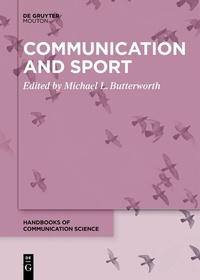
Communication and Sport
Description

Sport is a universal feature of global popular culture. It shapes our identities, affects our relationships, and defines our communities. It also influences our consumption habits, represents our cultures, and dramatizes our politics. In other words, sport is among the most prominent vehicles for communication available in daily life. Nevertheless, only recently has it begun to receive robust attention in the discipline of communication studies. The handbook of Communication and Sport attends to the recent and rapid growth of scholarship in communication and media studies that features sport as a central site of inquiry. The book attempts to capture a full range of methods, theories, and topics that have come to define the subfield of "communication and sport" or "sports communication." It does so by emphasizing four primary features. First, it foregrounds "communication" as central to the study of sport. This emphasis helps to distinguish the book from collections in related disciplines such as sociology, and also points readers beyond media as the primary or only context for understanding the relationship between communication and sport. Thus, in addition to studies of media effects, mediatization, media framing, and more, readers will also engage with studies in interpersonal, intercultural, organizational, and rhetorical communication. Second, the handbook presents an array of methods, theories, and topics in the effort to chart a comprehensive landscape of communication and sport scholarship. Thus, readers will benefit from empirical, interpretive, and critical work, and they will also see studies drawing on varied texts and sites of inquiry. Third, the handbook of Communication and Sport includes a broad range of scholars from around the world. It is therefore neither European nor North American in its primary focus. In addition, the book includes contributors from commonly under-represented regions in Asia, Africa, and South America. Fourth, the handbook aims to account for both historical trajectories and contemporary areas of interest. In this way, it covers the central topics, debates, and perspectives from the past and also suggests continued and emerging pathways for the future. Collectively, the handbook of Communication and Sport aspires to provide scholars and students in communication and media studies with the most comprehensive assessment of the field available.
More details
Other editions
Additional editions