

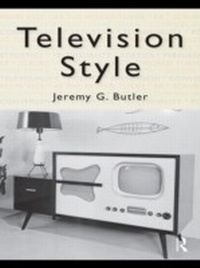
Television Style
1st Edition
Published on 5. April 2010
248 pages
978-1-135-89069-8 (ISBN)
Description

Style matters. Television relies on style-setting, lighting, videography, editing, and so on-to set moods, hail viewers, construct meanings, build narratives, sell products, and shape information. Yet, to date, style has been the most understudied aspect of the medium. In this book, Jeremy G. Butler examines the meanings behind television's stylstic conventions.
Television Style dissects how style signifies and what significance it has had in specific television contexts. Using hundreds of frame captures from television programs, Television Style dares to look closely at television. Miami Vice, ER, soap operas, sitcoms, and commercials, among other prototypical television texts, are deconstructed in an attempt to understand how style functions in television. Television Style also assays the state of style during an era of media convergence and the ostensible demise of network television.
This book is a much needed introduction to television style, and essential reading at a moment when the medium is undergoing radical transformation, perhaps even a stylistic renaissance.
Discover additional examples and resources on the companion website: www.tvstylebook.com.
Television Style dissects how style signifies and what significance it has had in specific television contexts. Using hundreds of frame captures from television programs, Television Style dares to look closely at television. Miami Vice, ER, soap operas, sitcoms, and commercials, among other prototypical television texts, are deconstructed in an attempt to understand how style functions in television. Television Style also assays the state of style during an era of media convergence and the ostensible demise of network television.
This book is a much needed introduction to television style, and essential reading at a moment when the medium is undergoing radical transformation, perhaps even a stylistic renaissance.
Discover additional examples and resources on the companion website: www.tvstylebook.com.
Reviews / Votes
'Television Style cuts through the cultural and academic haze that still clouds television, providing scholars and students with an incisive, comprehensive, and much-needed study detailing the intricacies and nuances of television as an artform.' - John T. Caldwell, UCLA, author of Production Culture: Industrial Reflexivity and Critical Practice in Film and Television (2008)'Once upon a time in Hollywood, creative people treated TV like the annoying little brother who always wanted to play with the big kids. If you were a TV director, good luck making the leap into the more respectable medium. And, if you were a film director, why on earth would you deign to work for that tiny screen? Well, things have changed, to say the least. The old biases no longer apply, particularly when it comes to style, and Jeremy G. Butler has provided an account of a medium that has never been as dynamic as it is today. In the past decade, television style has evolved at a dizzying rate, and Butler charts the changes with a clear-eyed energy appropriate for a medium that, many agree, has left its elder sibling in the dust.' - Ken Kwapis, Film and Television Director, The Office, 'The Larry Sanders Show', and 'He's Just Not That Into You'
'Television has grown more stylish in the last decade, and Butler's book explain how and why this has happened. This book places film theory and criticism in dialogue with masterful research on television production to illuminate these important changes. The rise of single-camera television and the role of the TV director are finally given the credit they are due for making TV today as exciting as cinema ever was.'- Ellen Seiter, USC
'A book as essential to television studies as Bordwell and Thompson's Film Art is to film studies.' Liz Robert, The Media Education Journal
More details
Language
English
Place of publication
London
United Kingdom
Publishing group
Taylor & Francis Ltd
Target group
College/higher education
Product notice
Reflowable
Illustrations
60 s/w Photographien bzw. Rasterbilder
60 Halftones, black and white
File size
6,92 MB
ISBN-13
978-1-135-89069-8 (9781135890698)
Copyright in bibliographic data and cover images is held by Nielsen Book Services Limited or by the publishers or by their respective licensors: all rights reserved.
Schweitzer Classification
Other editions
Additional editions
Person
Jeremy G. Butler is Professor of Telecommunication and Film at the University of Alabama. He is author of Television: Critical Methods and Applications (3rd edition, 2006).
Content
Introduction: Dare We Look Closely at Television
1. Television and Zero-Degree Style
2. Stylistic Crossover in the Network Era: From Film to Television
3. The Persuasive Power of Style
4. Style in an Age of Media Convergence
5. Televisuality and the Resurrection of the Sitcom in the 2000s
1. Television and Zero-Degree Style
2. Stylistic Crossover in the Network Era: From Film to Television
3. The Persuasive Power of Style
4. Style in an Age of Media Convergence
5. Televisuality and the Resurrection of the Sitcom in the 2000s
