

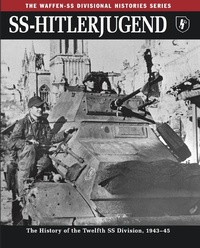
SS-Hitlerjugend
Description

- Adolf Hitler The divisions of the Waffen-SS were the elite of Hitler's armies in World War II. SS-Hitlerjugend is an in-depth examination of the unit formed in 1943 from veterans of the Leibstandarte Adolf Hitler Division and members of the Hitlerjugend (Hitler Youth) organization. The majority of the recruits were 17-year-old volunteers who were fanatically devoted to the Nazi cause and to Hitler personally. The book explores the background to the unit's formation, the type of young men it recruited, the key figures involved in the division and its organization. It also looks at the uniforms and insignia that members of the division wore to distinguish themselves on the battlefield.
SS-Hitlerjugend also provides a full combat record of the division, which fought on both fronts in World War II. The book outlines the unit's involvement in the defence of Normandy, when Allied troops were shocked by the youth of the enemy and their willingness to accept appalling losses; the battle for Caen and the catastrophe of the Falaise Gap; refitting in Germany before the Ardennes offensive; and its service on the Eastern Front at the end of the war, fighting to recapture Budapest.
Illustrated with rare photographs, SS-Hitlerjugend is a definitive history of one of Nazi Germany's most fanatical fighting units.
All prices
More details
Other editions
Additional editions
Person
Content
2 Training
3 Organization
4 Normandy
5 Falaise
6 Ardennes
7 Hungary
8 Key Figures
Appendices
Index
This powerful recruitment poster was intended to instil a sense of pride into Hitler Jugend members who were encouraged to show their patriotism and sense of duty by joining the Waffen-SS.
CHAPTER TWO
As the war turned against Germany, the Hitler Youth training camps were combed for manpower and ruthless methods of coercion applied. Boys as young as 17 were press-ganged by Waffen-SS recruiting officers for a new fighting unit, 12th SS Panzer Division Hitlerjugend.
With the outbreak of war in September 1939, the indoctrination of the Hitler Youth was stepped up. In florid terms, the legend of Langemarck continued to be evoked by Nazi propagandists:
'The myth of the sacrifice in the World War of Germany's youth has given to the post-war youth a new faith and a new strength to unfold the ideals of National Socialism. From the experience of the World War was born the idea of National Socialism. Out of its armies came the front line soldier.'
The September 1940 issue of the magazine Pimpf treated its readers to a prose poem on 'the gentle heart of the Führer', intoning:
'Now all German hearts belong to the Führer. His hand is the fate of our Fatherland. All that happens, that determines our present, is his will. The hand of the Führer leads us.'
The recruiting offices were besieged by impatient youths prepared to go to almost any lengths to be accepted. HW Koch, himself the member of a unit that was to fight in Berlin in the closing weeks of the war, wrote in his history, The Hitler Youth:
'Throughout the war, incidents occurred of boys appearing at their local Hitler Youth headquarters complaining that they had been overlooked in their call-up. backing up their claims with their birth certificates. With a shrug of the shoulder and a derogatory remark about some bureaucracy which had yet again failed to do its work properly, they were immediately enrolled in the Jungvolk. That the birth certificates had been faked was in most cases only discovered afterwards or when the erasure of the last digit of the year of birth had been carried out too clumsily. Mostly in these cases father or brother had been called up into the army and now the sons too "wanted to do their bit". They were usually allowed to stay.'
NEW LEADER
By this time, Baldur von Schirach had lost all credibility. When he finally succumbed to Rommel's suggestion that he should undertake military training, it was too late to win over both leading Nazis and senior members of the Wehrmacht. All had distrusted him from the start. In any case, his training had involved blatantly preferential treatment - not least, a rapid promotion to the rank of Leutnant in just six months. His military career was over on 2 August 1940, when he was appointed Reichsstatthalter (Governor and Gauleiter) of Vienna. His replacement was his one-time assistant, 27-year-old Artur Axmann, a man of altogether different stamp. A ruthless organizer, he had at the same time the knack of gaining the respect of subordinates.
HJ volunteers were encouraged to enrol in the key branches of the forces. Here recruits to the Nationalsozialistches Kraftfahr Korps (NSKK) are being put through their paces in an early PzKpfw IV tank.
Inheritance of 8870 young people between the ages of 10 and 18 did bring problems. More than a quarter of the youth leaders had been called up for the Wehrmacht, a shortage which led 16 and 17 year olds to be promoted to the rank of Unterbannführer, with responsibility for anything between 500 and 600 boys. The hitherto strict division between Jungvolk and Hitler Youth was eventually eliminated, to counter the danger that the young who remained behind while others were experiencing the conflict would become demoralized. Consequently, paramilitary training of Hitler Youth was intensified, often supervised by former members who had been decorated for valour during their service in the Wehrmacht.
THE NSKK
Particular efforts were made to appeal to a recruit's special interest. Opportunities were provided for enrolment in the key branches of the forces. In the Army, service was encouraged in the Nationalsozialistches Kraftfahr Korps (NSKK), the motorized branch of Motor-HJ, a special formation within the Hitler Youth. Members were required at the age of 16 to attend the Reichsmotorschule, to obtain a motorcycle licence. At the age of 18, transfer to the NSKK was possible. Here, thorough grounding was given, not simply in driving, but in mechanics and the international traffic code. Requirements were stringent; members of Motor-HJ were required to have 80 hours' driving experience and to have carried out 105 hours of service as a mechanic. No secret was made of the ultimate intention: to produce a ready made cadre for the front line motorized units of the Wehrmacht.
For those attracted to service in the air, there was the National Socialist Flieger Korps (NSFK), which undertook the flying training of the Hitler Youth. This was practical so long as Germany continued on the path of conquest, but from mid-1942, the reconstituted Flieger-HJ found itself fulfilling a very different function. The heartlands of the Reich were enduring an ever-accelerating bomber offensive, and the call on the ground now was not for fledgling pilots, but for anti-aircraft personnel. Manpower was plundered from the Hitler Youth as a whole, but, above all, from the Flieger-HJ. Senior members manned the guns, while younger ones were mustered to work for the communications network of the flak batteries, at searchlight batteries and as dispatch riders. Schoolchildren became accustomed to Wehrmacht soldiers, complete with clipboards and instructions, invading their classrooms. The pupils were required to return home, put on their Hitler Youth uniforms and report for duty as requested by the soldiers.
LEADERSHIP ISSUES
Propaganda minister Josef Göbbels recorded in his diary on 17 December 1942 that Axmann was expressing unease at this role for Hitler Youth:
'He is very much worried lest the draft in of juveniles for anti-aircraft duty might deprive his Hitler Youth leadership corps of its most promising members. About 40,000 well-trained young people are affected. While the anti-aircraft can ill afford to do without them, I believe, nonetheless, that the work of the Hitler Youth must be kept up in all circumstances, especially during the war. The young must be guided by a firm hand as far as possible. If left to themselves, the mischief will be all the greater.'
The Motor-HJ was already thriving when Hitler came to power in 1933. By 1938 28,000 driving licences had been issued to members, many of whom went on to serve in the motorized units of the Wehrmacht.
Germany's change of fortune on the Russian front in no way lessened another of the key activities of the Hitler Youth - international cooperation. As early as 1937, Baldur von Schirach visited Fascist Italy to make contact and arrange exchange visits with youth groups there. Five years later, it was the turn of Austria. Artur Axmann joined von Schirach, who also held the sinecure post of Reichsleader for Education of the NSDAP (Nazi Party) in Vienna, where the European Youth League was founded. The so-called 'Culture Day of European Youth' embraced representatives from a wide spread of countries, including the Spanish Falange, the Dutch National Socialist Youth and the Norwegian Nasjional-Samling-Youth.
MIXED RESPONSE
Within Germany itself, the reaction to the Vienna initiative was mixed. The concept of Germany as a partner in some sort of European alliance was anathema to Göbbels, who ordered a press boycott of the event. His stance was that Germany was fighting a war, which it would win as the master race; talks of alliances could wait until final victory, but until then the glory would not be shared.
The promotion of good fellowship, however, was by no means the overriding purpose of the German young. Duties in the vassal states had their sinister side. Within days of its occupation, Strasbourg was penetrated by a group of Hitler Youth, extending clandestine activities that dated from the early 1930s. Elsewhere, the Hitler Youth was involved in 'resettlement programmes', such as the expulsion of the native Polish populations from the Warthegau. This was the region of Poland annexed by Germany, where the policy was replacement by native Germans.
However, the 'Culture Day of European Youth' was observed with particular interest by the Swabian SS-Brigadeführer Gottlob Berger. As Head of SS Headquarters, he shared with his chief, Heinrich Himmler, a vision of a united Europe within which the Waffen-SS would become the central institution of Nazism. All this was in line with Berger's particular responsibility - the raising of pan-European Waffen-SS units. He had proved his organizational ability as far back as 1938, when directing the activities of the Czech...
