

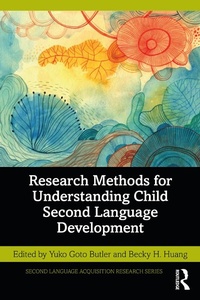
Research Methods for Understanding Child Second Language Development
1st Edition
Published on 15. September 2022
216 pages
978-1-000-63736-6 (ISBN)
Description

Butler and Huang's book is one of the first to focus on second language (L2) development research methods and techniques specifically targeted at children of primary and pre-primary years.
The last decade has seen a growing number of L2 studies of children aged 4-12, a demographic with special developmental characteristics that confound research methods designed for studying adults. Written by experts from a variety of disciplines, this book covers major research methods and techniques in existing L2 development research, including observations, surveys, interviews, introspective methods, speech production methods, receptive methods, eye tracking, and brain imaging, as well as research methods specifically designed for L2 children with special educational needs. The book also discusses various age-related considerations and challenges if they are employed to young L2 learners.
This will be essential reading for SLA, child development, and TESOL researchers, and students in these courses will benefit particularly from pedagogical material such as further readings and discussion questions.
The last decade has seen a growing number of L2 studies of children aged 4-12, a demographic with special developmental characteristics that confound research methods designed for studying adults. Written by experts from a variety of disciplines, this book covers major research methods and techniques in existing L2 development research, including observations, surveys, interviews, introspective methods, speech production methods, receptive methods, eye tracking, and brain imaging, as well as research methods specifically designed for L2 children with special educational needs. The book also discusses various age-related considerations and challenges if they are employed to young L2 learners.
This will be essential reading for SLA, child development, and TESOL researchers, and students in these courses will benefit particularly from pedagogical material such as further readings and discussion questions.
Reviews / Votes
The potential of this book is enormous. No longer can L2 researchers claim ignorance to the nuances and challenges of working with younger learners, a population so often overlooked. Yuko Butler and Becky Huang's volume, and the entire cast of contributors, deftly guides us on a full spectrum of methodological approaches and the myriad issues we are likely to encounter in conducting research with children. It's now up to us-the L2 research community-to step up and to put in to practice the time- and experience-tested techniques described herein. And I very much hope we will.(Luke Plonsky, Northern Arizona University)
This book is a gem for researchers of children's L2 development! It offers wise guidance across a wealth of methods, from ethnography and interviews, to eye-tracking and brain imaging, and a lot more. With its exciting selection of authors and its comprehensive coverage, this is the ideal textbook for a research methods course focusing on L2 children populations.
(Lourdes Ortega, Georgetown University)
In an increasingly bilingual world with more and more children growing up exposed to an additional language either at birth or as young as age 2-5, this long-needed volume will make a very timely and notable contribution to the field of child L2 acquisition. With its different chapters discussing, in a highly accessible fashion, a variety of research methods in reference to the relevant theoretical framework behind them, the book will serve as an excellent resource for both novice and expert researchers interested in identifying intricate issues in child L2 development. I strongly recommend it.
(Ayse Guerel, Bogazici University)
More details
Series
Edition
1. Auflage
Language
English
Place of publication
London
United Kingdom
Publishing group
Taylor & Francis Ltd
Target group
College/higher education
Professional and scholarly
Product notice
Reflowable
Illustrations
7 Tables, black and white; 1 Line drawings, black and white; 6 Halftones, black and white; 7 Illustrations, black and white
ISBN-13
978-1-000-63736-6 (9781000637366)
Copyright in bibliographic data and cover images is held by Nielsen Book Services Limited or by the publishers or by their respective licensors: all rights reserved.
Schweitzer Classification
Other editions
Additional editions
Yuko Goto Butler | Becky H. Huang
Research Methods for Understanding Child Second Language Development
Book
09/2022
1st Edition
Routledge
€206.20
Shipment within 15-20 days
Yuko Goto Butler | Becky H. Huang
Research Methods for Understanding Child Second Language Development
Book
09/2022
1st Edition
Routledge
€62.70
Shipment within 15-20 days
Persons
Yuko Goto Butler is Professor of Educational Linguistics in the Graduate School of Education at the University of Pennsylvania. She is also Director of the Teaching English to Speakers of Other Languages (TESOL) Program. Her research interests include language assessment and second and foreign language learning among children.
Becky H. Huang is Professor in the Department of Teaching and Learning at Ohio State University. Her research focuses on two interrelated areas that address the goal of promoting language and education outcomes for bilingual students: language/literacy development and assessment of bilingual students.
Becky H. Huang is Professor in the Department of Teaching and Learning at Ohio State University. Her research focuses on two interrelated areas that address the goal of promoting language and education outcomes for bilingual students: language/literacy development and assessment of bilingual students.
Content
Table of Contents
Chapter 1 Introduction: Researching Child Second Language Development (Becky H. Huang & Yuko Goto Butler)
Chapter 2 Observation and ethnographic methods for researching young learners (Peter Sayer & Susan Ataei)
Chapter 3 Surveys and questionnaires with young language learners (Emiko Hirosawa & W. L. Quint Oga-Baldwin)
Chapter 4 Using interviews with children in L2 research (Annamaria Pinter)
Chapter 5 Verbal Reports as a Window for Understanding Mental Processes among Young Learners (Yuko Goto Butler)
Chapter 6 Research methods for evaluating second language speech production (Becky H. Huang & Rica Ramirez)
Chapter 7 Receptive methods in child bilingualism and second language acquisition (Silvina Montrul, Alexandra Morales-Reyes & Begona Arechabaleta Regulez)
Chapter 8 Eye-tracking methods in child SLA research (Paola E. Dussias & Karen Miller)
Chapter 9 Brain imaging methods (Nia Nickerson & Ioulia Kovelman)
Chapter 10 Research methods for L2 children with special needs (Li Sheng & Sharon R. Hollenbach)
Chapter 11 Considerations for Research Methods to Study Child Second Language Development (Yuko Goto Butler)
Chapter 1 Introduction: Researching Child Second Language Development (Becky H. Huang & Yuko Goto Butler)
Chapter 2 Observation and ethnographic methods for researching young learners (Peter Sayer & Susan Ataei)
Chapter 3 Surveys and questionnaires with young language learners (Emiko Hirosawa & W. L. Quint Oga-Baldwin)
Chapter 4 Using interviews with children in L2 research (Annamaria Pinter)
Chapter 5 Verbal Reports as a Window for Understanding Mental Processes among Young Learners (Yuko Goto Butler)
Chapter 6 Research methods for evaluating second language speech production (Becky H. Huang & Rica Ramirez)
Chapter 7 Receptive methods in child bilingualism and second language acquisition (Silvina Montrul, Alexandra Morales-Reyes & Begona Arechabaleta Regulez)
Chapter 8 Eye-tracking methods in child SLA research (Paola E. Dussias & Karen Miller)
Chapter 9 Brain imaging methods (Nia Nickerson & Ioulia Kovelman)
Chapter 10 Research methods for L2 children with special needs (Li Sheng & Sharon R. Hollenbach)
Chapter 11 Considerations for Research Methods to Study Child Second Language Development (Yuko Goto Butler)
