

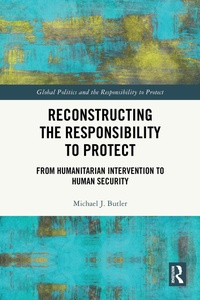
Reconstructing the Responsibility to Protect
From Humanitarian Intervention to Human Security
1st Edition
Published on 11. November 2024
164 pages
978-1-351-60171-9 (ISBN)
Description

This book revisits and interrogates the evolution of the Responsibility to Protect in search of the root cause of R2P's failure to date.
Employing a critical constructivist lens throughout, the book locates the origin of that apparent failure in the close association of R2P with humanitarian intervention. In returning to the ideational underpinnings and broader ambitions of R2P's architects, the analysis reveals that reducing R2P to little more than a "solution" to the long-standing problem(s) confronting humanitarian intervention betrayed its fundamental purpose: advancing a new norm of, and for, human security provision. Employing a modified version of the norm life-cycle model as a diagnostic tool, the author uncovers the underlying dynamics of R2P's normative stagnation over the past two decades. The book concludes with a prescriptive remedy in the form of a two-part blueprint for reconstructing and reanimating R2P's normative agenda for an international society confronted by mounting and existential threats to humanity.
This book will be of much interest to scholars and students of the Responsibility to Protect, human rights, security studies, and international relations in general.
Employing a critical constructivist lens throughout, the book locates the origin of that apparent failure in the close association of R2P with humanitarian intervention. In returning to the ideational underpinnings and broader ambitions of R2P's architects, the analysis reveals that reducing R2P to little more than a "solution" to the long-standing problem(s) confronting humanitarian intervention betrayed its fundamental purpose: advancing a new norm of, and for, human security provision. Employing a modified version of the norm life-cycle model as a diagnostic tool, the author uncovers the underlying dynamics of R2P's normative stagnation over the past two decades. The book concludes with a prescriptive remedy in the form of a two-part blueprint for reconstructing and reanimating R2P's normative agenda for an international society confronted by mounting and existential threats to humanity.
This book will be of much interest to scholars and students of the Responsibility to Protect, human rights, security studies, and international relations in general.
More details
Series
Edition
1. Auflage
Language
English
Place of publication
London
United Kingdom
Publishing group
Taylor & Francis Ltd
Target group
College/higher education
Professional and scholarly
Illustrations
1 Tables, black and white; 1 Line drawings, black and white; 1 Illustrations, black and white
ISBN-13
978-1-351-60171-9 (9781351601719)
Copyright in bibliographic data and cover images is held by Nielsen Book Services Limited or by the publishers or by their respective licensors: all rights reserved.
Schweitzer Classification
Other editions
Additional editions
Michael J. Butler
Reconstructing the Responsibility to Protect
From Humanitarian Intervention to Human Security
Book
05/2026
1st Edition
Routledge
€57.00
Shipment within 10-20 days

Michael J. Butler
Reconstructing the Responsibility to Protect
From Humanitarian Intervention to Human Security
Book
12/2024
Routledge
Unfortunately, price unknown
Available (delivery time upon request)
Michael J. Butler
Reconstructing the Responsibility to Protect
From Humanitarian Intervention to Human Security
Book
11/2024
1st Edition
Routledge
€196.90
Shipment within 10-20 days
Person
Michael J. Butler is Associate Professor of International Relations and Chair of the Department of Political Science at Clark University in Worcester, Massachusetts. He is the author/co-author or editor of six books and over two dozen peer-reviewed journal articles. He is a member of Sweden's Folke Bernadotte Academy International Research Working Group on Dialogue, Mediation, and Peace Processes; a Senior Fellow at the University of Toronto's Canadian Centre for the Responsibility to Protect; and an affiliate with the Netherlands Institute for Advanced Study. He has served as co-editor of the International Studies Intensives book series (Routledge) since 2016.
Content
List of Figures
Preface and Acknowledgements
Introduction: R2P, R.I.P.?
1 The Persistent Problem(s) of Humanitarian Intervention
2 The R2P 'Solution'
3 Failure to Launch
4 Responsibility Revisited
5 Rethinking the Referent
Conclusion: Reconstructing R2P
Preface and Acknowledgements
Introduction: R2P, R.I.P.?
1 The Persistent Problem(s) of Humanitarian Intervention
2 The R2P 'Solution'
3 Failure to Launch
4 Responsibility Revisited
5 Rethinking the Referent
Conclusion: Reconstructing R2P
