
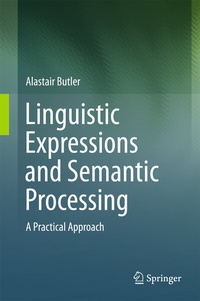
Linguistic Expressions and Semantic Processing
Description
Alles über E-Books | Antworten auf Fragen rund um E-Books, Kopierschutz und Dateiformate finden Sie in unserem Info- & Hilfebereich.
This book introduces formal semantics techniques for a natural language processing audience. Methods discussed involve: (i) the denotational techniques used in model-theoretic semantics, which make it possible to determine whether a linguistic expression is true or false with respect to some model of the way things happen to be; and (ii) stages of interpretation, i.e., ways to arrive at meanings by evaluating and converting source linguistic expressions, possibly with respect to contexts, into output (logical) forms that could be used with (i).
The book demonstrates that the methods allow wide coverage without compromising the quality of semantic analysis. Access to unrestricted, robust and accurate semantic analysis is widely regarded as an essential component for improving natural language processing tasks, such as: recognizing textual entailment, information extraction, summarization, automatic reply, and machine translation.
More details
Other editions
Additional editions

Person
Content
System requirements
File format: PDF
Copy protection: Watermark-DRM (Digital Rights Management)
System requirements:
- Computer (Windows; MacOS X; Linux): Use the free software Adobe Reader, Adobe Digital Editions, or any other PDF viewer of your choice (see eBook Help).
- Tablet/Smartphone (Android; iOS): Install the free app Adobe Digital Editions or another reading app for eBooks, e.g., PocketBook (see eBook Help).
- E-reader: Bookeen, Kobo, Pocketbook, Sony, Tolino and many more (only limited: Kindle).
The file format PDF always displays a book page identically on any hardware. This makes PDF suitable for complex layouts such as those used in textbooks and reference books (images, tables, columns, footnotes). Unfortunately, on the small screens of e-readers or smartphones, PDFs are rather annoying, requiring too much scrolling.
This eBook uses Watermark-DRM, a „soft” copy protection. This means that there are no technical restrictions to prevent illegal distribution. However, there is a personalised watermark embedded in the eBook that can be used to identify the purchaser of the eBook in the event of misuse and to provide evidence for legal purposes.
For more information, see our eBook Help page.