

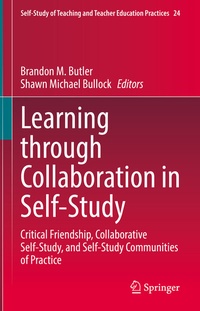
Learning through Collaboration in Self-Study
Description

Self-study is inherently collaborative. Such collaboration provides transparency, validity, rigor and trustworthiness in conducting self-study. However, the ways in which these collaborations are enacted have not been sufficiently addressed in the self-study literature. This book addresses these gaps in the literature by placing critical friendship, collaborative self-study and community of practice at the forefront of the self-study of teaching. It highlights these forms of collaboration, how the collaboration was developed and enacted, the challenges and tensions that existed in the collaboration, and how practice and identity developed through the use of these forms of collaboration. The chapters serve as exemplars of enacting these forms of collaboration and provide researchers with an additional base of literature to draw upon in their scholarly writing, teaching of self-study, and their enactment of collaborative self-study spaces.
More details
Other editions
Additional editions
Persons
Brandon Butler is an associate professor of social studies and teacher education at Old Dominion University in Norfolk, Virginia (USA). He teaches undergraduate, masters, and doctoral students in the areas of elementary social studies, practitioner inquiry and self-study, curriculum and instruction, teacher education, and teacher leadership. His scholarship is focused on the spaces in which teachers and teacher educators learn the work of the teaching and teacher education, including methods courses, doctoral courses, clinical field experiences, critical friendships, and communities of practice, with a particular focus on self-study methodology. His research can be found in a range of national and international journals in the fields of social studies education and teacher education.
Shawn Michael Bullock, Ph.D., P.Phys., is a Reader in the History of Science, Technology and Education at the University of Cambridge, U.K. and a Bye-Fellow of EmmanuelCollege. He uses the lenses offered by the history and philosophy of science and technology to examine issues in education, and has published extensively in the fields of teacher education and professional development, with a particular focus on self-study methodology. Dr. Bullock's diverse contribution to scholarship and teaching is partly reflected by his election to Fellowships of the Royal Astronomical Society, the Royal Geographical Society and the Royal Society for the encouragement of Arts, Manufactures and Commerce. Dr. Bullock also maintains current certifications as a professional physicist and a professional teacher within Canada, and qualified teacher status (QTS) in England.
