

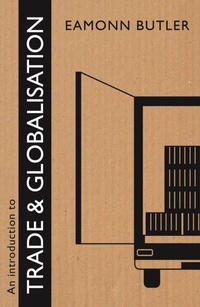
Introduction to Trade and Globalisation
1st Edition
Published on 16. September 2021
154 pages
978-0-255-36804-9 (ISBN)
Description

International trade has created a highly interdependent world. Everyday products - such as phones, trainers or cars - are designed, manufactured and assembled across several different countries, by countless different companies, both large and small, involving millions of people of all nationalities, creeds and cultures. We take much of this creativity and competition for granted. But it wouldn't be possible without the peaceful collaboration of millions of people around the planet - a much-overlooked aspect of globalisation. Yet some politicians - perhaps bound by electoral concerns - often take a narrower view, claiming globalisation leads to job losses, lower standards and threats to security. An introduction to Trade & Globalisation examines the tensions that inevitably arise alongside the many benefits of trade. Author Eamonn Butler looks at the rapid growth of international trade over the past 50 years, and how commerce and international politics have become increasingly entwined. He describes the fundamental and growing importance of trade and globalisation in modern life - whilst also seeking to understand the opposition to it. And, at the same time, he skilfully provides a straightforward, insightful and essential introduction to the principles, economics, and politics of international trade - one of the key developments of the modern era.
More details
Other editions
Additional editions
Eamonn Butler
An Introduction to Trade and Globalisation
Book
09/2021
Institute of Economic Affairs
€18.00
Shipment within 10-20 days
Person
Eamonn Butler is Director of the Adam Smith Institute, one of the world's leading policy think tanks. He holds degrees in economics and psychology, a PhD in philosophy, and an honorary DLitt. In the 1970s he worked in Washington for the US House of Representatives, and taught philosophy at Hillsdale College, Michigan, before returning to the UK to help found the Adam Smith Institute. He has won the Freedom Medal awarded by Freedoms Foundation at Valley Forge and the UK National Free Enterprise Award; his film Secrets of the Magna Carta won an award at the Anthem Film Festival, and his book Foundations of a Free Society won the Fisher Prize. Eamonn's other books include introductions on the pioneering economists Adam Smith, Milton Friedman, F. A. Hayek and Ludwig von Mises. He has also published primers on classical liberalism, public choice, capitalism, democracy, the Austrian School of Economics and great liberal thinkers, as well as The Condensed Wealth of Nations and The Best Book on the Market. He is co-author of Forty Centuries of Wage and Price Controls, and of a series of books on IQ. He is a frequent contributor to print, broadcast and online media.
Content
- Intro
- The author
- Introduction
- 1 The nature of trade
- Trade is (and was) everywhere
- Specialisation and efficiency
- Concerns over winners and losers
- Protectionism
- Efforts to reduce trade barriers
- Transnational corporations
- Trade as a moral good
- The future of trade
- PART ONE
- THE RISE OF TRADE
- 2 The origins of trade
- Stone Age trade
- Records and recriminations
- Gift exchange and the money revolution
- Medieval trading routes
- New ideas and new worlds
- 3 The rise of international trade
- The mercantilist era
- Faltering moves towards free trade
- Farewell to the Corn Laws
- An era of more open trade
- The decline of free trade policies
- PART TWO
- THE PRINCIPLES OF TRADE
- 4 The theory of trade
- Exchange and value
- Specialisation
- Comparative advantage
- Unequal advantages and trade
- Who trades with whom?
- Defying gravity?
- 5 The benefits of trade
- Static gains from trade
- Dynamic gains from trade
- Non-material benefits
- PART THREE
- DOUBTS ABOUT TRADE
- 6 Winners and losers in trade
- Economic change creates winners and losers
- Dislocation in richer countries
- Labour productivity
- Change and globalisation
- Exposure to competition
- 7 Concerns about globalisation
- Coercion of poorer countries
- Perpetual lag?
- Import substitution
- The fair trade movement
- Exploitation of poor workers
- Environmental concerns
- Cultural imperialism
- PART FOUR
- PROTECTIONISM
- 8 Protectionism: politics, tools, problems
- The politics of protectionism
- The tools of protectionism
- Which firms to protect?
- Unintended consequences
- The cost of protectionism
- 9 Arguments for protectionism
- The infant industries argument
- Anti-dumping argument
- Labour standards
- Product standards and biosecurity
- Security concerns
- Sanctions
- 10 Balance of payments deficits
- The balance of payments
- Deficits are not always a problem
- Country-to-country deficits
- Exchange rates
- Government intervention
- PART FIVE
- TRADE TODAY
- 11 Free trade redux
- Post-war commitment to trade
- Broadening horizons
- Different approaches
- Examples of regional trade agreements
- 12 Transnational corporations
- Managing global value chains
- The origins of TNCs
- Uncertain boundaries
- How powerful are TNCs?
- 13 Trade and morality
- Two views of trade
- Trade and liberal values
- Trade and equality
- The moral value of trade
- PART SIX
- THE FUTURE OF TRADE
- 14 Trends and lessons
- The benefits of international trade
- Trends and challenges
- Political challenges to free trade policies
- The pressure for protection
- The need for adaptability
- References
- Further reading
- About the IEA
- Blank Page
