

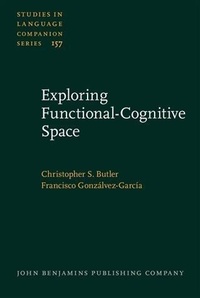
Exploring Functional-Cognitive Space
1st Edition
Published on 28. August 2014
XVIII, 579 pages
978-90-272-7022-1 (ISBN)
Description

This book, intended primarily for researchers and advanced students, expands greatly on previous work by the authors exploring the topography of the multidimensional "functional-cognitive space" within which functional, cognitive and/or constructionist approaches to language can be located. The analysis covers a broad range of 16 such approaches, with some additional references to Chomskyan minimalism, and is based on 58 questionnaire items, each rated by 29 experts on particular models for their importance in the model concerned. These ratings are analysed statistically to reveal overall patterns of (dis)similarity across models. The questionnaire ratings and experts' comments are then used, together with the authors' close reading of the literature, in detailed discussion leading to a final dichotomous rating for each feature in each model, the results again being analysed statistically. The final chapter presents the overall conclusions and suggests how existing collaborations between approaches could be strengthened, and new ones created, in future research.
More details
Other editions
Additional editions
Christopher S. Butler | Francisco Gonzalvez-Garcia
Exploring Functional-Cognitive Space
Book
08/2014
John Benjamins Publishing Co
€111.30
Shipment within 10-15 days
Persons
Content
- Intro
- Exploring Functional-Cognitive Space
- Editorial page
- Title page
- LCC data
- Table of contents
- Acknowledgments
- Abbreviations for models
- Figures and tables
- Introduction
- 1.1 Aims of the book
- 1.2 What's in a label?
- 1.2.1 Functional-cognitive space
- 1.2.2 Approaches, models, theories
- 1.2.3 Functionalist, formalist, cognitivist, constructionist and usage-based linguistics
- 1.3 The story so far
- 1.3.1 Previous work on relationships between functionalism and Chomskyan generative grammar
- 1.3.2 Previous work on relationships between functionalist, cognitivist and/or constructionist approaches
- 1.4 Choice of models for investigation
- 1.5 Methodological principles
- 1.6 The structure of the rest of the book
- Profiles
- 2.1 Functional Discourse Grammar
- 2.2 Role and Reference Grammar
- 2.3 Systemic Functional Linguistics
- 2.4 The work of Talmy Givón
- 2.5 Interactional Linguistics and its antecedents in Emergent Grammar
- 2.6 Word Grammar
- 2.7 The Columbia School
- 2.8 Cognitive Grammar
- 2.9 Construction Grammar(s)
- 2.9.1 Sign-Based Construction Grammar
- 2.9.2 Cognitive Construction Grammar
- 2.9.3 Embodied Construction Grammar
- 2.9.4 Frame-semantic Construction Grammar
- 2.9.5 Radical Construction Grammar
- 2.10 The collostructional approach
- 2.11 The Lexical Constructional Model
- 2.12 The Parallel Architecture
- Features for the characterization of models
- 3.1 General strategy in the choice of features
- 3.2 The six major groups of features
- 3.3 Relationship with the concept of criteria of adequacy
- 3.4 Communication and motivation
- 3.5 Coverage
- 3.6 The database for description
- 3.7 Explanation
- 3.8 The form of the grammar
- 3.9 Applications
- 3.10 The questionnaire
- 3.10.1 The questionnaire itself
- 3.10.2 The selection of respondents
- 3.10.3 Limitations of the questionnaire items: Problems and solutions
- 3.10.4 The respondents' final ratings
- Statistical analysis of the questionnaire data
- 4.1 Background to the statistical approach
- 4.2 The statistical techniques
- 4.2.1 Correlation
- 4.2.2 Multidimensional scaling
- 4.2.3 Hierarchical clustering
- 4.3 Correlations among the sets of questionnaire responses
- 4.4 Multidimensional scaling analysis of questionnaire responses
- 4.5 Hierarchical clustering analysis of questionnaire responses
- 4.6 Overall conclusions from the statistical analysis of the questionnaire data
- Characterization of models
- 5.1 Introduction
- 5.2 Communication and motivation
- 5.2.1 Initial summary of responses
- 5.2.2 FDG
- 5.2.3 RRG
- 5.2.4 SFL
- 5.2.5 Givón
- 5.2.6 EG+
- 5.2.7 WG
- 5.2.8 CS
- 5.2.9 CG
- 5.2.10 SBCG
- 5.2.11 CCG
- 5.2.12 ECG
- 5.2.13 FSCG
- 5.2.14 RCG
- 5.2.15 CLS
- 5.2.16 LCM
- 5.2.17 PA
- Characterization of models
- 6.1 Introduction
- 6.2.1 FDG
- 6.2.2 RRG
- 6.2.3 SFL
- 6.2.4 Givón
- 6.2.5 EG+
- 6.2.6 WG
- 6.2.7 CS
- 6.2.8 CG
- 6.2.9 SBCG
- 6.2.10 CCG
- 6.2.11 ECG
- 6.2.12 FSCG
- 6.2.13 RCG
- 6.2.14 CLS
- 6.2.15 LCM
- 6.2.16 PA
- Characterization of models
- 7.1 Introduction
- 7.2 Analysis of models
- 7.2.1 FDG
- 7.2.2 RRG
- 7.2.3 SFL
- 7.2.4 Givón
- 7.2.5 EG+
- 7.2.6 WG
- 7.2.7 CS
- 7.2.8 CG
- 7.2.9 SBCG
- 7.2.10 CCG
- 7.2.11 ECG
- 7.2.12 FSCG
- 7.2.13 RCG
- 7.2.14 CLS
- 7.2.15 LCM
- 7.2.16 PA
- Characterization of models
- 8.1 Introduction
- 8.2 Analysis of models
- 8.2.1 FDG
- 8.2.2 RRG
- 8.2.3 SFL
- 8.2.4 Givón
- 8.2.5 EG+
- 8.2.6 WG
- 8.2.7 CS
- 8.2.8 CG
- 8.2.9 SBCG
- 8.2.10 CCG
- 8.2.11 ECG
- 8.2.12 FSCG
- 8.2.13 RCG
- 8.2.14 CLS
- 8.2.15 LCM
- 8.2.16 PA
- Characterization of models
- 9.1 Introduction
- 9.2 Analysis of models
- 9.2.1 FDG
- 9.2.2 RRG
- 9.2.3 SFL
- 9.2.4 Givón
- 9.2.5 EG+
- 9.2.6 WG
- 9.2.7 CS
- 9.2.8 CG
- 9.2.9 SBCG
- 9.2.10 CCG
- 9.2.11 ECG
- 9.2.12 FSCG
- 9.2.13 RCG
- 9.2.14 CLS
- 9.2.15 LCM
- 9.2.16 PA
- Characterization of models
- 10.1 Introduction
- 10.2 Analysis of models
- 10.2.1 FDG
- 10.2.2 RRG
- 10.2.3 SFL
- 10.2.4 Givón
- 10.2.5 EG+
- 10.2.6 WG
- 10.2.7 CS
- 10.2.8 CG
- 10.2.9 SBCG
- 10.2.10 CCG
- 10.2.11 ECG
- 10.2.12 FSCG
- 10.2.13 RCG
- 10.2.14 CLS
- 10.2.15 LCM
- 10.2.16 PA
- Statistical analysis of final ratings
- 11.1 Introduction: The final ratings
- 11.2 Correlation
- 11.3 Multidimensional scaling
- 11.4 Hierarchical cluster analysis
- 11.5 Overall conclusions from the statistical analysis
- Compatibilities and contrasts
- 12.1 Introduction
- 12.2 Similarities and differences across models
- 12.3 Combining insights from different models
- 12.4 A critical retrospective assessment of the study
- 12.5 Envoi: Towards the future
- Language index
- Name index
- Subject index
