

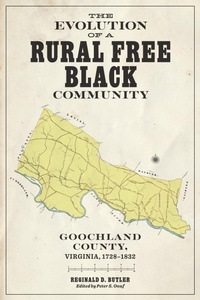
The Evolution of a Rural Free Black Community
Goochland County, Virginia, 1728-1832
Published on 1. August 2025
324 pages
978-0-8139-5261-1 (ISBN)
Description

A long-awaited work by one of the deans of Black studies
Reginald Butler, the second director of UVA's Carter G. Woodson Institute, wrote an influential and much-cited but never published dissertation at Johns Hopkins University that focused on community formation among the free Black population of Virginia. His innovative and meticulous research in county and state archives enabled him to reconstruct the ties that bound free Black Virginians to each other and their enslaved neighbors, as well as to white employers and officials.
Butler showed that community formation emerged in response to an oppressive, often violent regime of racial domination, yet it also depended on the critical role free Black people played in the local economy and their ability to sustain reciprocally beneficial working relations with their white neighbors. By reconstructing the lived experience of free Black families and the community they created at the neighborhood level, Butler's revelatory study offers still fresh perspectives on race and slavery in the formative decades of Virginian and American history. Now this seminal work finally sees the light of day, accompanied by several framing essays that properly situate Butler's foundational scholarship on free Black Americans in this still-burgeoning field.
Reginald Butler, the second director of UVA's Carter G. Woodson Institute, wrote an influential and much-cited but never published dissertation at Johns Hopkins University that focused on community formation among the free Black population of Virginia. His innovative and meticulous research in county and state archives enabled him to reconstruct the ties that bound free Black Virginians to each other and their enslaved neighbors, as well as to white employers and officials.
Butler showed that community formation emerged in response to an oppressive, often violent regime of racial domination, yet it also depended on the critical role free Black people played in the local economy and their ability to sustain reciprocally beneficial working relations with their white neighbors. By reconstructing the lived experience of free Black families and the community they created at the neighborhood level, Butler's revelatory study offers still fresh perspectives on race and slavery in the formative decades of Virginian and American history. Now this seminal work finally sees the light of day, accompanied by several framing essays that properly situate Butler's foundational scholarship on free Black Americans in this still-burgeoning field.
More details
Other editions
Additional editions
Reginald D. Butler | Peter S. Onuf
The Evolution of a Rural Free Black Community
Goochland County, Virginia, 1782-1832
Book
08/2025
University of Virginia Press
€136.67
Shipment within 3-4 weeks
Persons
The late Reginald D. Butler served as the second director of the University of Virginia's Carter G. Woodson Institute for African-American and African Studies from 1996 until 2005. Peter S. Onuf is the Thomas Jefferson Foundation Professor of History Emeritus at the University of Virginia.
Content
- Cover Page
- Title Page
- Copyright Page
- Contents
- Editor's Preface
- Preface
- Introduction: Race, Status, the Local, and the Personal
- Prologue
- Introduction
- 1. Born into Freedom
- 2. Manumission and Planter Response
- 3. Securing Freedom
- 4. Youth and Bound Labor
- 5. Work and Freedom
- 6. Kin, Neighbors, and Community Consolidation
- Courthouse Custom as an Archival Filter: Comparing Goochland Sources with Other Central Virginia Counties
- A "Forceful and Effective" Leader: Reginald D. Butler's Intellectual Legacy as Director of the Carter G. Woodson Institute, 1996-2005
- Recollections
- Notes
- Index
- Recent books in the Carter G. Woodson Institute Series
