

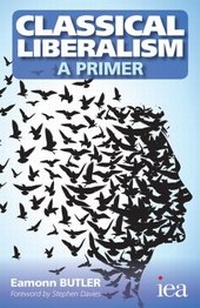
Classical Liberalism - A Primer
1st Edition
Published on 16. July 2015
160 pages
978-0-255-36708-0 (ISBN)
Description

This primer aims to provide a straightforward introduction to the principles, personalities and key developments in classical liberalism. It is designed for students and lay readers who may understand the general concepts of social, political and economic freedom, but who would like a systematic presentation of its essential elements.
More details
Other editions
Additional editions
Eamonn Butler
Classical Liberalism - A Primer
Book
07/2015
Institute of Economic Affairs
€13.00
Shipment within 10-20 days
Content
- Intro
- _GoBack
- 16
- The author
- Acknowledgements
- Foreword
- Summary
- 1 Introduction
- The purpose of this book
- Outline of the book
- 2 What is classical liberalism?
- Ten principles of classical liberalism
- 3 Classical liberalism: the family tree
- Early ancestors
- The rise of classical liberalism
- Success and reassessment
- The modern revival of classical liberalism
- The diversity of classical liberal ideas
- 4 Classical liberalism and freedom
- The arguments for freedom
- Positive and negative liberty
- Rights and freedoms
- Restraints on freedom
- 5 Classical liberal morality
- Coercion and toleration
- The arguments for toleration
- Toleration and the state
- 6 Classical liberal politics
- The origin and purpose of government
- The myth of social justice
- Public choice and private interests
- The legitimacy of government
- 7 Classical liberal society
- Spontaneous orders
- Justice and the rule of law
- The rationality of natural orders
- Civil society
- Spontaneous order and natural rights
- 8 Classical liberal economics
- The spontaneous order of the market
- The spontaneous 'miracle' of prices
- Markets without commands
- Rules and property
- The arguments for economic freedom
- The destabilising effects of government
- Trade and protectionism
- 9 Classical liberalism today
- Eclipse and revival
- The rebirth of classical liberalism
- The meaning of classical liberalism
- Classical liberal internationalism
- The classical liberal vision
- 10 Key classical liberal thinkers
- John Locke (1632-1704), English philosopher
- Bernard Mandeville (1670-1733), Anglo-Dutch satirist
- Voltaire [François-Marie Arouet] (1694-1778), French writer
- Adam Ferguson (1723-1816), Scottish social theorist
- Adam Smith (1723-1790), Scottish philosopher and economist
- Thomas Jefferson (1743-1826), American revolutionary leader
- Frédéric Bastiat (1801-50), French political theorist
- Richard Cobden (1804-1865), English manufacturer and politician
- John Stuart Mill (1806-73), English philosopher and reformer
- Herbert Spencer (1820-1903), English anthropologist and philosopher
- Friedrich A. Hayek (1899-1992), Anglo-Austrian political scientist
- Ayn Rand (1905-82), Russian-American novelist and moralist
- Isaiah Berlin (1909-97), Latvian-British philosopher
- Milton Friedman (1912-2006), American economist
- James M. Buchanan (1919-2013), American economist
- Robert Nozick (1938-2002), American philosopher
- 11 Classical liberal quotations
- Magna Carta
- Natural rights
- Limited government
- Spontaneous order.
- .Benign guidance.
- .Versus planning and controls
- Justice and the rule of law
- Economic freedom
- Personal freedom
- Political freedom
- 12 Classical liberalism timeline
- 13 Further reading
- Introductions
- Overviews
- Classic texts
- Selected web links
- About the IEA
