

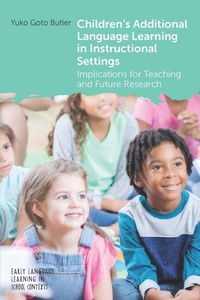
Children's Additional Language Learning in Instructional Settings
Implications for Teaching and Future Research
Published on 10. June 2025
358 pages
978-1-80041-380-1 (ISBN)
Description

This book provides the first comprehensive overview of young children's language learning in pre-primary and primary education. It collates research to date on language development and pedagogy among children learning a language in addition to their home language(s) in instructional settings, providing readers with a thorough understanding of the topic and directions for further study. The book promotes a learner-centered approach to research and teaching and encourages critical reflection on how best to conduct research among children. It recognizes the substantial diversity of young language learning experiences and pays attention to individual differences and variability in children's language development, embracing an ecological perspective sensitive to contextual factors. Closing the gap between research and practice, each chapter opens with pedagogical or policy-related questions, explores relevant theories and research findings from instructed second language acquisition, and offers discussion questions and recommended reading for further reflection and study. This will be invaluable reading for all those who are undertaking research and working with young language learners.
Reviews / Votes
This volume offers a comprehensible and insightful analysis of key factors shaping children's additional language learning in instructional settings. With its thoughtful exploration of children's oral and written development, the role of instruction, affective and social factors as well as digital technology, the volume provides invaluable guidance for researchers and educators. A must-read for anyone devoted to fostering children's success in additional language learning. * Maria del Pilar Garcia Mayo, University of the Basque Country, Spain * In this veritable tour de force, Yuko Goto Butler presents an all-embracing, compelling overview of children's additional language development. In her characteristically meticulous style, she connects research to pedagogy, imparts invaluable insights, advocates for a child-centered approach to research and considers multilingualism, diversity, and variability in children's language development. This is an essential resource for academic courses, challenging us all to boldly go where no one has gone before! * Sandie Mourao, Nova University of Lisbon, Portugal * This insightful book bridges theory and practice to explore how children learn additional languages in instructional settings. With a learner-centred approach, it champions multilingualism, diversity, and ecological perspectives - essential reading for educators, researchers, and policymakers committed to understanding and supporting language development in young learners. * Victoria A. Murphy, University of Oxford, UK *More details
Series
Language
English
Place of publication
Bristol
United Kingdom
Target group
College/higher education
Product notice
Reflowable
File size
4,48 MB
ISBN-13
978-1-80041-380-1 (9781800413801)
Copyright in bibliographic data and cover images is held by Nielsen Book Services Limited or by the publishers or by their respective licensors: all rights reserved.
Schweitzer Classification
Other editions
Additional editions
Yuko Goto Butler
Children's Additional Language Learning in Instructional Settings
Implications for Teaching and Future Research
Book
06/2025
Multilingual Matters
€57.70
Shipment within 10-20 days
Person
Yuko Goto Butler is a Professor of Educational Linguistics and Director of the Teaching English to Speakers of Other Languages (TESOL) Program in the Graduate School of Education at the University of Pennsylvania, USA. Her research focuses on young language learners, language assessment and technology in language teaching.
Content
Abbreviations
Introduction
Chapter 1. Exploring Children's Additional Language Learning in School
Why understanding their development is so challenging?
Chapter 2. First Language Development and its Diversity
What do children know about and do with language before attending additional language classes?
Chapter 3. The Influence of Starting Age
Is "the younger, the better" true for additional language learning?
Chapter 4. The Roles of Cognitive Development and First Language
What distinguishes children's additional language learning from their first language learning and adults' additional language learning?
Chapter 5. Written Language Development
How do children learn to read and write in an additional language?
Chapter 6. Tasks and Interactions in Language Classrooms
How do tasks and interactions promote children's additional language learning?
Chapter 7. Affect and Social Factors
What do we know about the role of affect and social factors in children's additional language learning?
Chapter 8. Digital Technology and Children's Language Learning
How does digital technology influence children's additional language learning?
Chapter 9. Teaching and Teachers of Young Language Learners
What is unique about teaching additional language to children?
Chapter 10. Assessing Additional Language Learning
What should teachers keep in mind when assessing children's additional language learning?
Chapter 11. Learning Additional Languages through Academic Content
How do children learn both language and content?
Chapter 12. Future Directions for Research
What considerations are necessary when researching children's additional language learning?
References
Discussion Questions and Additional Readings
Index
Introduction
Chapter 1. Exploring Children's Additional Language Learning in School
Why understanding their development is so challenging?
Chapter 2. First Language Development and its Diversity
What do children know about and do with language before attending additional language classes?
Chapter 3. The Influence of Starting Age
Is "the younger, the better" true for additional language learning?
Chapter 4. The Roles of Cognitive Development and First Language
What distinguishes children's additional language learning from their first language learning and adults' additional language learning?
Chapter 5. Written Language Development
How do children learn to read and write in an additional language?
Chapter 6. Tasks and Interactions in Language Classrooms
How do tasks and interactions promote children's additional language learning?
Chapter 7. Affect and Social Factors
What do we know about the role of affect and social factors in children's additional language learning?
Chapter 8. Digital Technology and Children's Language Learning
How does digital technology influence children's additional language learning?
Chapter 9. Teaching and Teachers of Young Language Learners
What is unique about teaching additional language to children?
Chapter 10. Assessing Additional Language Learning
What should teachers keep in mind when assessing children's additional language learning?
Chapter 11. Learning Additional Languages through Academic Content
How do children learn both language and content?
Chapter 12. Future Directions for Research
What considerations are necessary when researching children's additional language learning?
References
Discussion Questions and Additional Readings
Index
