

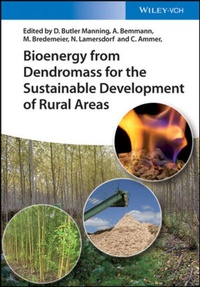
Bioenergy from Dendromass for the Sustainable Development of Rural Areas
Description

Most of the results reported are available here for the first time in English and have been collated in central Europe, but are equally applicable to other temperate regions. They highlight best practices for enhancing dendromass potential and productivity, while discussing the implications on rural economies and ecosystems.
More details
Other editions
Additional editions
Persons
David Butler-Manning studied forestry at Dublin (Ireland) and Freiburg (Germany). He is currently the project coordinator for AgroForNet, a federal research initiative for the sustainable use of dendromass to generate bioenergy.
Christian Ammer is the head of the section Silviculture and Forest Ecology of the Temperate Zones at Göttingen University (Germany). His main interests are in the fields of regeneration ecology, the relationship between competition and growth in mixed stands, and the effects of resource availability and ontogeny on biomass partitioning of trees.
Michael Bredemeier studied forestry at the universities of Munich, Göttingen (Germany), and Corvallis (USA). In his current position he is professor, research scientist and coordinator at the Forest Ecosystems Research Centre of Göttingen University.
Norbert Lamersdorf is the deputy head of the department of Soil Science of Temperate and Boreal Ecosystems at Göttingen University (Germany). During the past 25 years, he has taken part in a wide range of international research projects on forest ecosystems, including EU-NITREX, EXMAN, BACPOLES, NOVALIS and RATING-SRC.
Content
Bioenergy from Dendromass for the Sustainable Development of Rural Areas - Research Findings from the AGROFORNET and BEST Projects of the German "Sustainable Land Management" Funding Programme
Linking the Producers and Consumers of Woodfuel to Contribute to the Sustainable Development of Rural Areas: An Introduction to AGROFORNET
Strengthening Bioenergy Regions: An Introduction to BEST
ENVIRONMENTAL CONSTRAINTS, LANDSCAPE FUNCTIONS AND ECOSYSTEM SERVICES
The Bio-Energy Allocation and Scenario Tool (BEAST) to Assess Options for the Siting of Short Rotation Coppice in Agricultural Landscapes - Tool Development and Case Study Results from the Göttingen District
The Influence of More Widespread Cultivation of Short Rotation Coppice on the Water Balance - From the Site to Regional Scale
Short Rotation Coppice as Habitat for Vascular Plants
Synergies and Conflicts Between More Widespread Cultivation of Short Rotation Coppice and Nature Conservation at the Landscape Level
Nature Conservation Requirements of Short Rotation Coppice Management
The Effects of Short Rotation Coppice on the Visual Landscale
EVALUATING, MANAGING AND ENHANCING THE SUPPLY OF DENDROMASS
Site Conditions, Initial Growth and Nutrient and Litter Cycling of Newly Installed Short Rotation Coppice and Agroforestry Systems
Potential Offered by a Willow-Grassland Alley Cropping System as a Biogenic Source of Energy
The Effects of Irrigation on the Growth of Poplars and Willows Grown in Short Rotation
A Spatially Explicit Approach to the Identification of Sites Suitable for Woody Biomass Systems Based on Site Factors and Field Geometry - A Case Study for the Göttingen District
Site-Based Yield Estimation and Biomass Calculation in Short Rotation Coppice Plantations
Photosynthetic Nitrogen Use Efficiency of Two Poplar Varieties Commonly Grown in Short Rotation Coppice Plantations and Implications for Fertiliser Management
Biotic Risk Factors in Short Rotation Coppice in Germany: Current Situation, New Findings and Future Perspectives
An Expert System to Forecast Population Developments of Insects Harmful to Short Rotation Coppice Plantations
Supporting the Use of Woody Energy Crops Through Efficient Stand Assessment Via Terrestrial Laser Scanning
Measuring Dendromass Quantities in the Open Landscape at Test Locations in Eastern German Using Publicly Available Geographic Data
An Analysis of the Potential to Cultivate Short Rotation Coppice on Deutsche Bahn AG Property in Central Germany Using a GIS-Based Approach
Compensation of Nutrient Losses Resulting from the Intensified Use of Woody Biomass Using Bark-Ash Pellets
SOCIO-ECONOMIC AND LEGAL ASPECTS OF DENDROMASS FOR BIOENERGY
Supply Chain-Based Business Models for Woodfuel
Socio-Economic Sustainability Criteria for Bioenergy Villages Incorporating Short Rotation Coppice in Their Energy Supply
The Economic Assessment of Short Rotation Coppice Plantations and Their Profitability Relative to Annual Crops in Sachsen, Germany
Decision Criteria and Implementation Strategies for Short Rotation Coppice in Germany from the Perspective of Stakeholders
The Energy and Agricultural Policy Framework for Short Rotation Coppice in the EU and its Implementation in the Member States
The Legal Framework for Short Rotation Coppice in Germany in the Context of the "Greening" of the EU's Common Agricultural Policy
Opportunities Provided by Formal and Informal Planning to Promote the Cultivation of Dendromass for Energy and the Establishment of Wood-Based Supply Chains in Germany
Sustainability Certification of Short Rotation Coppice in Germany
APPLICATIONS
Strategies for the Development of Wood-Based Service Systems and Supply Chains to Promote Rural Development
Advisory Services and Public Awareness for Woody Biomass Production: A Regional Example of How to Provide Information and Guide Realisation, and the Corresponding Demand for Information
A Decision Support System to Link Stakeholder Perception with Regional Renewable
List of Contributors
Christian Ammer
Georg-August-Universität Göttingen
Burckhardt-Institut
Abteilung Waldbau und Waldökologie der gemäßigten Zonen
Büsgenweg 1
37077 Göttingen
Germany
Robert Barkowski
Technische Universität Dresden
Institut für Internationale
Forst- und Holzwirtschaft
Professur für Forst- und Holzwirtschaft Osteuropas
Pienner Straße 19
01737 Tharandt
Germany
Albrecht Bemmann
Technische Universität Dresden
Institut für Internationale Forst- und Holzwirtschaft
Professur für Forst- und Holzwirtschaft Osteuropas
Pienner Straße 19
01737 Tharandt
Germany
Gero Becker
Albert-Ludwigs-Universität Freiburg
Institut für Forstbenutzung und Forstliche Arbeitswissenschaft
Professur für Forstbenutzung
Werthmannstraße 6
79085 Freiburg
Germany
Uta Berger
Technische Universität Dresden
Institut für Waldwachstum und Forstliche Informatik
Professur für Forstliche Biometrie und Systemanalyse
Pienner Straße 8
01737 Tharandt
Germany
Annedore Bergfeld
Leibniz-Institut für Länderkunde Leipzig e.V.
Abteilung Regionale Geographie Europas
Schongauerstraße 9
04329 Leipzig
Germany
Andreas W. Bitter
Technische Universität Dresden
Institut für Forstökonomie und Forsteinrichtung
Professur für Forsteinrichtung
Pienner Straße 23
01737 Tharandt
Germany
Thiemen Boll
Leibniz Universität Hannover
Institut für Umweltplanung
Herrenhäuser Straße 2
30419 Hannover
Germany
Michael Bredemeier
Georg-August-Universität Göttingen
Zentrum für Biodiversität und nachhaltige Landnutzung
Sektion Waldökosystemforschung
Büsgenweg 2
37077 Göttingen
Germany
Joachim Brummack
Technische Universität Dresden
Institut für Verfahrenstechnik und Umwelttechnik
Lehrstuhl für Thermische Verfahrenstechnik und Umwelttechnik
Helmholtzstraße 14
01069 Dresden
Germany
Gerald Busch
Bureau for Applied Landscape Ecology and Scenario Analysis-BALSA
Am Weißen Steine 4
37085 Göttingen
Germany
David Butler Manning
Technische Universität Dresden
Institut für Internationale Forst- und Holzwirtschaft
Professur für Forst- und Holzwirtschaft Osteuropas
Pienner Straße 19
01737 Tharandt
Germany
Heike Culmsee
DBU Naturerbe GmbH
Deutsche Bundesstiftung Umwelt
An der Bornau 2
49090 Osnabrück
Germany
Miriam Ehret
Universität Kassel
Fachgebiet Grünlandwissenschaft und Nachwachsende Rohstoffe
Fachbereich ökologische Agrarwissenschaften
Steinstraße 19
37213 Witzenhausen
Germany
Rasmus Ettl
Technische Universität München
Fakultät für Forstwissenschaft und Ressourcenmanagement
Fachgebiet für Waldernährung und Wasserhaushalt
Hans-Carl-von-Carlowitz-Platz 2
85354 Freising
Germany
Dejuan Euring
Georg-August-Universität Göttingen
Büsgen-Institut
Abteilung Forstbotanik und Baumphysiologie
Büsgenweg 2
37077 Göttingen
Germany
Markus Euring
Georg-August-Universität Göttingen
Büsgen-Institut
AG Chemie und Verfahrenstechnik von Verbundwerkstoffen
Büsgenweg 2
37077 Göttingen
Germany
Karl-Heinz Feger
Technische Universität Dresden
Institut für Bodenkunde und Standortslehre
Professur für Standortslehre und Pflanzenernährung
Pienner Straße 19
01737 Tharandt
Germany
Doreen Fragel
Energieagentur Region Göttingen e.V.
Berliner Straße 4
37073 Göttingen
Germany
Franziska Friese
Hymmen Industrieanlagen GmbH
Theodor-Hymmen-Straße 3
33613 Bielefeld
Germany
Richard Georgi
Technische Universität Dresden
Institut für Waldbau und Waldschutz
Professur für Waldschutz
Pienner Straße 8
01737 Tharandt
Germany
Denie Gerold
Ostdeutsche Gesellschaft für Forstplanung mbH
Niederlassung Sachsen
Zum Wiesengrund 8
01723 Kesselsdorf
Germany
Axel Göttlein
Technische Universität München
Fakultät für Forstwissenschaft und Ressourcenmanagement
Fachgebiet für Waldernährung und Wasserhaushalt
Hans-Carl-von-Carlowitz-Platz 2
85354 Freising
Germany
Rüdiger Graß
Universität Kassel
Fachgebiet Grünlandwissenschaft und Nachwachsende Rohstoffe
Fachbereich ökologische Agrarwissenschaften
Steinstraße 19
37213 Witzenhausen
Germany
Christina von Haaren
Leibniz Universität Hannover
Institut für Umweltplanung
Herrenhäuser Straße 2
30419 Hannover
Germany
Heiko Hagemann
Wald-Zentrum
Internationales Institut für Wald und Holz NRW e.V.
Hafenweg 24a
48155 Münster
Germany
Linda Hartmann
Georg-August-Universität Göttingen
Büsgen-Institut
Abteilung ökopedologie der gemäßigten Zonen
Büsgenweg 2
37077 Göttingen
Germany
Jürgen Heinrich
Martin-Luther-Universität Halle-Wittenberg
Professur für Landwirtschaftliche Betriebslehre
Karl-Freiherr-von-Fritsch-Straße 4
06120 Halle (Saale)
Germany
Imke Hennemann-Kreikenbohm
NABU
Bundesgeschäftsstelle
Charitèstraße 3
10117 Berlin
Germany
Hendrik Horn
Technische Universität Dresden
Institut für Waldwachstum und Forstliche Informatik
Professur für Waldwachstum
Pienner Straße 8
01737 Tharandt
Germany
Martin Jansen
Georg-August-Universität Göttingen
Büsgen-Institut
Abteilung ökopedologie der gemäßigten Zonen
Büsgenweg 2
37077 Göttingen
Germany
Leena Jennemann
Bosch & Partner GmbH
Kantstraße 63a
10627 Berlin
Germany
Stefan Julich
Technische Universität Dresden
Institut für Bodenkunde und Standortslehre
Professur für Standortslehre und Pflanzenernährung
Pienner Straße 19
01737 Tharandt
Germany
Alireza Kharazipour
Georg-August-Universität Göttingen
Büsgen-Institut
AG Chemie und Verfahrenstechnik von Verbundwerkstoffen
Büsgenweg 2
37077 Göttingen
Germany
Uwe Kies
Wald-Zentrum
Internationales Institut für Wald und Holz NRW e.V.
Hafenweg 24a
48155 Münster
Germany
Christine Knust
Technische Universität Dresden
Institut für Bodenkunde und Standortslehre
Professur für Standortslehre und Pflanzenernährung
Pienner Straße 19
01737 Tharandt
Germany
Michael Kralemann
HAWK Hochschule Hildesheim/Holzminden/Göttingen
Fakultät Ressourcenmanagement
Rudolf-Diesel-Straße 12
37075 Göttingen
Germany
Andreas Krause
Universität Hamburg
Zentrum für Holzwirtschaft
Mechanische Holztechnologie
Leuschnerstraße 91c
21031 Hamburg
Germany
Kim C. Krause
Georg-August-Universität Göttingen
Burckhardt-Institut
Abteilung Holzbiologie und Holzprodukte
Büsgenweg 4
37077 Göttingen
Germany
Mathias Kröber
Martin-Luther-Universität Halle-Wittenberg
Professur für Landwirtschaftliche Betriebslehre
Karl-Freiherr-von-Fritsch-Straße 4
06120 Halle (Saale)
Germany
Norbert...
